Section 3 — Extraembryonic Membranes, Embryogenesis, Germ Layers, Organogenesis & Pregnancy Adjustments
 Call Kai
 Learn
 Practice Test
 Spaced Repetition
 Match
 Flashcards
 Knowt Play
1/30

There's no tags or description
Looks like no tags are added yet.
31 Terms
Extraembryonic membranes and when do they form
structures that form in the first 2-3 weeks of development
membranes that develop around embryo + helps support it
doesnt become aprt of embyro
What are the four extraembryonic membranes
amnion, yolk sac, allantois, chorion


Amnion
forms amniotic sac


yolk sac
forms part of digestive tube to feed
+ first blood cells

Allantois
umbilical cord
Chorion
Forms the placenta
Embryogenesis
During implantation, blastocyst begins converting to gastrula (inner cell mass develops into bilaminar embryonic disc)
Bilaminar Embryonic disc is subdivided into what
epiblast (upper layer) and hypoblast (lower layer)
What happens at week 3 of development (2)
gastrulation → development of 3 primary germ layers (trilaminar embryonic disc)
epiblast → 3 layers
hypoblast→
+ development of extraembryonic membranes
Gastrulation
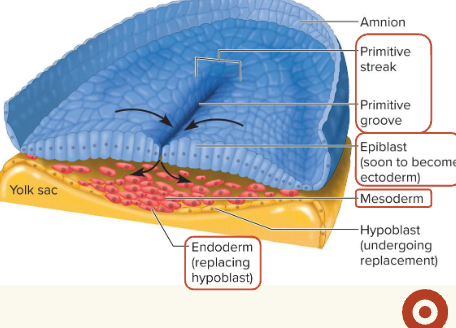
bilaminar embryonic disc → 3 layered embryo (ectoderm, mesoderm, endoderm)
What appears during gastrulation
primitive streak / dorsal groove
Notochord and what does it do
temporary rod like structure made from mesodermal cells
provides axial support
What are the three germ layers from top to bottom
and what turns into them
Ectoderm, mesoderm, endoderm
epiblast gives rise to all 3


What are the 3 layers here
Blue - ectoderm , red endoderm, yellow endoderm (where the hypoblast used to be)
Ectoderm + function (2)
external layer → nervous system and skin epidermis
epidermis skin cells, neurons of brain, pigmented cells

Endoderm + functions (3)
Internal layer
epithelial lining of digestive, respiratory, and urogenital systems
lung thryoid pancreatic

Mesoderm _ functions
middle layer → forms all other tissues
all 3 muscles, RBCs,

What germ layers are considered epithelia
ectoderm and endoderm
ectoderm - outer epithelia
endoderm - inner epithelia
What is the first major event of organogenesis
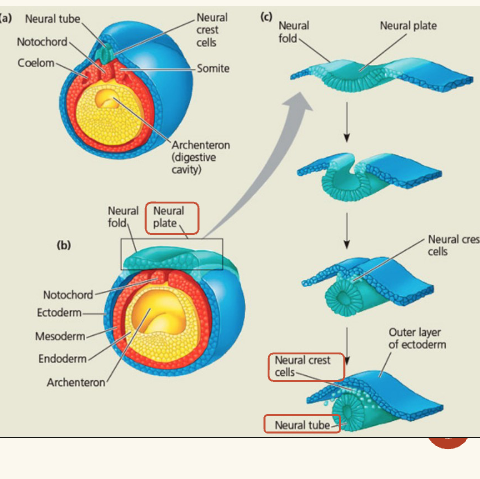
neurulation
Neurulation
specialization of ectoderm
Neural plates fold inward → neural groove → fuse into neural tube → brain & spinal cord
neural crest cells and what can they turn into (4)
ectoderm cells that form along neural tubes during neurulation → break away and migrate to different parts of the embryo to form
cranial ganglia
spinal ganglia
sympathetic ganglia
andrenal medulla
Organogenesis
formation of body organs and systems
involves all 3 germ layers
What happesn at the end of the 8th week (2)
organogenesis mainly ends → all organ systems are present but not fully functional
end of embryonic stage → embryo → fetus
Fetal development
ffrom week 9-birth
rapid growth of body structures established in embyro
Fetal development the trimesters
week 9 → first trimester fetus
week 13 → second trimester fetus
week 28 → third trimester fetus
week 40 → end of third trimest
adjustments to pregnancy (4)
placenta releases relaxin → relaxes pubic symphysis and pelvic ligaments → ease birth passage
reproductive organs become engorged with blood
lordosis → inward curve of lower back
uterus expands to fill up most of abdominal cavity
Pregnancy on GI tract
estrogen and progesterone levels are high → morning sickness
Pregnancy on urinarysystem
increased urine output
caused by increased metabolism and waste from fetus
Stress incontinence
urine leaks when pressure in abdomin increases because bladder is squeezed
pregnancy on respiratory system (2)
tidal volume increases → needs more oxygen for mother and fetus
dyspnea (shortness of breath) can happen later in pregnancy becasue uterus pushes diaphragm up → less space for lungs to expand
Pregnancy on cardiovascular system (3)
blood volume increases 25-40% → supply fetus and mother + prepare for blood loss at pregnancy
blood pressure and pulse increase (heart working harder)
venous return from lower limbs impaired (uterus can block vena cava)