Hearing Science Quiz 11
 Call Kai
 Learn
 Practice Test
 Spaced Repetition
 Match
 Flashcards
 Knowt Play
1/49

There's no tags or description
Looks like no tags are added yet.
50 Terms
What is temporal integration?
Change in threshold as the duration of a stimulus changes
A sound source located directly in front of the listener is at _____.
0 degrees azimuth
Finding the location of a sound source outside of the head is known as _____.
Localization
Masking that occurs due to energy in the masker that overlaps with the signal in frequency and time is known as _____.
Energetic masking
ILDs are primarily caused by _____.
The head shadow effect
The reduction of sound level at the ear farther away from the sound source caused by the presence of the head between the sound source and the ear is known as the _____.
Head shadow effect
What is the tendency of an object to vibrate vigorously when it comes in contact with a sound source closest to its resonant frequency?
Sounding board resonance
Basilar membrane tuning curves are symmetrical, but neural tuning curves are not symmetrical.
False
Where is the auditory cortex located?
Temporal lobe
Neurons in the left auditory cortex are preferentially active for _____ input.
Right-sided
What are afferent neurons?
Ascending neurons that carry information towards higher structures in the central nervous system
Another name for the direct sound (the sound that travels directly from the source to the listener) is the _____.
Lead

What is the modulation rate of the signal depicted above?
4 Hz
A fire alarm produces a sound pressure of 650,000 μPa measured at a certain distance from the sound source. What is the level in dB SPL?
90 dB SPL
Humans are _____ to frequencies from approximately 500 to 5000 Hz.
Most sensitive
A pure tone of which of the following frequencies would produce the largest ILD when presented at 90 degrees azimuth?
8000 Hz
What is the loudness in sones of a 1000 Hz tone presented at 70 dB SPL?
8
The primary function of the superior olivary complex is to _____.
Code information used in the localization of sound
The superior olivary complex is _____.
The most peripheral point in the CANS to receive direct input from both cochlae
_____ noise will reach 0-dB effective masking level at a lower sound pressure (SPL) than will _____ noise.
Narrowband; white
What is the definition of “ipsilateral”?
Belonging to or occurring on the same side of the body
The auditory system primarily uses ILD cues for localizing frequencies _____; it primarily uses ITD cues for localizing frequencies _____.
Above 2000 Hz; below 2000 Hz

Masker is a 1000 Hz tone. According to the masking patterns above, a 1000 Hz tone presented at 40 dB SPL will cause a _____ -dB threshold shift for a 4000 Hz tone.
0
Reverberations occur when _____.
Reflections are multiple or continuous to the point where they actually prolong the existence of a sound within a confined space
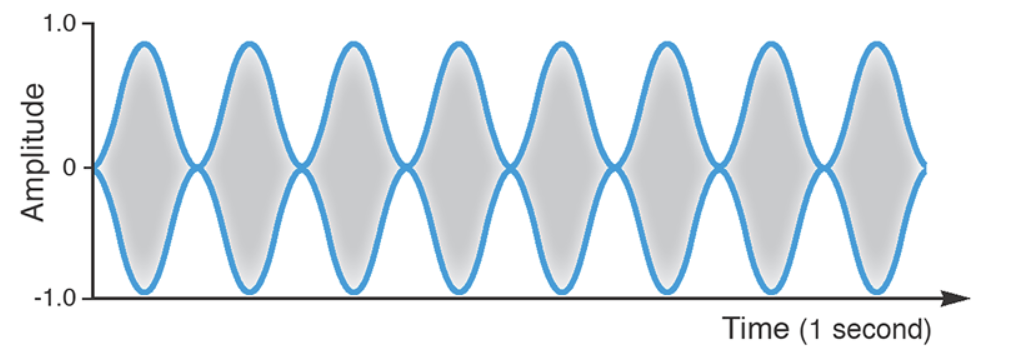
What is the modulation depth of the signal depicted above?
100%
What is the loudness in sones of a 1000 Hz tone presented at 30 dB SPL?
0.5
The formula for pressure (and the reason why you would rather have someone wearing flat-bottom sandals and not high-heeled shoes step on your foot) is _____.
Pressure = Force / Area
For every doubling of distance from a sound source, sound pressure drops _____.
6 dB
Presentation of the masker and maskee at the same time is known as _____.
Simultaneous masking
The medial olivocochlear bundle descends from the medial superior olive to the _____.
Outer hair cells
What causes the upward spread of masking?
The asymmetry of the excitation pattern along the basilar membrane
Damage to the auditory cortex _____.
Interferes with complex signal processing, while often having no effect on more basic functions, such as auditory threshold and general localization ability

Masker is a 1000 Hz tone. According to the masking patterns above, a 1000 Hz tone presented at 80 dB SPL will cause a _____ -dB threshold shift for a 4000 Hz tone.
70
What is the upward spread of masking?
Phenomenon in which the masking effect of a tone is greater above the masking frequency than below it
The relationship between sound intensity to the square of the distance from the sound source is the _____.
Inverse square law
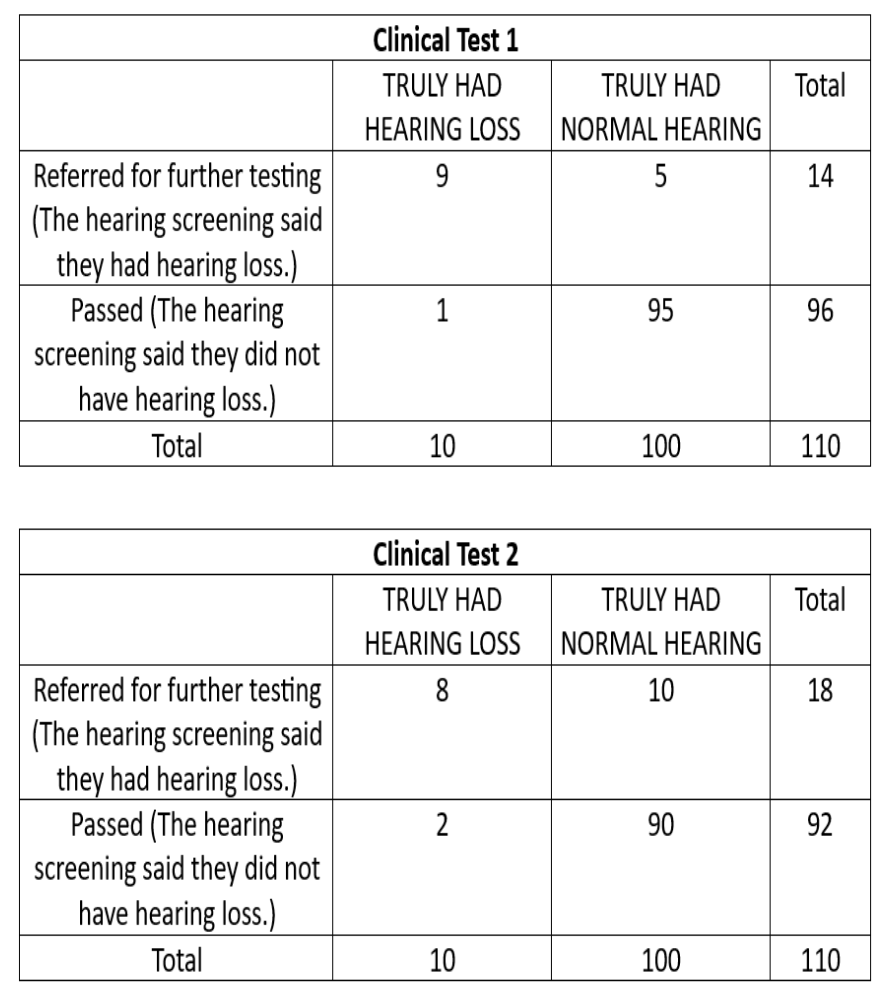
What is the negative predictive value of Clinical Test 2?
98%

What is the sensitivity of Clinical Test 2?
80%

What is the specificity of Clinical Test 1?
95%

What is the accuracy of Clinical Test 1?
94.5%

What is the positive predictive value of Clinical Test 1?
64%
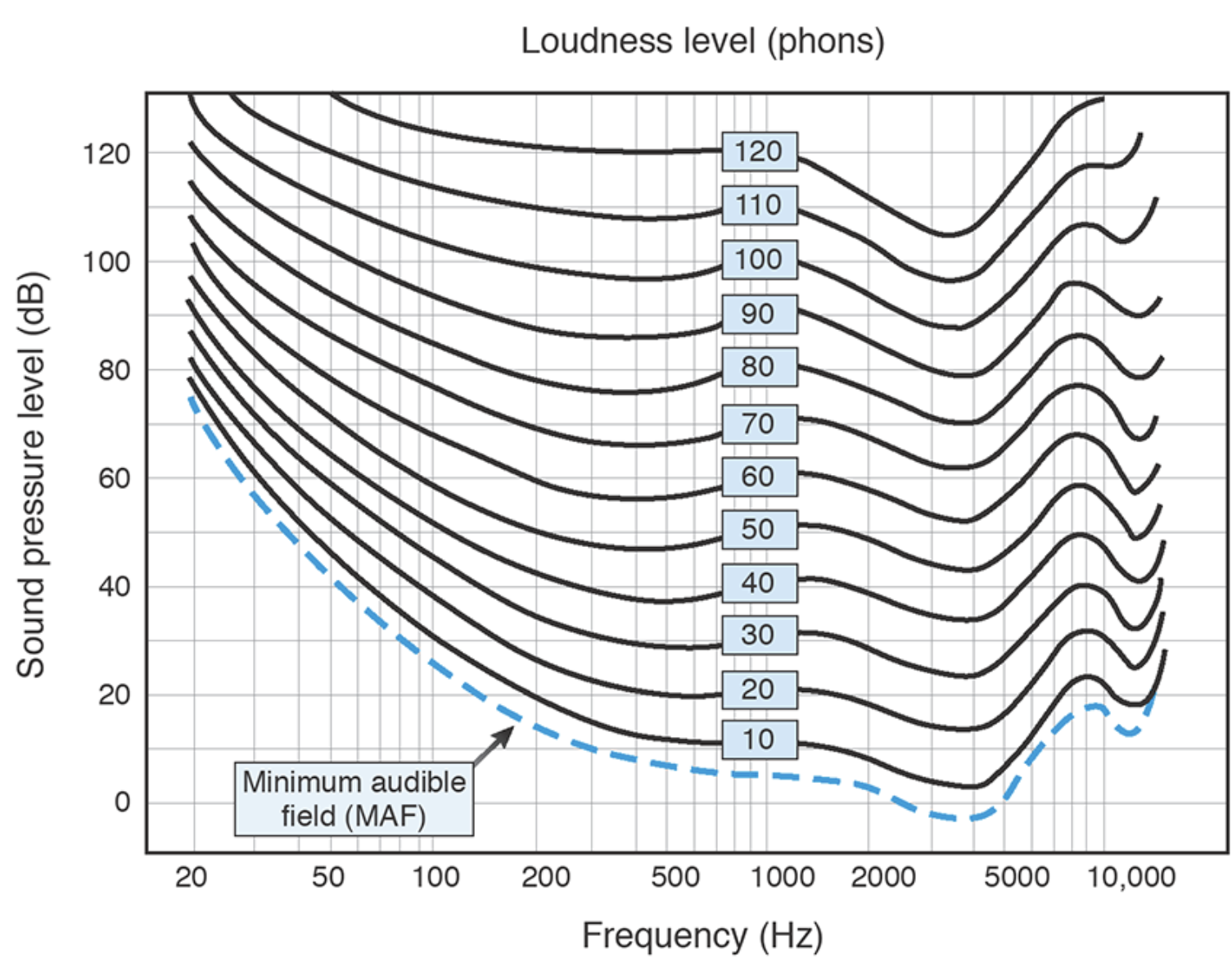
What is the loudness in phons of a 1000 Hz tone presented at 20 dB SPL?
20

What is the level, in dB SPL, of a 4000 Hz tone with a loudness of 80 phons?
70

What is the loudness in phons of a 200 Hz tone presented at 110 dB SPL?
110

What is the level, in dB SPL, of a 4000 Hz tone with a loudness of 40 phons?
35

What is the level, in dB SPL, of a 200 Hz tone with a loudness of 10 phons?
20
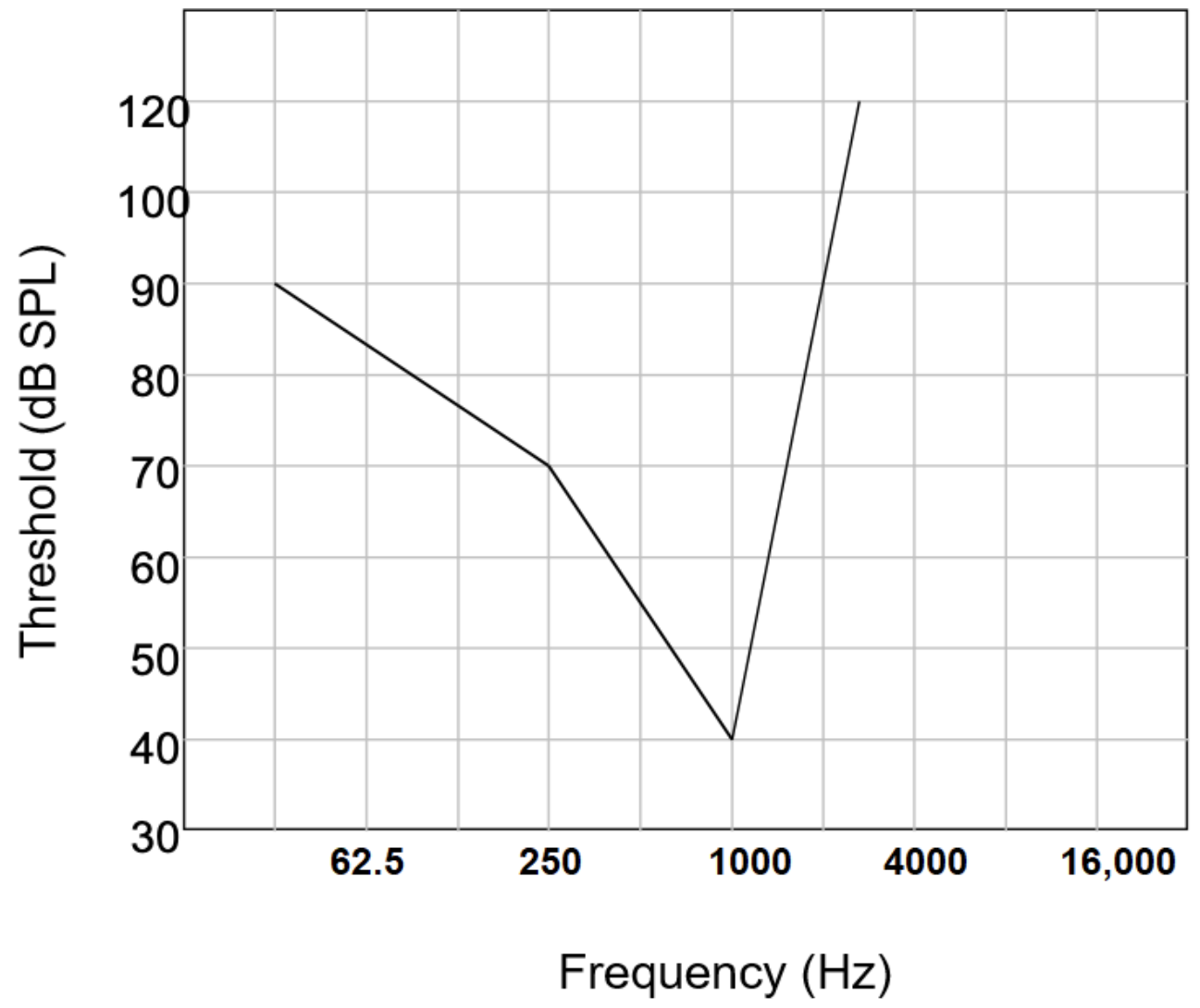
What will this neuron do when the anesthetized animal is presented with a 250 Hz tone at 40 dB SPL?
It will fire randomly at its spontaneous firing rate

What is the characteristic frequency of the neuron?
1000 Hz

What is the lowest level at which the nerve fires above its spontaneous rate for a 2000 Hz tone?
90 dB SPL

Which of the following statements could be true, assuming these graphs were made by measuring neuronal firing rates?
Neuron C has a higher threshold and broader turning than neuron A

What is the characteristic frequency of Tuning Curve B?
600 Hz