Bio Unit 3 Exam Slide Flashcards
 Call Kai
 Learn
 Practice Test
 Spaced Repetition
 Match
 Flashcards
 Knowt Play
1/46

There's no tags or description
Looks like no tags are added yet.
47 Terms
what is a stem cell?
a cell that can divide to form more stem cells or differentiate to become specialized cells.
differentiation
When cells become specialized to perform a specific job
• All cells in an organism have identical DNA, they have different jobs b/c
of which genes are “turned on”/activated.
• Human embryonic stem cells must be induced to differentiate before they
can be used in medical treatments.
An embryonic stem cell is _______ (can become any
type of body cell)
pluripotent
Nerve and muscle cells do not have _________ …thus
damaged cells are not replaced if they are damaged or die.
adult stem cells
organization of cells
cells - usually organized into tissues
tissues - usually organized into organs
organs - Structural unit composed of two or
more tissues organized to carry out specific
tasks
system - Organs and other components that interact physically and/or chemically to carry out reproduction and survival tasks.
All vertebrates have the same types of organ systems.
Organism (i.e. Human)
the four tissue types in all adult vertebrates:
connective
epithelial
muscle
nervous
which tissues hold body parts together and provide structural support, most abundant tissue in humans?
connective
which tissues cover body surfaces and line internal cavities?
epithelial
which tissues move the body and its parts?
muscle
which tissues detect stimuli and relay information?
nervous
What are connective tissues? Some examples?
Soft connective tissues hold body parts in place.
examples:
Tendon
connects muscle to bone
Ligament
connects bone to bone
Cartilage
cushions joints; supports ears & nose
Adipose tissue (fat)
stores energy, insulates, cushions/protects
explain muscles and tendons
Muscles and bones work like a lever system
When skeletal muscles contract, they transmit force to a tendon that makes the bones move
Tendon - Strap of dense connective tissue that connects a skeletal muscle to bone
bone tissue:
Connective tissue with cells
surrounded by a calcium-hardened
matrix
• Jobs:
• Support and moves the body
• Produce blood cells
blood
Fluid connective tissue
• Cells and platelets form inside
bones
• Jobs:
• Transport gases, nutrients,
wastes
• Help blood clot, has immune functions
epithelial tissue:
Sheetlike animal tissue:
• One free surface exposed to some body fluid or the environment
• Microvilli are projections on epithelial tissue that increase the surface area.
types of epithelial tissues?
Squamous – flat; on surface
Columnar – in intestines
Ciliated – hair
muscle tissue:
Contracts in response to signals from nervous
tissue
• Helps move the body or parts of it
skeletal muscle tissue:
Attaches to bones to move body parts:
• Voluntary
• Ex. Biceps,
quadriceps, etc.
cardiac muscle tissue
Makes up the heart wall:
• Involuntary
• Doesn’t fatigue
• Has the greatest # of mitochondria of all muscle cells
smooth muscle tissue
Lines walls of intestines, blood vessels, bladder, arteries, and other hollow organs
• Involuntary
• Moves food through intestines
• Moves blood through arteries
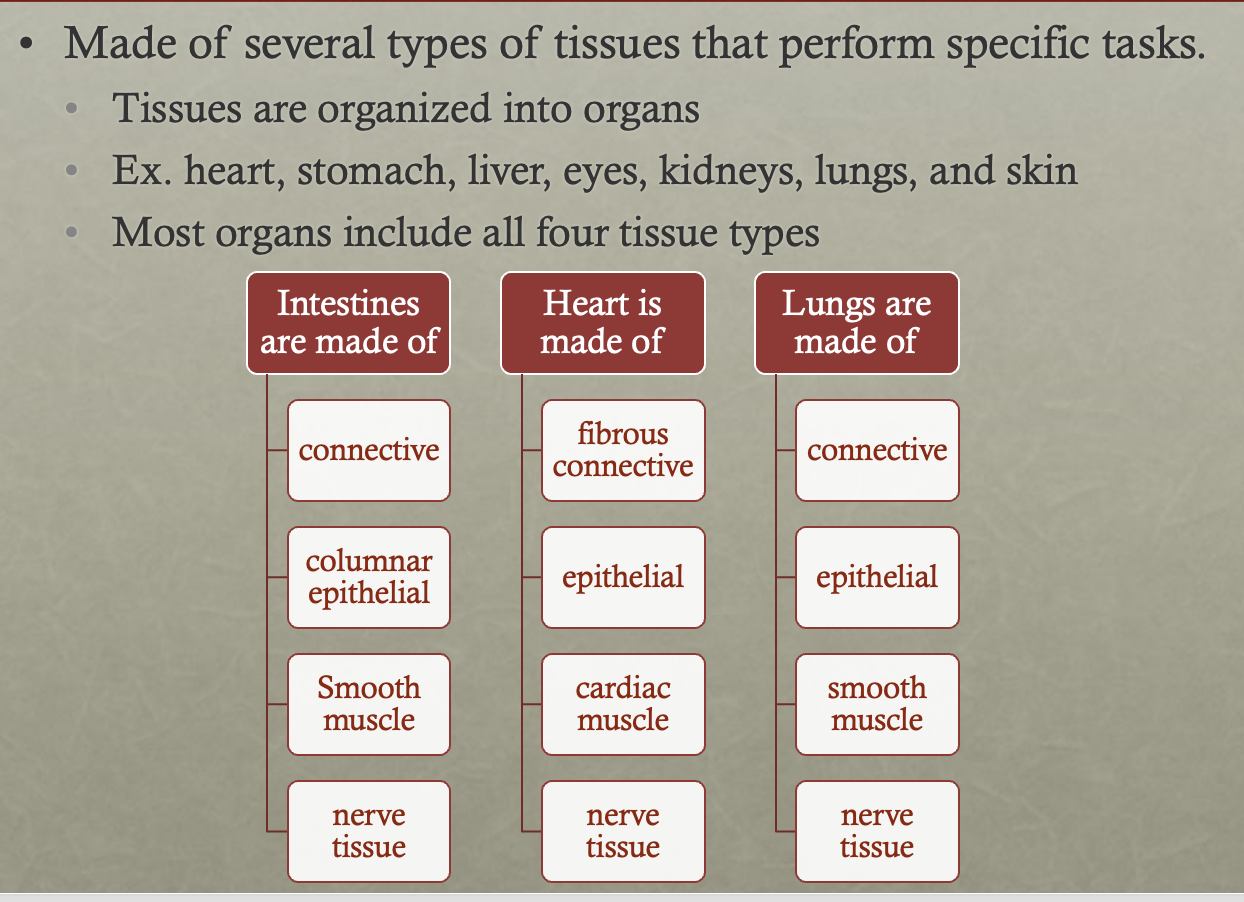
organs are …
Skeletal- Muscular system
Composed of bones and muscles
• Job is to support body
circulatory system
Composed of heart & blood vessels & blood
Job is to transport oxygen in and around the body; carbon dioxide out of the body & get nutrients to the blood
respiratory system
• Composed of trachea, lungs
• Job is gaseous exchange of oxygen in and carbon dioxide out of the body
Digestive system
Composed of stomach, liver, small & large intestine, pancreas
Job is digestion and absorption of nutrients which comes from eaten food
urinary system
Composed of kidneys, bladder, etc.
Job is removing liquid wastes from the body
Lymphatic (Immune) System
Composed of spleen, lymph vessels, lymph nodes
• Job is defense of the body (keep us healthy)
nervous system
Composed of brain, spinal cord, and nerves
• Job is communication throughout the body & control of the body through fast and short electro-chemical impulse messages
• Eg. Talking, moving…
Endocrine system
• Composed of endocrine glands and hormones
• Job is to regulate & control the body through the slower and longer messages via chemical hormones
Integumentary system
• Includes the skin
• Job is protection of inner organs from injury and disease
respiratory systems job is to
Supply cells with oxygen from the environment
Deliver waste carbon dioxide to the environment
circulatory system job
It’s a transportation system
The heart pumps
The blood delivers oxygen and nutrients to body cells and carries wastes away through a network of blood vessels
Open circulatory system
The hemolymph leaves vessels and flows among tissues
Closed circulatory system – Mammals!
Blood stays inside a continuous network of vessels
Flow is faster than in open systems
Found in all vertebrates and some invertebrates
Heart
A muscular pump
❤ Contraction of the ventricles drives blood circulation
• 4-chambers
• Pulse
• Blood pressure
• SA node
• Valves
Every Heart Beat…
Sends a surge of blood through the arteries.
You can feel this surge, or pulse, along arteries near the surface of the skin, especially along the neck and the inside of the wrist.
The radial artery is the major supplier of blood to your arms. Find it on your wrist.
The carotid artery supplies blood to the face and brain. Find it on your neck
Systolic pressure (“top number”)
Highest pressure of a cardiac cycle
Occurs as the contracting ventricles force blood into the arteries
Blood pressure
– the pressure exerted by blood against the walls of vessels that enclose it
Diastolic pressure (“bottom number”)
Lowest pressure of a cardiac cycle
Occurs when ventricles are fully relaxed
The SA node
• Heart’s pacemaker
• Group of heart cells that emits rhythmic signals
• These signals tell cardiac muscle fibers of the heart
wall to contract in a coordinated fashion.
valves
Valves monitor the direction that blood can flow.
Closing heart valves cause heartbeat sounds.
The heart pumps blood out to the body through the ______, the largest artery in the body.
Like a branching tree, the aorta divides again and again into smaller & smaller ______, eventually forming tiny blood vessels called ______, which carry blood to all the cells in the body.
The capillaries connect to larger and larger vessels called _____, which carry blood back to the heart.
aorta
arteries
capillaries
veins
Pulmonary circuit
Blood flows FROM THE HEART TO THE LUNGS & BACK.
Pulmonary arteries carry O2-poor blood away from the heart to the
lungs
Pulmonary capillaries: pick up O2 and release CO2
Pulmonary veins carry O2-rich blood back to the heart
Systemic circuit
Blood flows TO THE BODY TISSUES & BACK to the heart.
Oxygen-rich blood travels through this circuit.
An artery called the AORTA gives off supplies O2- RICH blood
flowing away from the heart… to the body.
Veins called the superior & inferior vena cava return O2-poor blood
to the heart.
plasma
Fluid portion of blood
Job=transports blood cells & platelets
It contains nutrients, wastes, signaling
molecules, & hundreds of plasma proteins
red blood cells - also known as _______ - are what?
erythrocytes
Disk-shaped, red color comes from hemoglobin,
which is an iron-containing pigment that can
reversibly bind oxygen.
Job= Transport O2 and, to a lesser extent, CO2
Lack nucleus/organelles; lives about 4 months
Approx 300 trillion circulate in your body (most
numerous type of cell in the blood)
Circulate for about 4 months