Regulation of Body Fluid Osmolality
 Call Kai
 Learn
 Practice Test
 Spaced Repetition
 Match
 Flashcards
 Knowt Play
1/16

There's no tags or description
Looks like no tags are added yet.
17 Terms
Osmolality
All body fluids are isomolar at 285 mOsm/kgH2O
A variation in more or less than 3 mOsm/KgH2O triggers sensors in the body to do something to bring osmolality back to normal
Changes in plasma/ECF osmolality can cause cells to increase or decrease their cell volume
The loop of Henle has varying osmolality
Regulation of Body Fluid Osmolality
Stimulus - change in osmolality
Receptor (sensor) - osmoreceptors in hypothalamus
Control centre - ADH release from pituitary gland
Effector - Change in water permeability of renal DCT and collecting ducts
Hypothalamic Osmoreceptors
Receptors that detect changes in plasma osmolality
Very sensitive to even small changes
Regulate ADH (vasopressin)
Modulates water retention or loss - no effect on solutes
Diuretic = increase urine production
Anti-diuretic = decrease urine production

Where is ADH produced and released?
Produced by the hypothalamus and transported to the posterior pituitary
What stimulates ADH secretion?
The main stimulus is an increase in plasma osmolality
A decrease in blood volume or pressure can also stimulate ADH secretion
What happens to ADH secretion when plasma osmolality increases?
Stimulates increased ADH secretion - ADH then increases water reabsoprtion by the kidneys, helping to dilute the plasma from collectiing ducts
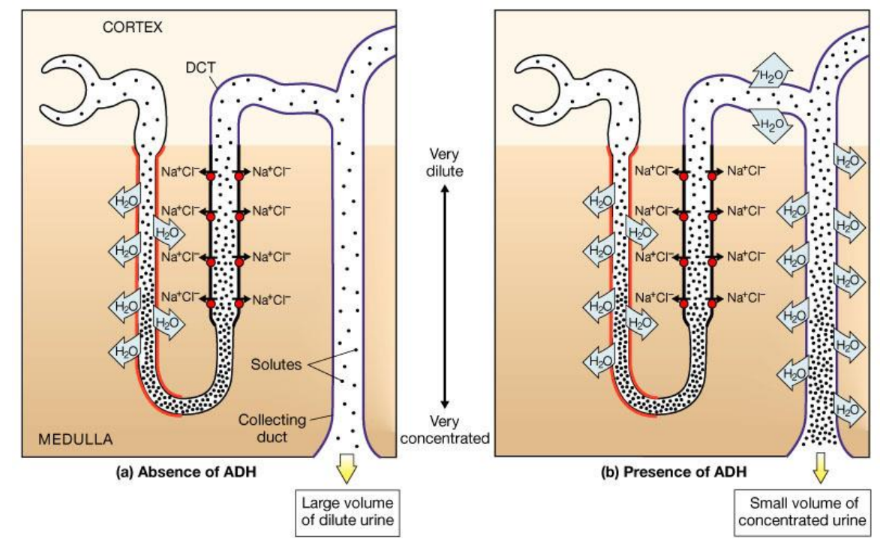
ADH leads to insertion of aquaporins in collecting ducts which increases their permeability to water and thus water reabsorption
Increases urine concentration - urine osmolarity increases

What happens when plasma osmolality decreases?
ADH secretion decreases reducing water reabsoprtion by the kidneys allowing more water to be excreted and producing dilute urine
Collecting ducts become less or not permeable to water
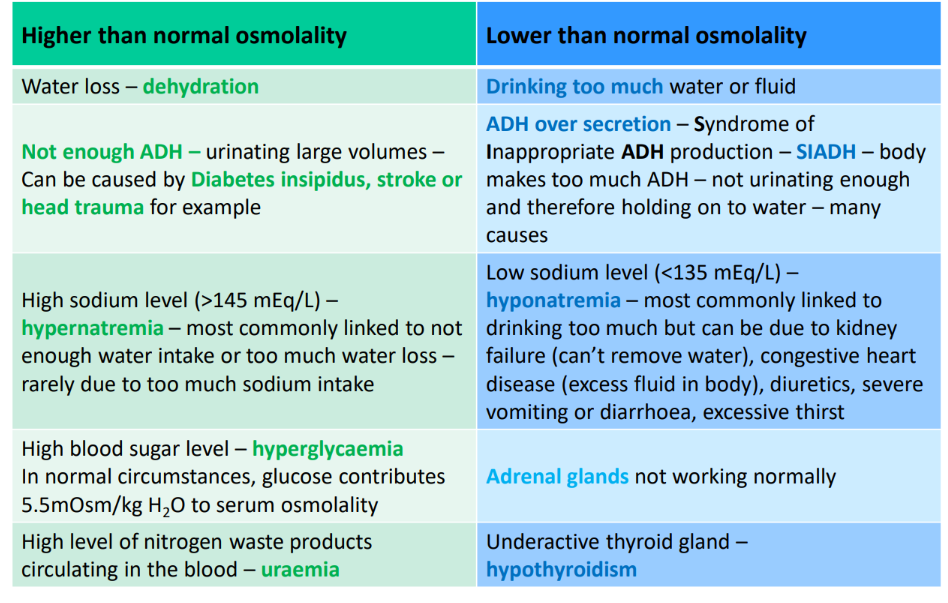
Higher and lower than normal osmolality table
ADH secretion and aquaporin insertion
After release from the pituitary, ADH travels in the bloodstream to the V2 receptors on the basolateral membrane of the cells lining the collecting ducts
Binding of ADH to the V2 receptors raises cAMP levels causing intracellular vesicles containing AQP2 to fuse with the apical membrane
Water is reabsorbed from the collecting ducts by osmosis, the gradient bought about by the high solute concentration in the surrounding medulla, into the vasa recta
How does ADH increase water permeability of the collecting duct?
ADH binds to V₂ receptors on collecting duct cells, activating a cAMP/PKA pathway that causes aquaporin-2 channels to be inserted into the apical membrane
To produce a dilute urine - table

To produce a concentrated urine - table

What happens when you drink sea water?
Dehydration
Muscle cramps
Dry mouth
Thirst
What happens to the collecting ducts when ADH is absent?
Fewer AQP2 channels are present in the apical membrane, so the collecting ducts remain relatively impermeable to water. Less water is reabsorbed
What is the relationship between ADH and urine volume?
High ADH → increased water reabsorption → low urine volume
Low ADH → decreased water reabsorption → high urine volume
What is the relationship between ADH and urine concentration?
High ADH → concentrated urine
Low ADH → dilute urine
Diabetes Insipidus - change in terminology
