Chemistry
 Call Kai
 Learn
Learn Practice Test
 Spaced Repetition
 Match
Match Flashcards
 Knowt Play
1/35

Earn XP
Description and Tags
Unit 3 and 4 Content
Name | Mastery | Learn | Test | Matching | Spaced | Call with Kai | Chat |
|---|
No analytics yet
Send a link to your students to track their progress
36 Terms
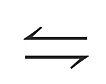
What is a reversable reaction?
Reversible reactions are reactions that can proceed in both the forward and reverse direction. They happen at the same time.
Physical changes are usually [blank] while some chemical reactions aren’t [blank]
Reversible. For example, water freezing twice.

What is Equilibrium?
The point in a reversible reaction where there is no change in the concentration of products and reactants. Where the rate of the forward and reverse reactions is equal. Reactants and products are not of equal concentration, only that the individual concentrations stay the same.
What does ‘Rate’ of a reaction mean?
How fast a reaction takes place.
What is Dynamic Equilibrium?
Forward and reverse reactions occur. Occur at the same rate.
What is Static Equilibrium?
The forward and reverse reactions occur at the same rate. They are not occurring at all.
What is a closed system?
Doesn’t allow any matter to be exchanged with the surroundings. But energy can be transferred to and from the surroundings.
What is an open system?
Reactants or products might be lost to the environment. This prevents equilibrium from being reached.

What is Le Chatelier’s Principle?
It states that for a system at dynamic equilibrium, if a change is made to the conditions, the position of the equillibrium will shift to counteract the change.
What does it mean for a reaction to be Endothermic?
The reaction absorbs heat from its surroundings, resulting in a positive enthalpy change (ΔH > 0). Surroundings become colder.
What does it mean for a reaction to be exothermic?
The reaction releases energy—usually as heat—into its surroundings, causing the temperature of the environment to increase. Has a negative enthalpy change (ΔH < 0).
What happens when temperature is decreased within a system?
System will counteract the change by moving in the direction that will increase the temperature.
What happens when temperature is increased within a system?
System will counteract the change by moving in the direction that willl decrease the temperature.
In an exothermic reaction what direction does the system move in if the temperature is increased and decreased?
Increased - equllibrium position reverses
Decreased - equillibrium position moves forward
In an endothermic reaction what direction does the system move in if the temperature is increased and decreased?
Increased - equillibrium position moves forward
Decreased - equallibrium position reverses
What happens when you change the concentration of a reaction?
The equillibrium will shift to try and keep the cocnentrations the same as before.
What happens when you increase the concentration of a reactant?
System moves to the product side to decrease the reactant concentration, resulting in a net forward reaction.
If instead, the concentration of a product was increased, the system would use a reverse reaction to decrease the product concentration.
What happens when you decrease the concentration of a reactant?
System moves to the reactant side to increase the concentration of the reactant, resulting in a net reverse reaction.
If instead, the concentration of the product side was decreased, the system would use a forward reaction to increase the product concentration.
What happens when the pressure is increased in a reaction?
The equillibrium is shifted to the side with fewer moles
What happens when the pressure is decreased in a reaction?
The equillibrium is shifted to the side with more molecules
What happens if the volume of the reaction is diluted with an aqueos solution?
If the volume is doubled by diluting it, all concentrations decrease by half. The system will partially oppose this by moving to the side that is producing the greater number of particles.
What does adding a catalyst do to the equllibrium of a system?
Lowers the activation energy. It does not increase or decrease the concentration. It instead speeds up the process of reacing equllibrium faster.
What effect does an inert gas have on equillibrium?
It has no effect on equllibrium. They are found in group 18 of the periodic table.

On the graph what does this represent?
Equillibrium of a system
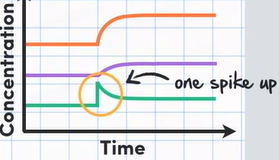
On the graph what does this represent?
Increase in concentration

On the graph what does this represent?
Decrease in Concentration

On the graph what does this represent?
Change in temperature

On the graph what does this represent?
Decrease in volume, increase in pressure
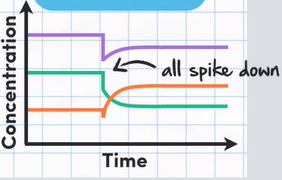
On the graph what does this represent?
Increase in volume, decrease in pressure
Collision Theory
Particles will only react successfully if they collide under specific conditions.
1. Collide with at least a minimum amount of kinetic energy (activation energy)
2. Collide with the correct orientation
What is the effect of increasing concentration according to collision theory?
Increasing the concentration increases the number of reactant particles. This increases the frequency of collisions, increases the number of succesful collisions. this means an increase in the rate of the forward reaction. This means the system is no longer at equllibrium (shifted to the right).
What is the effect of increasing pressure (decreasing volume) according to collision theory?
Increases the concentration of reactands and products. Number of successful reactand and product collisions. Increases the rate of both reactants. Bigger increase in the reverse reactions. System no longer at equillibrium (shifted to the left).
What is the effect of increasing temperature according to collision theory?
An increase in temperature favours the reaction with the highest activation energy. Vice versa for a decrease.
What is the equillbrium consant? (kc)
Tells us the proportion of products to reactants at equillibrium. This allows us to make calculations and predictions surrounding equillibrium.

How does kc indicate the position of the equillibrium?
If the position of the equillbrium is to the left with high concentration of reactants, the equillbrium constant will be small. If the position of the equillibrium is to the right with a high concentration of products, the equillbrium constant will be large.
What states of matter do you not include when calculating the equillibrium constant?
Liquids or solids