Review Notes: Intermediary Metabolism - Pentose Phosphate Pathway
 Call Kai
 Learn
 Practice Test
 Spaced Repetition
 Match
 Flashcards
 Knowt Play
1/15

There's no tags or description
Looks like no tags are added yet.
16 Terms
Phases of The PPP
Purpose of PPP: produces NADPH
occurs in the cytoplasm
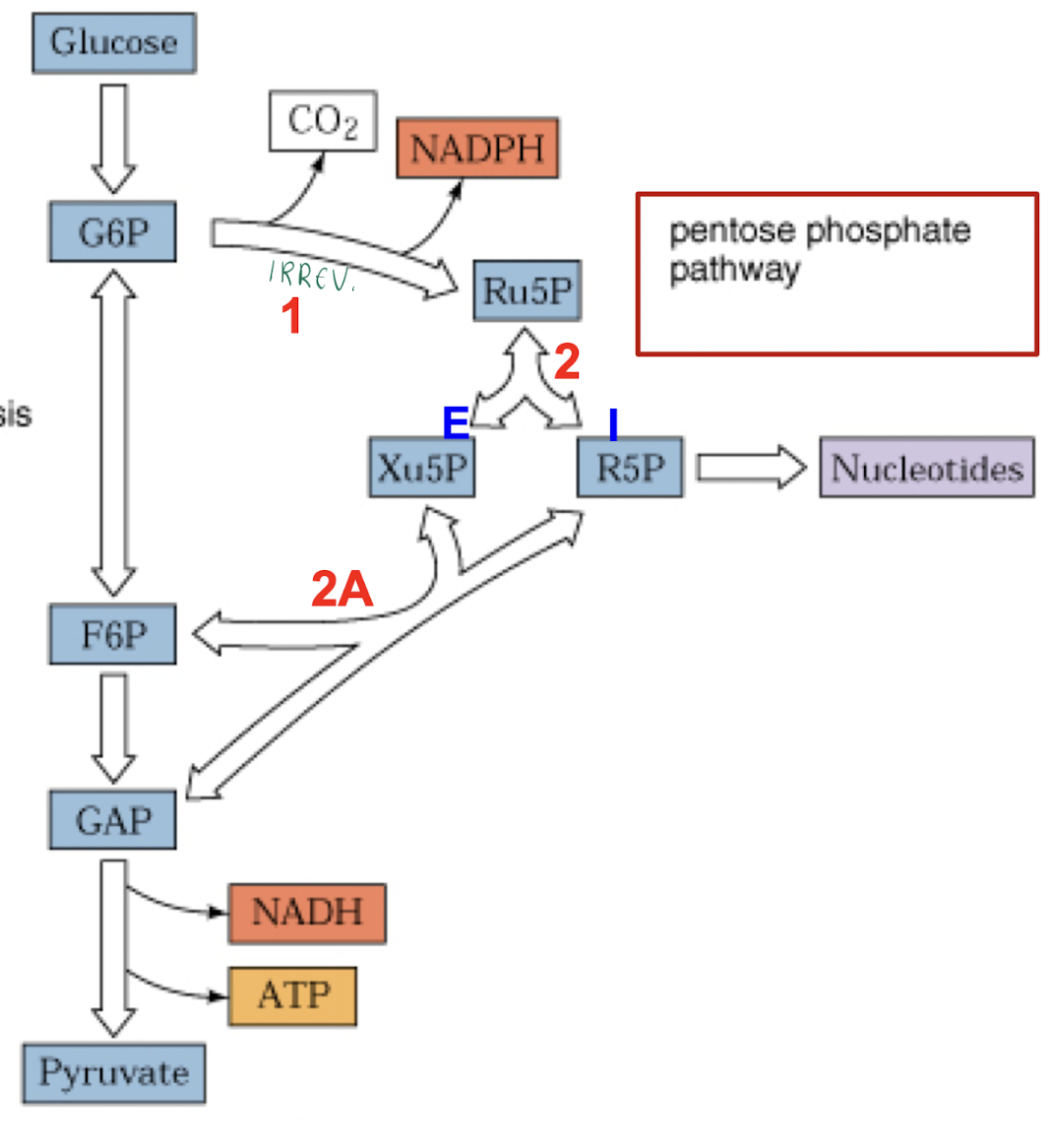
Phase 1: oxidation rxns
= takes G6P out of glycolysis to produce Ru5P + CO2 + NADPH
transfer electrons to NADPH
Irreversible
Phase 2: Isomerization & epimerization rxns
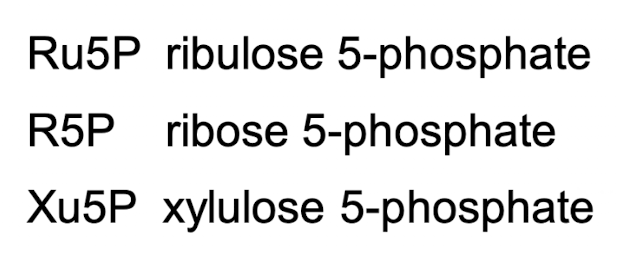
= converts RU5P to Xu5P (epimerization) & R5P (isomerization)
reversible
R5P can be converted to nucleotides or reenter glycolysis
Phase 2A: Pentoses → Glycolytic intermediates (F6P/ GAP)
= Xu5P & R5P renter glycolysis as F6P or GAP
note: F6P & GAP can be used in gluconeogenesis in the LIVER (not in muscle)
Major Products of the PPP
PPP: takes G6P out of glycolysis via the hexose monophosphate shunt
major products:
NADPH
for synthesis of cholesterol & fatty acids
for protection against oxidative damage (protects RBC’s)
pentose sugars
for synthesis of DNA & RNA

smaller rate products: metabolism of dietary pentoses
rearranges C skeleton of dietary carbs to enter glycolysis via phase 2A
What is the Pentose Phosphate Pathway active in?
Tissues that synthesize fattys acids, cholesterol, steroids
liver, gonads, & adipose tissue have high rates of PPP
Tissues that are rapidly dividing
GI tract & Cancers
Tissues directly exposed to oxygen (as the PPP produces NADPH to protect against oxidative damage)
erythrocytes (RBC’s) - allows them to deal with reactive oxygen species
→ overall active in : liver, gonads, adipose, GI tract, cancers, RBC’s
→ NOT usually active in skeletal muscle - only rly see increased expression of PPP enzymes w damage
PPP: NAD+ → NADPH
note: both NAD+ & NADP+ accept e-’s as hydride ions
purpose of phosphate on NADP+/NADPH: NOT for redox potential, its to signal where electrons are to be used (anabolic pathways like FA synthesis, cholesterol synthesis, nucleotide synthesis)
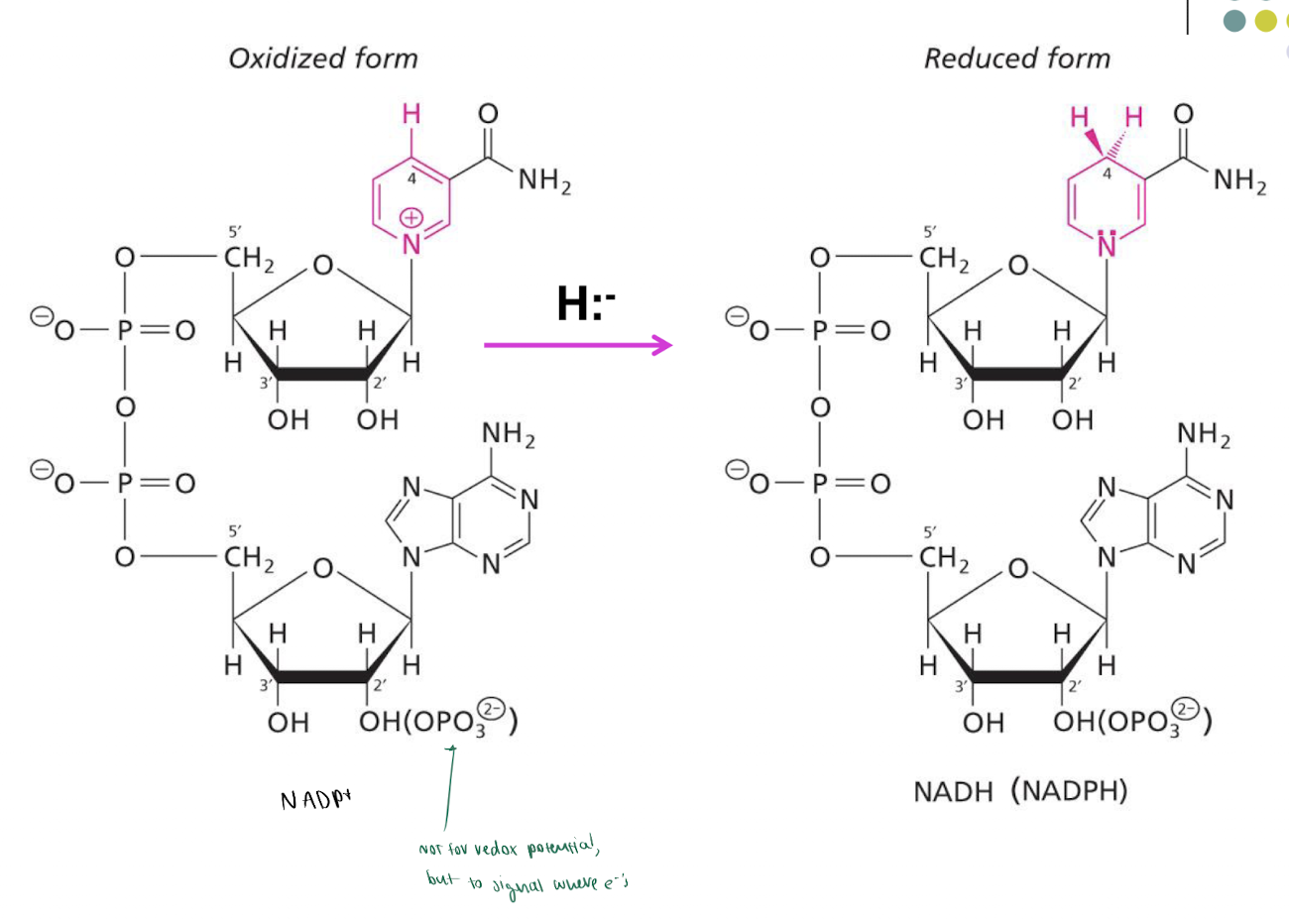
NADH vs NADPH
NADH: for ATP synthesis in oxidative phosphorylation
[NAD+] is kept higher in cell than NADH to favour OXIDATION
NADH is made the MOST in the matrix
NADPH: for synthesis of biomolecules & protecting RBC against damage from reactive oxygen species
[NADPH] is kept higher than NADP+ to favour REDUCTION
NADPH is made the MOST in the cytosol
made by 4 enzymes:
2 in the PPP
cytosolic isocitrate dh - thus this enzyme is important in muscle bc PPP doens’t occur in muscle to make NADPH
malate dh
Impact of PPP on Glutathione: The Master Antioxidant
→ Glutathione serves as an antioxidant that reacts with & neutralizes highly harmful/toxic reactive oxygen intermediates/species (ROI/ROS)
reactive oxygen species: free radicals, hydrogen peroxide, organic peroxides
a tripeptide w a sulfhydryl (-SH) group → serves as a sulfhydryl buffer
-SH allows us to go from ox → red form
present at high levels in RBCs (~5mM) for protection against oxidative damage & hemolysis (RBC destruction)


role of PPP: NADPH produced by PPP keeps glutathione in its reduced state (GSH) to protect RBC’s
via: GSH redox cycle
→ moves electrons from G6P to form GSH to reduce toxic O species
enzymes involved:
G6PD
glutathione reductase ( uses NADPH )
glutathione peroxidase (detoxifies)
PPP pulls G6P from glycolysis via HMP shunt
G6P-dh oxidizes G6P to 6-phosphogluconate → produces NADPH
G6PD is the most important enzyme here
glutathione reductase reduces GSSG (ox) → 2 GSH (red glutathione)
glutathione peroxidase oxidizes 2 GSH, detoxifying the reactive O species to protect RBC’s
note: in most cells the reduced form of glutathione (GSH) has higher levels to protect RBC’s
GSH : GSSG is > 500
GSSG (ox form) : a glutathione disulphide
overview of GSH redox cycle

GSH redox cycle: Glutathione peroxidase rxn

GSH redox cycle: Glutathione reductase rxn

2 Major Phases in PPP: Oxidative & Non-oxidative
→ PPP occurs in cytoplasm
→ PPP, gluconeogensis, & glycolysis are linked
→ PPP operates in 3 diff modes that may have some crossover
Oxidative Phase: linear pathway & irreversible
generates 2 NADPH + CO2
involves:
oxidation → hydration → oxidative decarboxylation
committed rxn is the 1st, involving G6PD
Non-oxidative Phase: non-linear pathway & reversible
involves:
pentose isomerization: Ru5P → R5P
pintos epimerization: Ru5P → Xu5P (differ at C3)

note: focus on oxidation rxns/ phase
Phase 1: Oxidation Reactions of PPP
reactants: G6P, 2 NADP+, H2O
products: Ru5P, 2 NADPH, CO2, 2H+

→ involves 3 rxns: oxidation → hydration → oxidative decarboxylation
similar to the last 3 steps in CAC & 3 steps in B-oxidation of FA
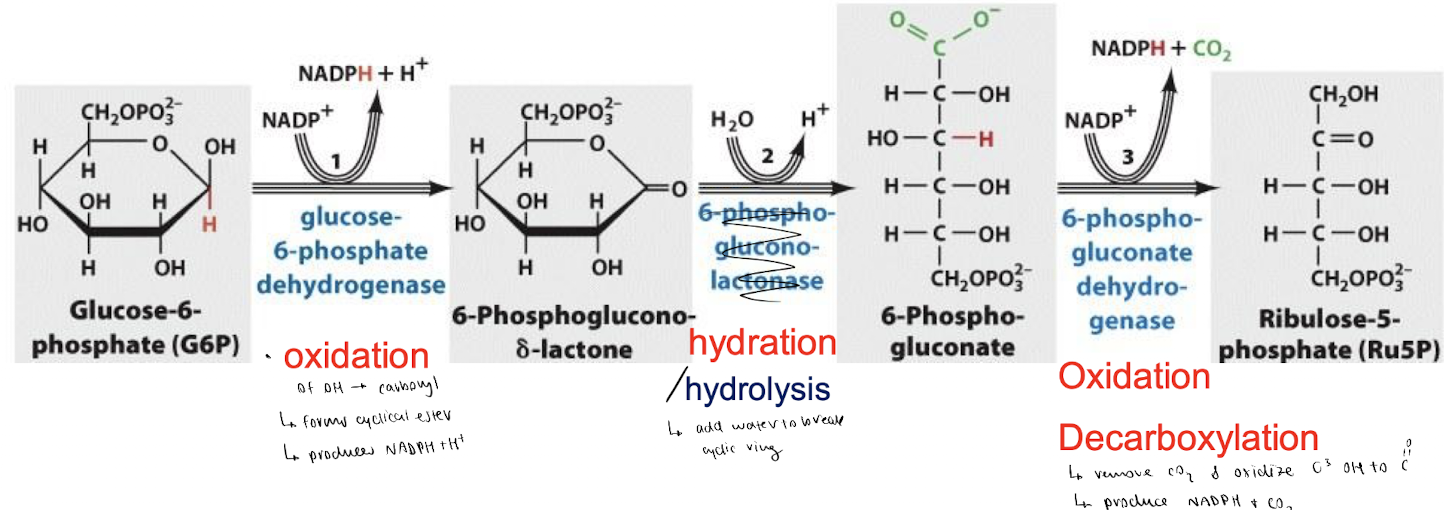
Oxidation: G6P -G6PD→ 6-phosphoglucono-delta-lactone + NADPH
oxidation of OH → carbonyl group
forms cyclic ester & produces NADPH + H+
the COMMITTED rxn of PPP
catalyzed by G6PD
regulated
prices NADPH
Hydration/hydrolysis: 6-phosphoglucono-delta-lactone → 6-phosphogluconate
add water to break cyclic ring
Oxidative decarboxylation: 6-phosphogluconate -6-phosphogluconate dh→ Ru5P + NADPH + CO2
removes CO2 & oxidizes C3 -OH to carbonyl group
produces NADPH + CO2
committed rxn overview:

What is the effect of G6PDH deficiency on the PPP?
note: G6PDH deficiency is the most common enzyme deficiency worldwide
→ results in decreased NADPH levels, as it usually oxidizes G6P to 6-phosphoglucono-delta-lactone & produces NADPH, THUS glutathione is in its ox form (GSSG) → CANT protect RBC’s from reactive O species → hemolysis occurs
G6DPH catalyses the committed rxn in PPP
G6PH deficiency = an inborn error of metabolism that predisposes ppl to RBC breakdown
an X-linked recessive disorder → thus males are MOST affected
often have no symptoms

Phase 2: Non-oxidative Phase of PPP
pentose isomerization: Ru5P (ketone) → R5P (aldehyde)
pentose epimerization: Ru5P (C3 OH on R) → Xu5P (C3 OH on L)
both are ketones that differ at C3
Xu5P produced is important in regulation & an epimer of Ru5P

How is the PPP, gluconeogenesis & glycolysis linked?
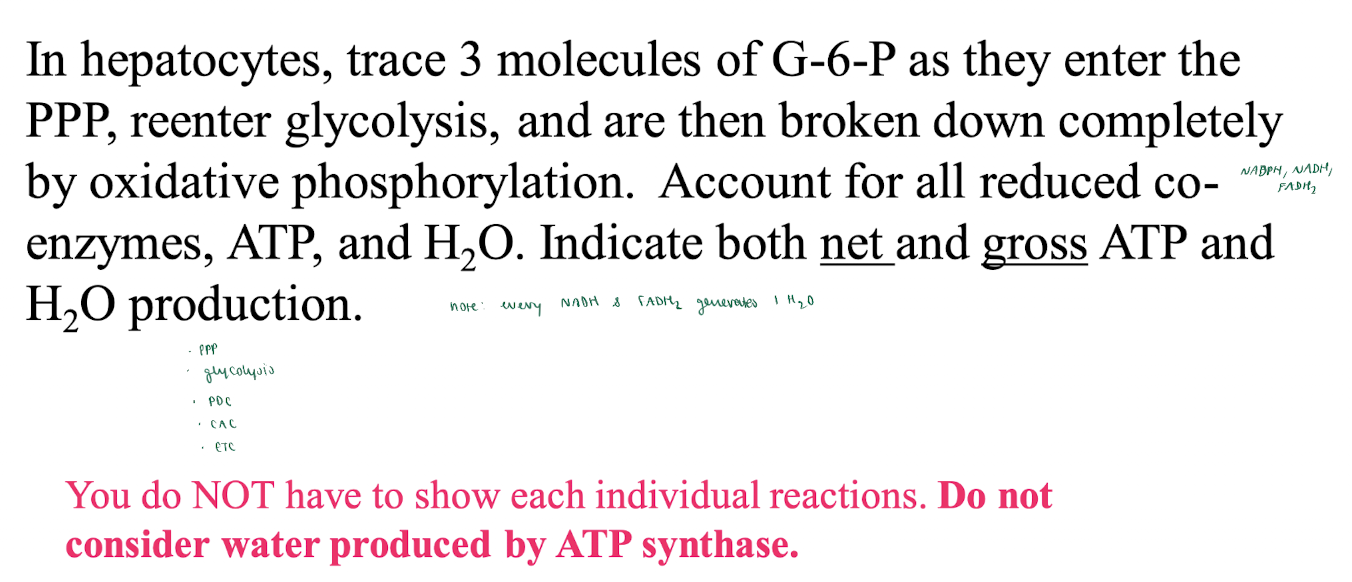
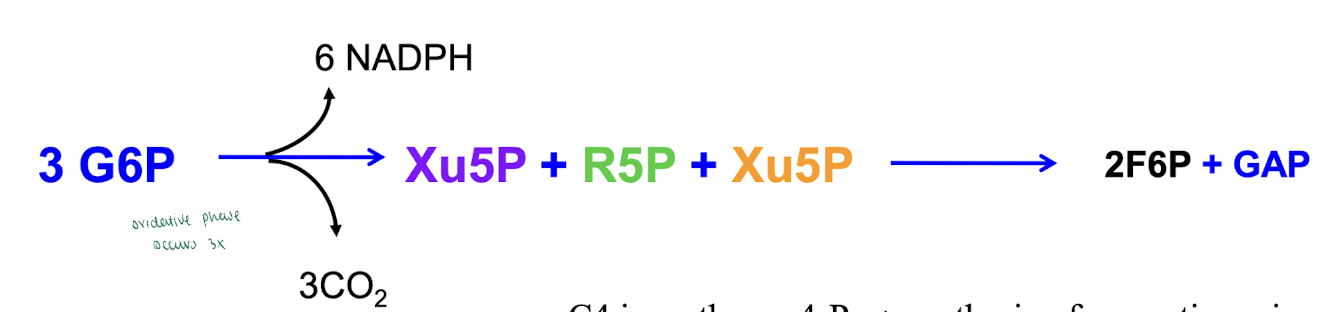
→ bc 3 G6P in glycolysis are pulled into the PPP via the HMP shunt → oxidative phase of PPP occurs 3x and produces Xu5P, 3 CO2 & 6 NADPH, THEN Xu5P & the non-oxidative phases R5P & Xu5P are converted to 2F6P + GAP
connection:
the PPP takes 3 G6P out of glycolysis
F6P & GAP produced by the PPP are a part of glycolysis & gluconeogenesis

Q. In a tissue that metabolizes glucose via the pentose phosphate pathway, C-1 of glucose would be expected to end up principally in:
answer: CO2
glucose → G6P in glycolysis, then the PPP pulls G6P out and the oxidative phase occurs that removes C-1 as CO2 in the 3rd step (oxidative decarboxylation)

What are the different modes of the PPP?
What are their purposes?
mode 1
goal: Nucleotide synthesis, using R5P & NADPH from PPP

mode 2
goal: NADPH synthesis for cells undergoing cholesterol & FA synthesis
takes 6 G6P → ox phase occurs 6x → produces 12 NADPH & lose one glucose as 6 CO2 → non-ox phase occurs that recombines the pentoses produced into 4 F6P + 2 GAP that DONT re-enter gycolysis, INSTEAD they combine back into 5 G6P to re-enter PPP to make more NADPH

mode 3
goal: for cells needing energy & NADPH synthesis
thus pentoses produced by PPP continue to glycolysis → PDC → CAC to produce energy
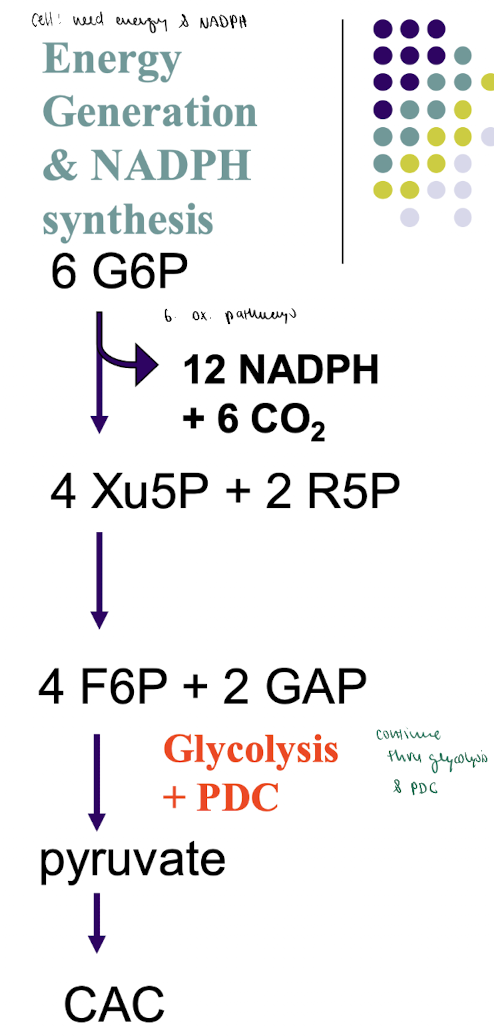
THUS, the PPP can prioritize synthesis of NADPH & CO2, or also produce pentoses used for nucleotide synthesis, or also produce pentoses to reenter glycolysis→PDC→CAC for energy needs

Regulation of the PPP
rate of G6PDH rxn regulates the PPP + substrate availability (NADP+)
2 binding sites for NADP+ on G6PDH: w increased [NADP+] it binds to the allosteric regulatory site & allows NADP+ to bind more to the active site (stabilizes)
NADPH can competitively inhibit (via product inhib) at the active site, NOT the allosteric site
→ when NADPH is being used rapidly → more NADP+ available, thus activating G6PDH
→ insulin (high blood sugar) stimulates the synthesis of G6PDH
thus more glucose is taken from the blood & used for NADPH synthesis in the PPP
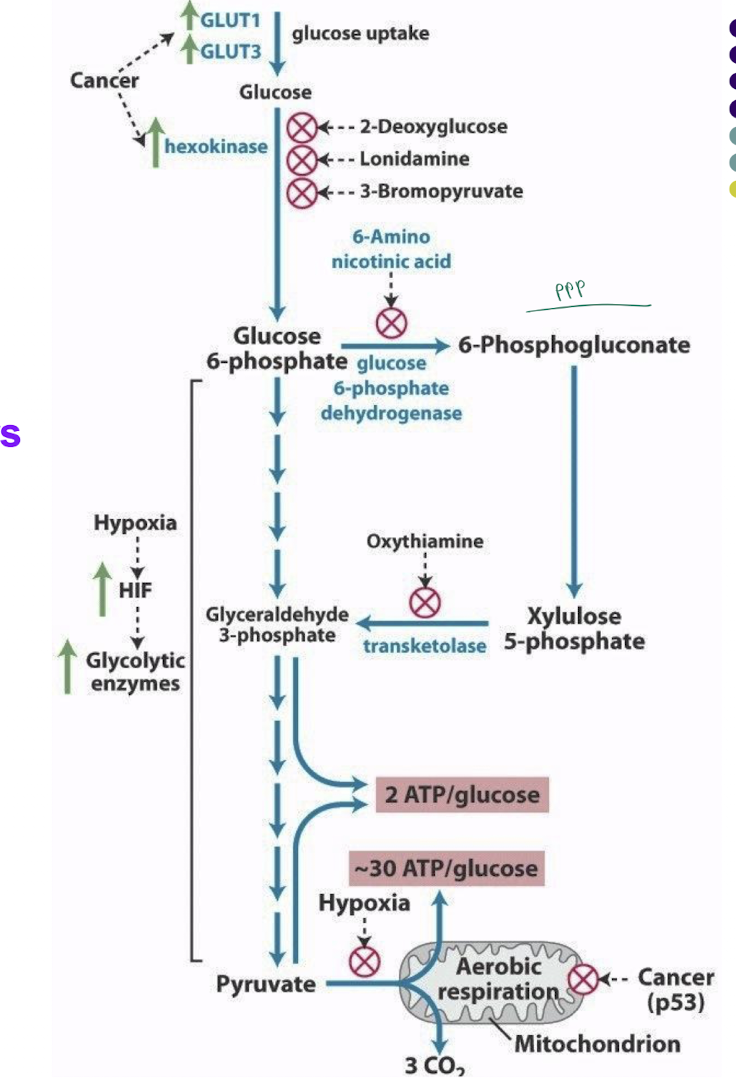
The PPP in rapidly dividing cancer cells
the PPP is ALSO active in rapidly diving cancer cells:
produces NADPH → used for synthesis of FA, lipids, cholesterol…. in growing cancer cells
non-oxidative phase produces pentoses used to make nucleotides - cancers quire large amounts of nucleic acids for replication
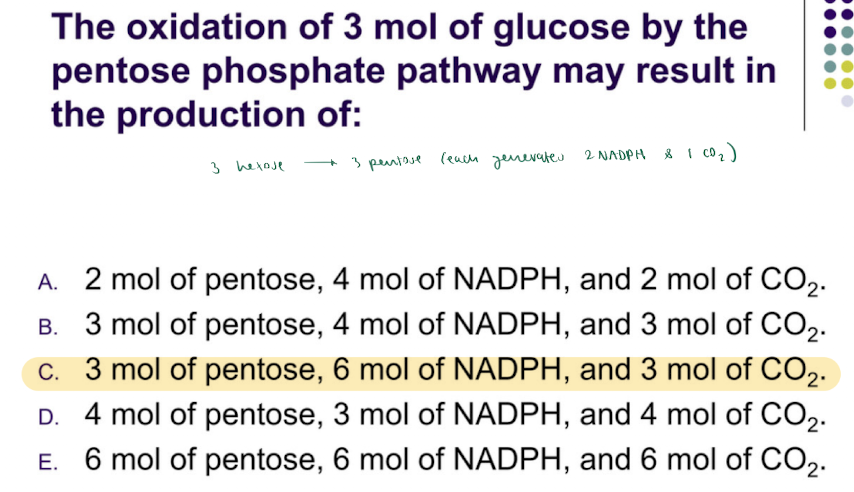
Q. the oxidation of 3 mol of glucose by the pentose phosphate pathway may result in the production of?
3 glucose → 3 G6P
PPP pulls in 3 G6P via HMP shunt
ox phase produces 2NADPH per G6P = 6 NADPH
ox phase produces 1 CO2 per G6P = 3 CO2
non-ox phase produces 1 pentose per G6P = 3 pentoses
answer: 3 mol of pentose, 6 mol of NADPH, and 3 mol of CO2