Objective 6 - Diseases
 Call Kai
 Learn
Learn Practice Test
 Spaced Repetition
 Match
Match Flashcards
 Knowt Play
1/58

There's no tags or description
Looks like no tags are added yet.
Name | Mastery | Learn | Test | Matching | Spaced | Call with Kai | Chat |
|---|
No analytics yet
Send a link to your students to track their progress
59 Terms
What is are Sickle Cell Diseases (Hgb S)?
most common form of hemoglobinopathy
SCD - describes a group of genetic disorders
production of abnormal HbS
involves 1 amino acid switch at 6th position on Beta Chain
glutamic acid → valine
What are features of Sickle Cell Disease?
Autosplenectomy - loss of splenic function
Acute Chest Syndrome - pulmonary infarction from sickling in lung
Vaso Occlusion - severe pain / inflammation from cells trapped in microvessels
Bacterial infections
Leg Ulcers
Avascular necrosis - impaired blood to head of femur/humerus
What are lab findings of Sickle Cell Disease?
diagnosed after about 6 months
↑ WBC and bilirubin
MCV/MCHC : normocytic/normochromic anemia
↑ retic
except in aplastic crisis (low)
BM: erythroid hyperplasia
positive hemoglobin solubility test

What can be seen on a blood smear in someone with sickle cell disease?
Sickle cells
Target cells
HJ bodies
Basophilic stipplings
nRBCs
spherocytes
What percentages will indicate Sickle Cell anemia (HbSS disease), the most common homozygous form of sickle cell disease?
HbS: > 80%
HbA: none
HbF: 1-20%
A2: 2-20%
What Hgb Electrophoresis pattern indicates sickle cell disease?
migrate electrophoretically to the same position as HbD and HbG at alkaline pH (cellulose acetate)
acid pH differentiates
What clinical clues can point to Sickle Cell Disease?
recurrent severe pain
acute chest syndrome
anemia
autosplenectomy
frequent infection
sickle cells
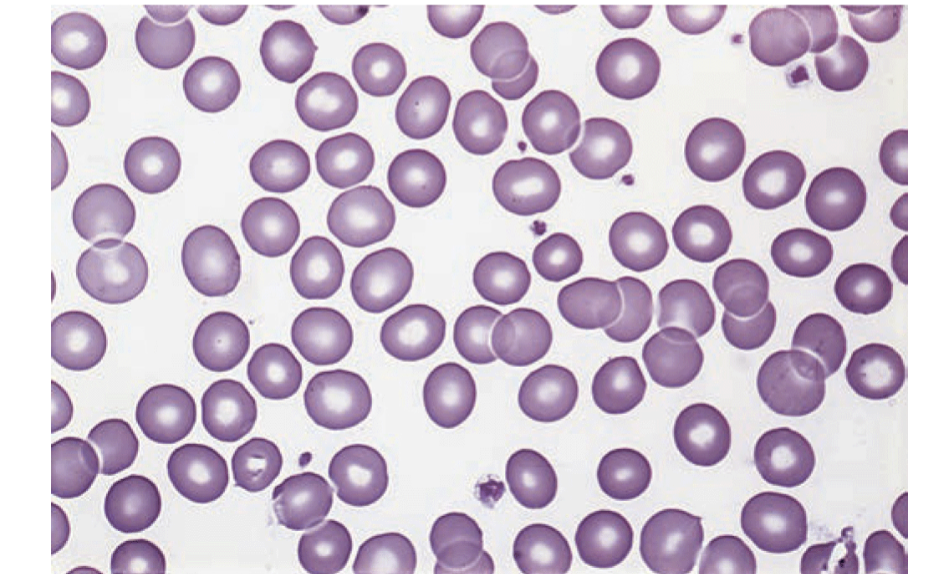
What results indicate Sickle Cell Trait (HbAS)?
40% Hgb S
60% Hgb A
typically asymptomatic
sickling and crisis can occur when pts are hypoxic
PB: normal, few target cells
positive Hgb solubility test
↑ reticulocytes (5-20)
sideroblastic granules / HJ bodies possible
possible shift to left
↑ immature WBC and PLTs
BM - erythroid hyperplasia
not during crisis
What lab findings indicate Hgb C Trait (AC)?
pt has 1 normal B globin gene and 1 HbC gene
Labs
30-40% Hgb C
60-70% Hgb A
target cells on PB
mild hypochromia

What is Hemoglobin CC disease?
a2B26Glu-Lys
Change from glutamic acid → lysine
Hgb C polymerizes under low oxygen tension
has short thick crystals within RBCs “bar of gold”
less hemolysis

What lab findings indicate Hemoglobin CC disease?
normocytic / normochromic
target cells, microspherocytes, schistocytes
RBC indices: normal
mod inc in retics
nRBCs may be present
negative hgb solubility test
What electrophoresis results indicate Hgb CC disease?
Hgb C = 95%
HbA = none
HbF = < 7
HbA2 = negligible
needs acidic pH to be separated
What is hemoglobin SC disease?
a2B6Glu-ValB6Glu-Lys
at position 6, glutamic acid is replaced by valine (Hgb S) on one chain and is replaced by lysine (Hgb C) on other globin chain
less severe than Hgb S but more severe than Hgb C
patient produces BOTH HbS and HbC
HbS from one parent
HbC from other parent
What clinical findings indicate Hemoglobin SC disease?
presents in teenage years
vaso occlusive crisis is less frequent than in Hgb SS
HbS from 1 parent and HbC from other
moderate hemolytic anemia
splenomegaly
resp. tract infections with S. pneumonia
med lifespan
women: 60 yrs
men: 68 yrs
What lab results indicate Hemoglobin SC disease?
normocytic / normochromic
normal RBC indices
Hgb: 11-13 g/dL
retic: 3-5%
positive hgb solubility test

What on a peripheral blood smear indicate Hemoglobin SC disease?
few sickle cells
target cells
intraerythrocytic crystalline structures (SC crystals)
What electrophoresis results would indicate Hemoglobin SC disease?
near equal amounts Hgb S and C
No HbA
small HbF
What is used to treat Hemoglobin SC disease?
same as for Hgb SS
What is used to treat Hgb CC and AC disease?
none
What is characteristic of BOTH Beta and alpha thalessemia?
↓ hgb function
microcytic , hypochromic anemia
What is Beta Thalassemia?
adult Hgb
inherited genetic mutations
divided by gene symbols B0 or B+
What is B0 Beta Thalassemia?
set of genetic mutations that result in complete absence of B chains
What is B+ Beta Thalassemia?
set of genetic mutations that result in reduced amounts of B globin
What are the different B thalassemias - caused by genetic mutations?
major -severe
intermedia
minor - least severe (trait)
What are the different a thalassemias - caused by gene deletions?
Hgb Barts
Hgb H
Hgb Constant Spring
What percentages indicate B thalassemia major?
Hgb F: 70-90%
HbA2
NO HbA
What is associated with B thalassemia major?
severe hemolytic anemia
Hgb < 7.0 g/dl
micro / hypo
rigid RBC → destroyed by spleen
What are features of B thalassemia major?
homozygous
transfusion dependent
BOTH parents have B thalassemia
Dx: between 6 m and 2 yrs of age
failure to thrive, pallor, infections, splenomegaly
four a globin chains, no B chains (B0B0)
What happens in B thalassemia major in non transfused / inadequately transfused infants?
severe chronic anemia → strong stimulus for erythropoiesis
causes: marked expansion of the marrow space
characteristic skeletal changes of skull, long bones, hand bones
stunted growth and prominent facial bones
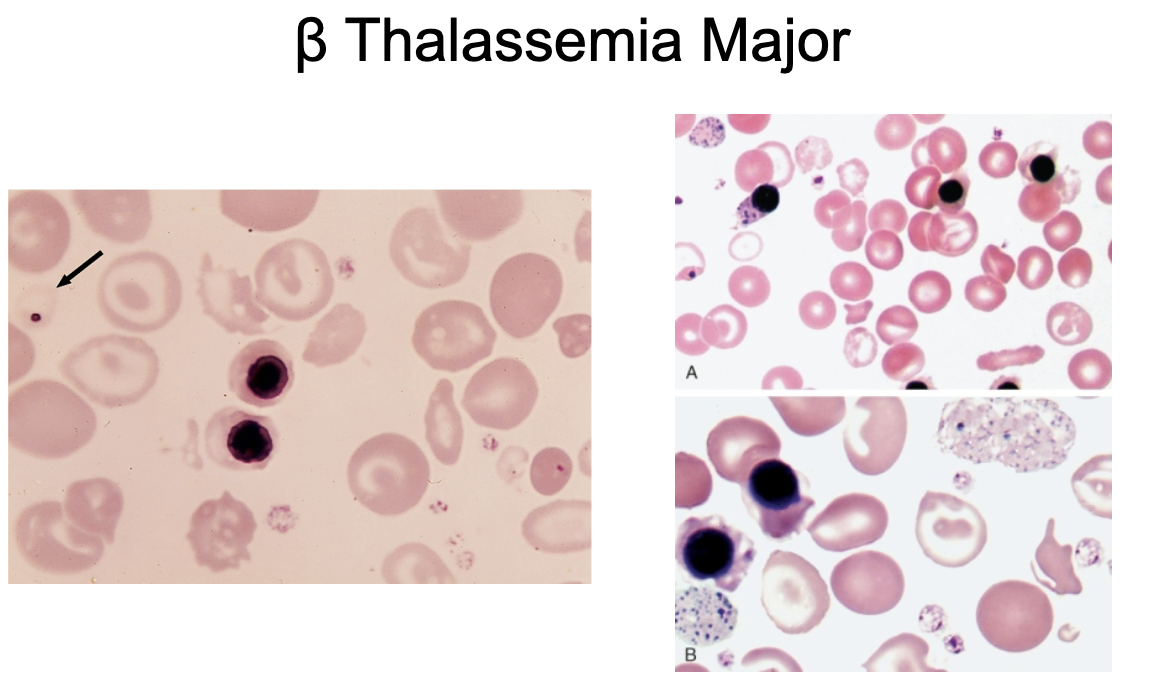
What is on a peripheral blood smear for B thalassemia major?
target cells, teardrop cells, elliptocytes
basophilic stipplings (RNA)
H-J bodies (DNA)
Pappenheimer bodies (iron)
Heinz bodies (hgb)
polychromasia
nRBCs
What lab results indicate B Thalassemia Major?
ineffective erythropoiesis
↑ retics and LDH
↓ haptoglobin
Hgb < 7.0 g/dL
micro/hypo anemia
severe hemolytic anemia
What is used to treat B Thalassemia Major?
hematopoietic stem cell transplant - only cure
10-15 mL/kg of RBCs transfusion every 2-5 weeks
iron chelation
hydroxyurea
desferrioxamine
What are characteristics of B Thalassemia Intermedia?
malfunctioning hepcidin → increased iron absorption
iron overload
present with symptoms > 2 yrs old
pt may need occasional transfusion of RBC
lead to severe infections , gall stones

What lab findings indicate B thalassemia intermedia?
Hgb 7-10 g/dL
varying degrees of anemia
↑ bilirubin
jaundice, splenomegaly
physical, bony characteristics
What are characteristics of B thalassemia Minor?
B-thal trait
silent carriers
one beta gene is mutated and one is normal (B0B)
asymptomatic anemia
stress can trigger:
infections/ trauma
What percentages indicate B thalassemia Minor?
Hgb A: 92-95%
Hgb A2: 3.5 to 7%
Hgb F: 1 to 5%

What lab findings indicate B Thalassemia Minor?
Hgb: 10-13 g/dL
RBC norm / ↑
minimal ineffective erythropoiesis
mild micro / hypo
MCV < 75 fl
MCHC < 32%
target cells elliptocytes, basophilic stipplings
What is a-thalassemia?
involves adult / fetal hgb
extent of decreased production of a chain depends on mutation, number of globin genes affected, and which gene is affected
a2 globin gene produces 75% of a chains in normal RBCs
normal: aa/aa
What is a0 Thalassemia?
deletion of BOTH a globin genes on chrom 16
no a chains are produced
21 known mutations
affects 4% of pop of SE Asia
What is a+ Thalassemia?
deletion or non deletional mutation in one of two a globin genes on chrom 16
other one is intact and functional
decreased a chain production
50-80% carriers in
Saudi Arabia, India, SE Asia, Africa
What is the a1 (silent carrier) clinical syndrome of a-thalassemia?
1 a gene deleted
asymptomatic, incidental discovery
borderline low MCV possible
What is the a2 (a-thalasemia minor, trait) clinical syndrome of a-thalassemia?
2 a genes deleted
asymptomatic, incidental discovery
mild micro / hypo
↑ RBCs
target cells
What is the a3 (Hgb H disease B4) clinical syndrome of a-thalassemia?
3 a genes deleted, excess of B chains
unstable hgb, heinz bodies, rigid RBCs destroyed in spleen
mod micro/hypo
30% HbH, rest is HbA
What is the a4 (Hgb Barts y4) clinical syndrome of a-thalassemia?
all 4 genes deleted
no normal chains produced
80% hgb Barts - can not carry O2
incompatible with life
die in utero or just after both
What is Alpha Silent Carrier (a+ thalassemia trait)?
defect in one of the four a-globin genes
presence of a very small amount (up to 2%) of hemoglobin Barts at birth
not anemic, normal blood smear
slightly low MCV - clue to the carrier state
What is the correlation between Women and Alpha Silent Carrier (a+ thalassemia)?
not at risk of hemoglobin Barts hydrops fetalis
may have children with hemoglobin H disease
What is a thalassemia minor (trait)?
defects of two of four a-globin genes
cis (—/aa) - both delete on one chromosome
trans (a-/a-) one delete on each chrome
at birth
5-15% hemoglobin Barts - disappear with development
parents are asymptomatic with mild microcytic, hypochromic anemia
MCV: 70-75 fl
How is a thalassemia minor identified?
incidentally or by screening programs in regions with high prevalence

What is associated with Hemoglobin H disease?
deletion of 3 out of 4 a genes (only 1 functional
Denoted: B4 (tetramers)
splenomegaly
BM erythroid hyperplasia
main finding: Hgb H inclusions (brilliant cresyl blue stain) B tetramers
What lab findings indicate hemoglobin H disease?
mild/mod anemia
hgb 7-10 g/dL
5-40% HbH
rest is HbA
small amount HbA2 and Hb Barts
hypochromia microcytosis
target cells
What is Hgb Bart associated with?
(—/—) homozygous a0 that result in absence of all a chain production
4 gamma chains present
death in utero or shortly after birth - edema, pallor

What is Hydrops fetalis
life threatening condition of fluid build up in several body compartments
in Hgb Barts - cardiac failure and edema are associated

What lab findings indicate Hgb Barts?
marker: micro/hypo
Hgb 3-8 g/dL, nRBCs
tear drop cells, target cells
BM: erythroid hyperplasia
What pregnancy symptoms indicate Hgb Barts?
preeclampsia common
complications
hemorrhage postpartum
What percentages are associated with Hgb Barts disease?
predominant Hgb: Hgb Bart (y4)
followed byL
Hgb Portland (z2y2)
Hgb H (B4)
What is Constant Spring?
HbCS
point mutation in the a2 globin gene
results in additional bases added to end of mRNA during transcription
elongated mRNA is unstable
abnormal a chains join B chains
difficult to see in electrophoresis
alkaline pH
What is homozygous Constant Spring?
thalassemia minor
HbCS 5-8%
microcytosis
What is heterozygous Constant Spring?
asymptomatic
HbCS 1%
What is Thalassemia with HgbS “Sickle like” B-thalassemia.
50-80% HgbS
20-50% HgbA
↑ HgbF
opposite of sickle cell trait
indicates decreased severity of sickling process
microcytosis