Lecture 15: Cost Minimization
 Call Kai
 Learn
 Practice Test
 Spaced Repetition
 Match
 Flashcards
 Knowt Play
1/22

There's no tags or description
Looks like no tags are added yet.
23 Terms
TOPIC 1) Isocost Curve
Cost function
c(q)= rK(q) + wL(q)
Note c(q), K(q), and L(q) do not mean multiply by q but rather that these variables are a function of output.
Accounting cost versus economic cost
Accounting cost refers to explicit out-of-pocket expenses.
Economic cost includes both explicit expenses and implicit opportunity cost (what you give up to run a business)
Economic cost > accounting cost
Economic profits < accounting profits
Why would a firm remain even if there economic profits are 0
Because it means the owners are covering all production costs and earning exactly what they could have made at the next best alternative venture.
Do all points on the isoquant curve (various combinations of K & L that yield the same output) have equal costs associated with them?
No! Take a look at this example, note we know W and R are fixed (perfect competition)

Isocost Curve
Curve showing all possible combinations of K and L that can be purchased at a given cost.
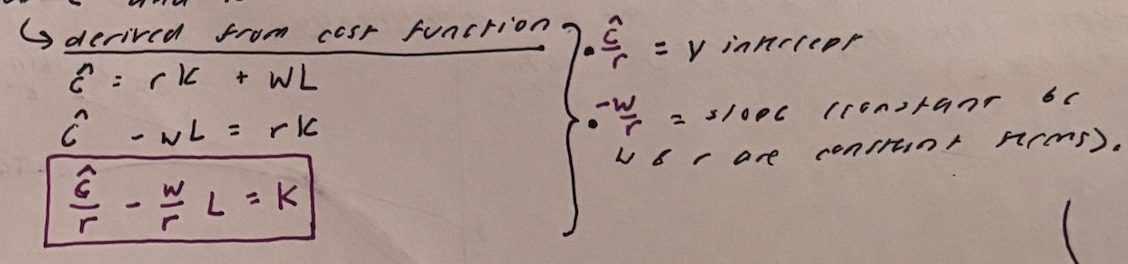
Principles of isocost curve
there are many isocost clines, one for each value of overall cost
higher lines reflect higher costs
lower lines reflect lower costs
Not a constraint! Just measures cost
Scale expansion path

Isocosts and Isoquants (fitting them together)
we can combine them to determine the cost of production for a firm. The cost will depend on whether we are considering the short run (K fixed, L variable) or the longrun (both variable.)
Topic 2: Short Run Cost
K is fixed let K= K*
At point A, this lower-cost option would be more optimal for the firm, but K is their only option in the SR so instead they produce at point b
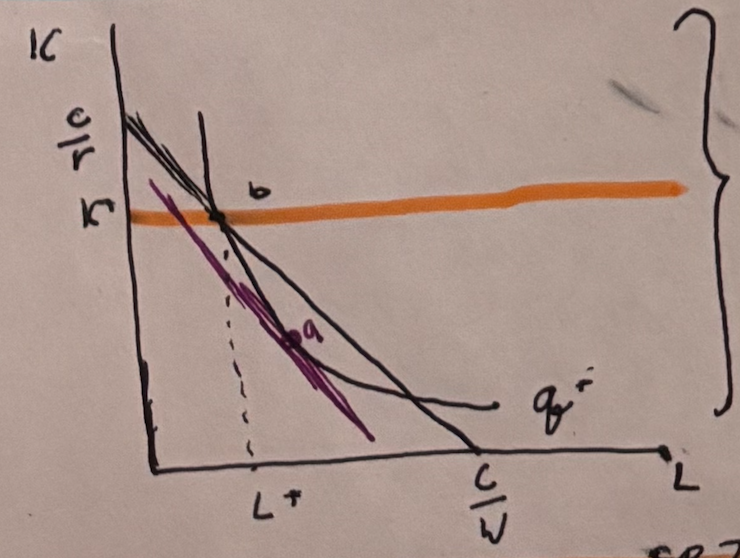
Short run total cost function
The relationship between TC & q depends on costs arising from fixed and variable inputs.
SATC= rk* + wL(q)= SRFC + SRVC
EXAMPLE: Calculate SRTC given SRTC given that q= f(K,L)= K x L, Ket k*=8, let w= $4, let r=$1. And illustrate this on a graph

Topic 3: Long-run Costs
What differentiates LR from SR
In this instance, firms can change both K & L. THe firm will end up choosing the lowest cost (K,L) combination to produce q*.
Long run cost optimal point graphically
Choose K and L to be on lowest isocost line that produces q*.
Lung run cost optimum mathematically
Minimize cost subject to the production constraint so..
slope of isocost= slope of isoquant
-w/r=-MRTS= -MPL / MPK
Rule for minimizing profit (alternate equimarginal principle and intuition behind it.)

Why is it that SRTC > LRTC
Short un K is usually not the cost-minimizing K.
Optimal K < K*, cost at optimal K <cost at K*
Graphical depiction of above

How do you find the Long run total cost function
Use lagrandian
LRTC function example: min rK + wL st. q= f(K,L)

EX2: Longrun cost function K* q= K x L and W= $4 and r= $1

Using the above equation compare SRTC to LRTC for q=9, 25, q= 16 with a focus on k
