W3 Corneal Topography for CL Fitting
 Call Kai
 Learn
Learn Practice Test
 Spaced Repetition
 Match
Match Flashcards
 Knowt Play
1/28

There's no tags or description
Looks like no tags are added yet.
Name | Mastery | Learn | Test | Matching | Spaced | Call with Kai | Chat |
|---|
No analytics yet
Send a link to your students to track their progress
29 Terms
How much of the optical power of the eye is the cornea?
2/3
What does topography depend on?
Surface curvature
Surface regularity
What does the radius of the cornea vary from?
7.4 to 8.8mm
How is the cornea divided?
Central zone(4.5mm of constant curvature diameter)
Peripheral zone (longer diameter than central)
Do the 2 eyes differ?
They’re very similar- almost a mirror image
What are measures of a-sphericity?
e - eccentricity which is the rate of deviation of the curvature from a circle
Shape factor - p
Asphericity parameter - Q
What is the average e2?
0.22 +- 0.15

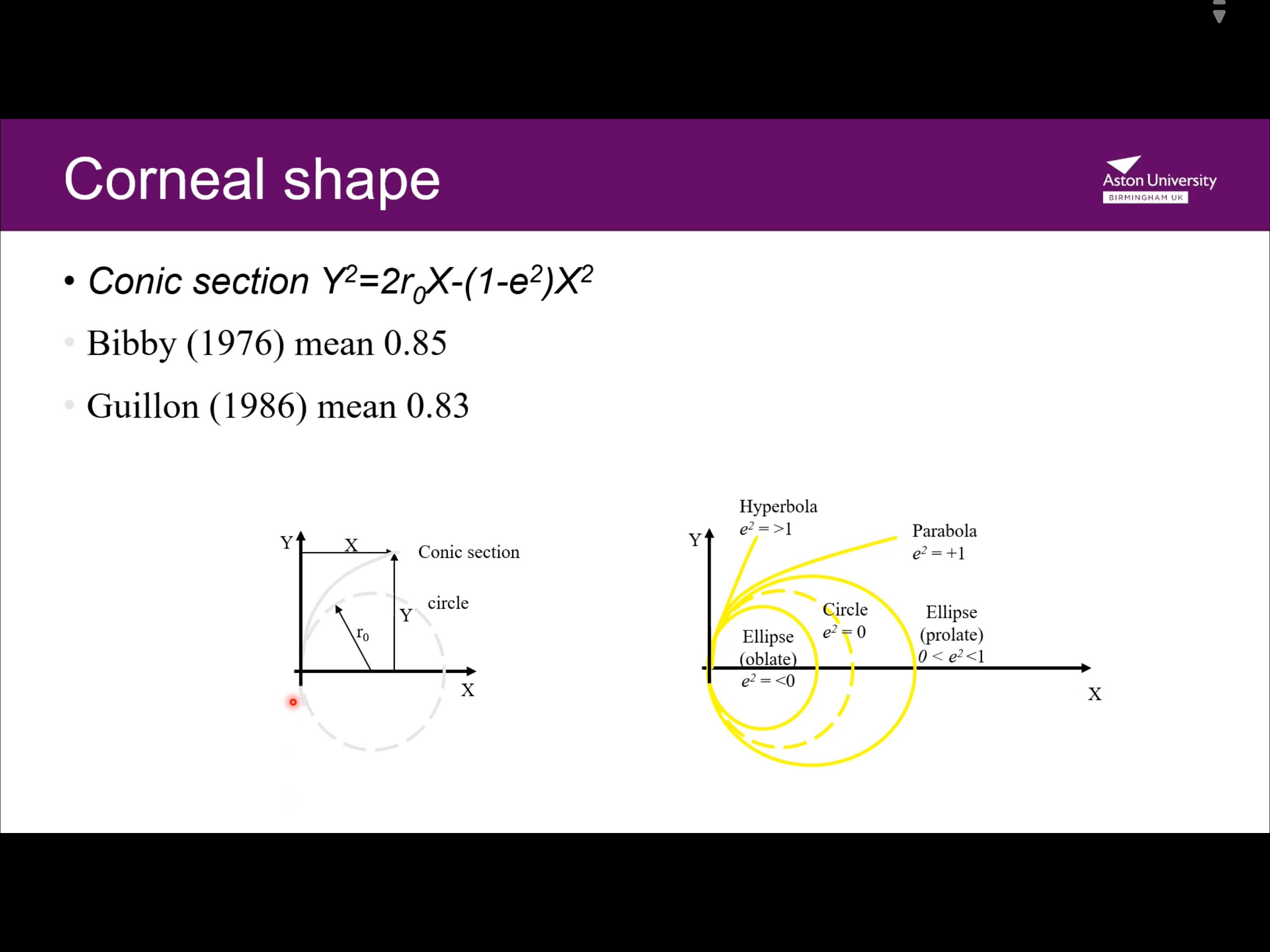
What is the perfect circle?
E2 is not asphericitc at all, equal to 0
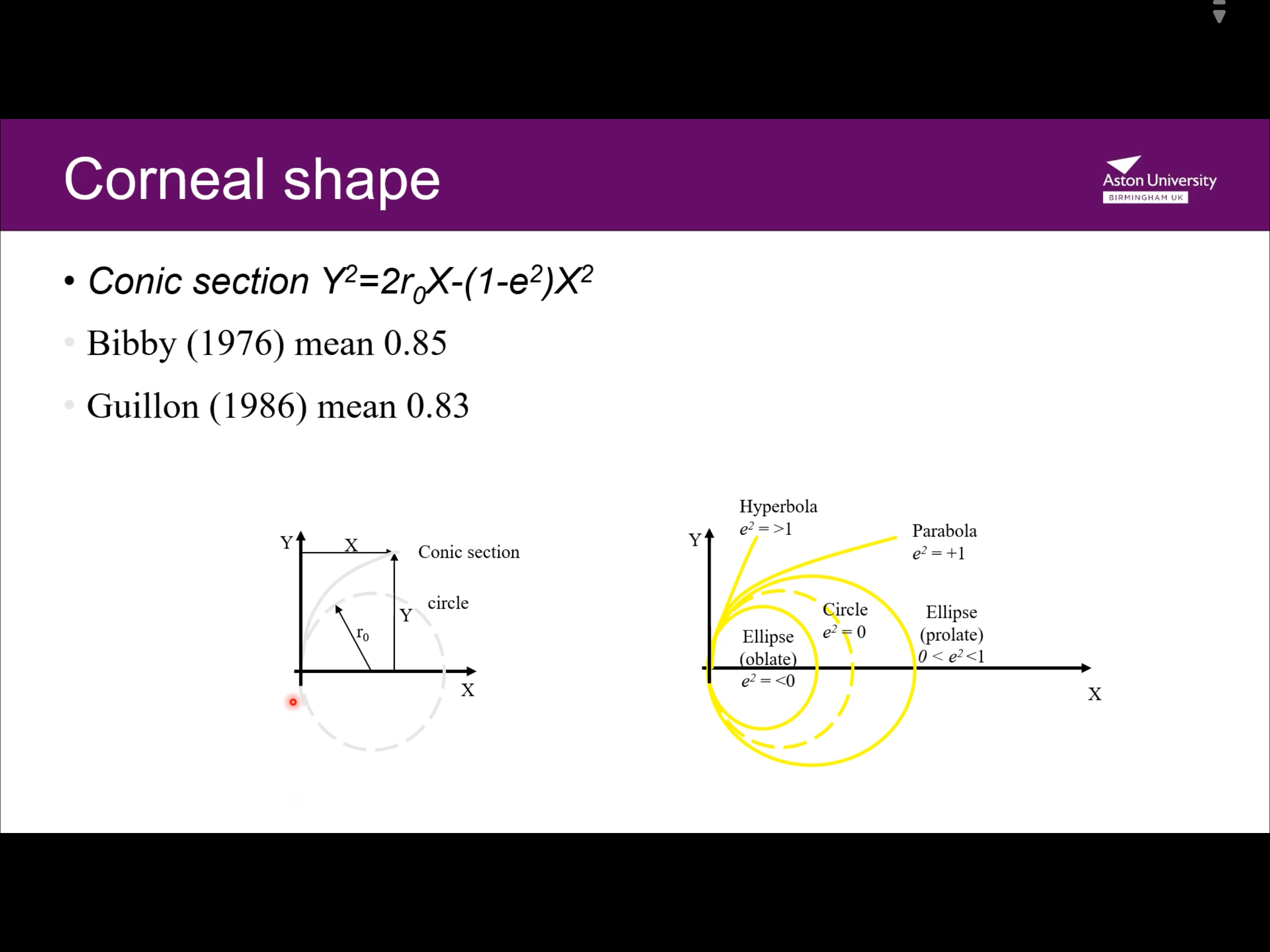
What is an ellipse oblate circle?
E2 is less than 0

What is ellipse prolate?
E2 is less than 1 and more than 0
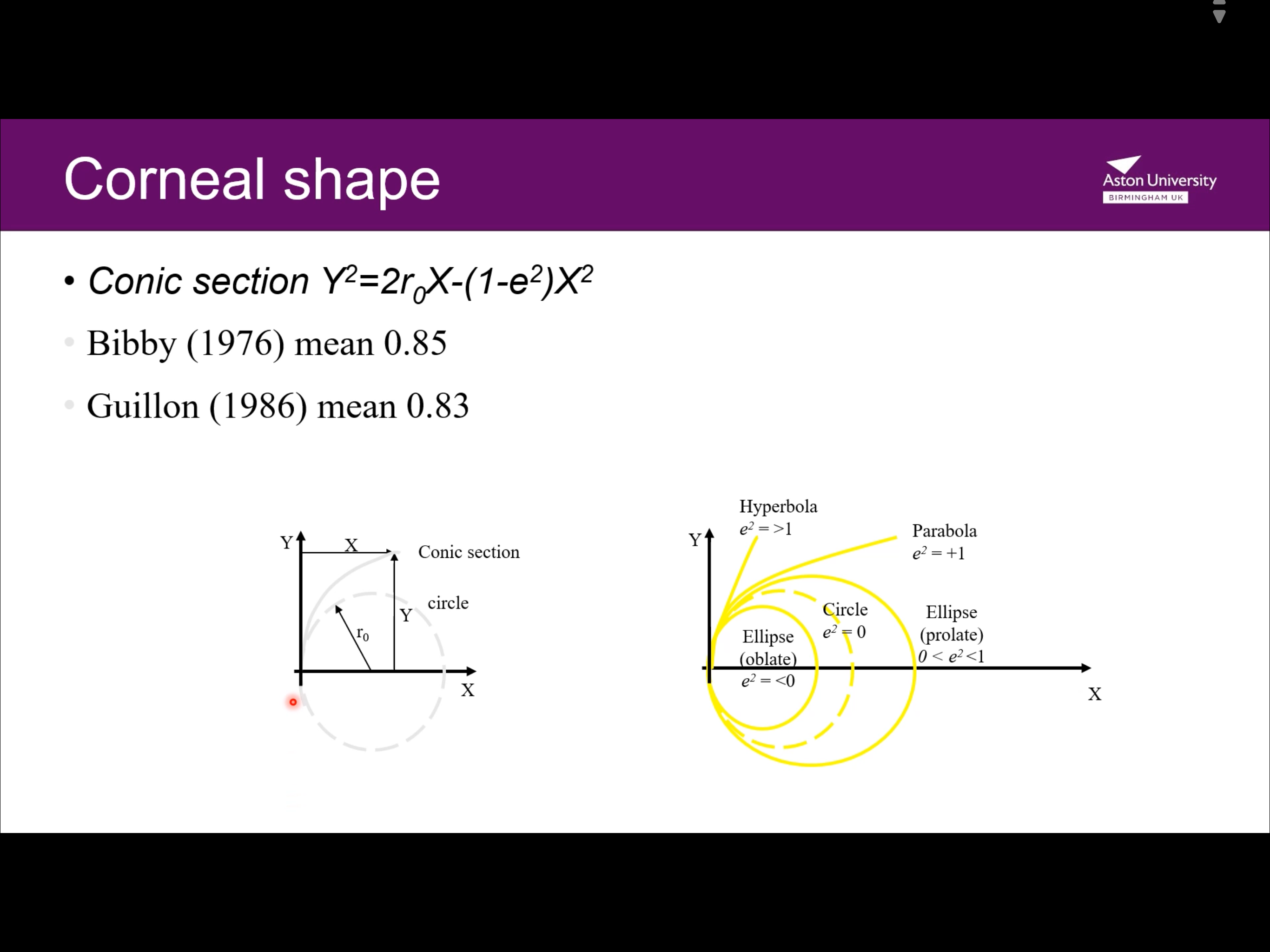
What happens when e2 becomes +1?
It becomes parabola

What happens when e2 becomes more than +1?
Becomes hyperbola
How has corneal curvature been assessed in the past?
Placido used discs with black and white rings in 1880’s to assess irregularities on the cornea
Gullstrand photographed and analysed keratoscope images
What is the placido disc?
Klein keratoscope
+6D lens in centre
Internally illuminated
Purely qualitative

How can we alternatively measure the shape of the cornea?
Inspect image formed by cornea acting as a convex mirror
Done via placido disc, Gullstrand’s and ophthalmometry
ALTERNATIVELY, you can create a profile with a slit of light
How is correct working distance monitored?
Monitored through Schneider disc or similar system
Double image unless exactly aligned which must focus on eyepieces
Axis orientation achieved by rotating mirrors until horizontal limbs of mirror are coincident

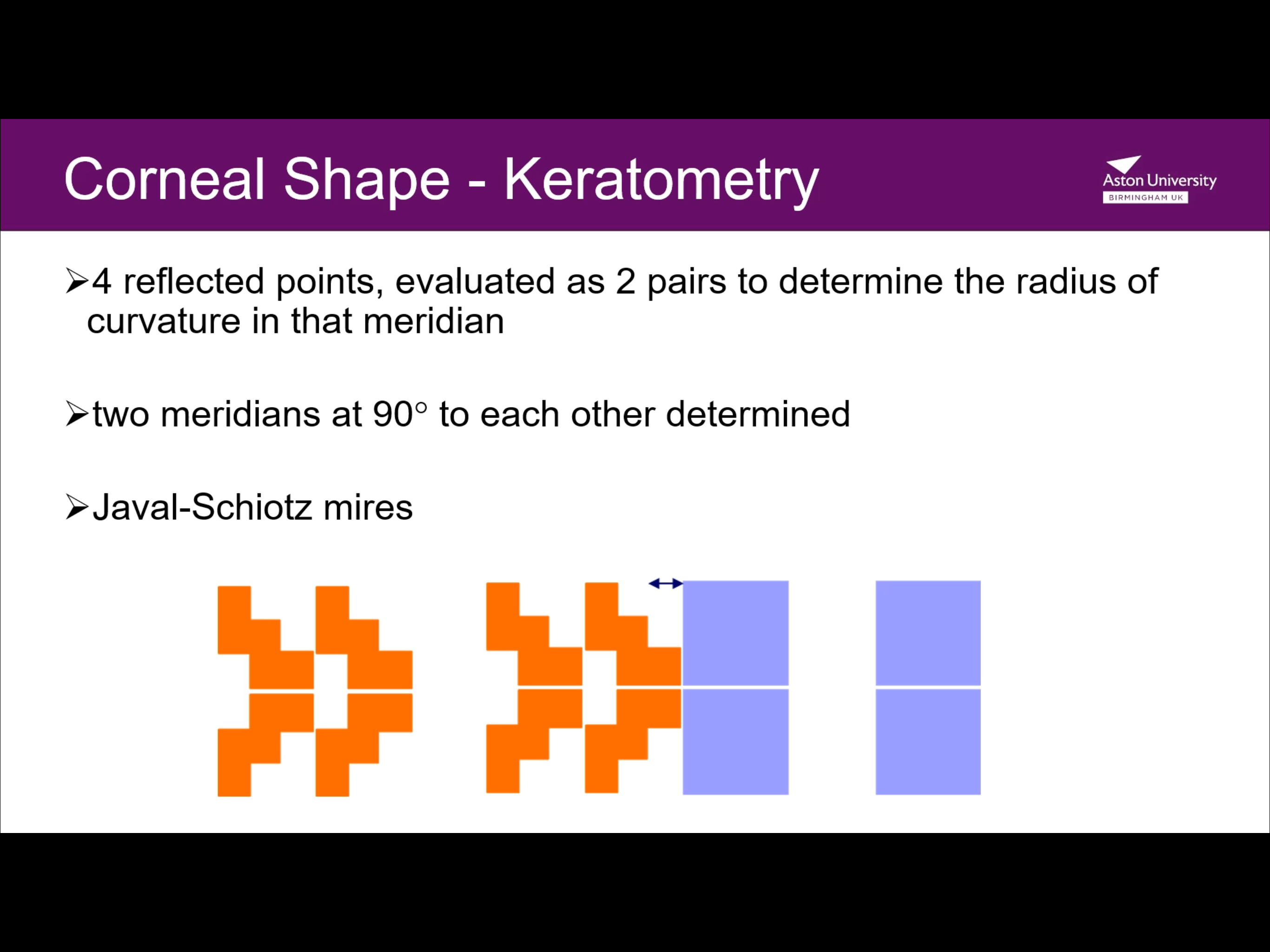
What are Javal-Schiotz mires keratometers?
Has 2 refractive points evaluated as 2 pairs to determine radius of curvature in that meridian
2 meridians at 90 degrees to each other determined
Oranges and purple should only barely touch in the periphery
What do we assume about keratometry?
Assume spherical arc- uniform
Orthogonal axes (lines that intersect each other at right angles)
Back surface of cornea has less than 10% power of front surface power
What are errors when operating keratometry?
Focusing
Proximal accommodation
Misalignment
Orientation of instrument
What are px errors when operating keratometry?
Corneal distortion causes mire distortion
Fixation steadiness- unable to focus eye
What are uses of keratometry?
Baseline data
Measure degree of corneal astigmatism
Measure and select lens choice
Lens flexure- when px blinks see if keratometry reading differs following blink- if px blinks see if lens bends
Post wear oedema/corneal moulding
Contact lens verification
What can we do with video keratometry?
Measures 7-9mm area, various types of display possible, repeatability must be assessed
What are all the inaccuracies with video keratometry?
Image from tears reflects light differently
Dry eyes need drops which affect dispense
Corneal disease
Less coverage and more shadows
Astigmatism more than 1D affects alignment

Where should the eye by aligned?
Centre of entrance pupil most ideal but VK directed towards centre of curvature

What does a corneal map indicate?
Warm colours correspond to steeper corneal radius
Cooler colours correspond to flatter radius
In astigmatism bow tie shape is seen- becomes narrower and more obvious

What’s a corneal map used for?
Corneal maps show corneal curvature and power in 2D image. Useful diagnosis and monitoring corneal conditions and assessing changes in corneal power changed by conditions. Corneal maps larger and more useful for viewing central detail
Less sensitive for measuring corneal curvature

Whats a tangential map used for?
more accurate than corneal maps
Easier to detect localised changes in cornea
Smaller and better for showing true shape of cornea
Used to select best contact kens design for irregular cornea

Why is a corneal map good for laser refractive surgery?
Map denotes the distance of corneal surface
Used for post operative refractive corrections

Demonstrate irregular vs asymmetrical astigmatism.
..
