BIOL2204 Marine Biology - Week 2
 Call Kai
 Learn
 Practice Test
 Spaced Repetition
 Match
 Flashcards
 Knowt Play
1/62

There's no tags or description
Looks like no tags are added yet.
63 Terms
Defining features of Platyhelminthes?
Dorso-ventrally flattened and unsegmented
How many tissue layers do Platyhelminthes have?
Three. They are triploblastic, with an ectoderm and endoderm as well as a true mesoderm.
What type of symmetry do Platyhelminthes have?
Bilateral
Digestive system of Platyhelminthes?
Blind-ended gut. An incomplete gastrovascular cavity with a single opening.
Have a short eversible pharynx to suck up food particles and prey, which is taken into the gut and digested by secreted enzymes.
Nervous system of Platyhelminthes?
Very simple. Shows cephalisation.

Circulatory system of Platyhelminthes?
No circulatory system. Extensive branching of gut distributes nutrients throughout body
Respiratory system of Platyhelminthes?
No specific respiratory structures. Flat body enables effective diffusion of gases across body surface
Excretory system of Platyhelminthes?
Wastes are collected from the body by flame cells. These contain cilia which beat and force fluid through the excretory ducts.

Reproductive system of Platyhelminthes?
All simultaneous hermaphrodites. Can also reproduce asexually via fission.
Do Platyhelminthes have a coelom?
No. They are acoelomates.
How do Platyhelminthes move?
Cilia on ventral surface and muscular contractions cause locomotion
Defining features of Nemertea (ribbon worms)?
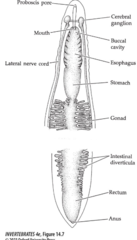
long, tubular, and eversible proboscis.
No segmentation.
Elongate worms.
How many tissue layers do Nemerteans have?
Three. They are triploblastic, with an ectoderm, endoderm, and mesoderm
Do Nemerteans have a coelom?
Pseudocoelomates. Coelom is not like other typical coeloms but is represented by the Rhynchocoel
Rhynchocoel
The fluid-filled cavity in Nemertean worms that houses the eversible proboscis.
Nemertean proboscis
A long, tubular, eversible gut element that sits in the Rhynchocoel.
Digestive system of Nemertea?
Full gut.
Respiratory system of Nemertea?
No respiratory structures. Diffusion across body surface brings oxygen into the body
Nervous system of Nemertea?
Show cephalisation.

Circulatory system of Nemertea?
Closed circulatory system
Reproductive system of Nemertea?
Mainly sexual. Gonochoristic (i.e separate males and females) with external fertilisation.
Most undergo direct development.
What is a pilidium larva?
A result of indirect development in Nemertean worms. This larvae is planktonic and known for its distinctive helmet shape.

Direct development
An organism hatches/is born resembling a miniature version of the adult, without undergoing metamorphosis. There is no distinct larval stage
Indirect development
Offspring undergo a significant transformation, often through metamorphosis, from a larval stage to an adult form
Defining features of Annelida?
repeated body organisation
chaetae and parapodia
muscular body with a muscular gut
How many tissue layers do Annelids have?
Three. They are triploblastic, with an ectoderm, endoderm, and mesoderm
What is the symmetry of Annelids?
Bilateral
Do Annelids have a coelom?
Yes, they are coelomates.
Coelom define
A large, fluid-filled, multi-functional cavity. Coeloms provide many advantages in organisms, including:
- More space for organ development
- Hydrostatic skeleton
- Facilitating circulation of nutrients, gases, and wastes
- Protecting and cushioning internal organs
- Provision of a storage reservoir for gametes, nutrients, and wastes
What is the primary function of the coelom in Annelids?
A hydrostatic skeleton to provide support and aid in movement. Circular and longitudinal muscles contract against the coelom to cause the body to elongate or contract and therefore move
Nervous system of Annelids?
Contain a well-developed nervous system with cephalisation.

Digestive system of Annelids?
Contains a full gut with a complete digestive tract with regional specialisation.
Circulatory system of Annelids?
Circulatory system is closed

Respiratory system of Annelids?
No specific respiratory structures, gas exchange occurs by diffusion through body wall.
Reproductive system of Annelids?
Mainly sexual reproduction (gonochoristic or hermaphroditic).
Phylum: Annelida, Class: Polychaeta - Key characteristics
Bristle worms - have bristles/chaetae.
Parapodia present.
Sensory appendages on head (cephalic appendages).
Polychaeta body structure
Body split into two sections, the head and the trunk.
The head has a projection anterior to the mouth called the prostomium.
Prostomium
The most anterior part of an annelid worm's body, it lies anterior even to the mouth. In polychaetes, the prostomium usually has palps and/or tentacles and often has eyes.
Peristomium
The first true segment on the body of an annelid worm. It lies posterior to the mouth.
Parapodia
The lateral extensions of the body wall found on the body segments
They are frequently used for locomotion, but aid in respiration, excretion, protection, and sensory information.
Polychaeta feeding strategies?
Can be predators, scavengers, herbivores, suspension feeders, or deposit feeders.
Polychaeta reproductive strategies?
Polychaetes do not have permanent gonads. Gametes are produced from cells lining the coelom and mature in the body cavity.
Trochophore larvae
The form of a fertilised egg in Annelids and Molluscs.
Planktonic, free-swimming larvae
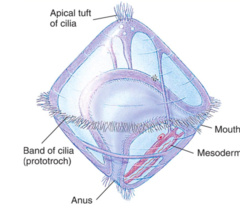
Polytroch larvae
The second stage of Polychaete trochophores.
The larvae elongate as they grow and start to become segmented.

Phylum: Annelida, Class: Polychaeta, Sub-class: Echiura
Spoon worms.
Unsegmented worms with a proboscis that cannot be retracted.
No parapodia.
Phylum: Annelida, Class: Sipuncula
Peanut worms.
Unsegmented worms.
Contain a large coelom
eversible proboscis
Defining features of Mollusca?
The mantle - a mass of soft flesh that covers the soft body and encloses the internal organs.
muscular foot that is specialised for different functions

Mollusca symmetry
Bilateral
Shell types of Mollusca
Shell is often hard calcium carbonate to protect the soft bodies. They include:
- External shells (gastropods, bivalves, some cephalopods)
- Internal shells (some cephalopods)
- No shells (slugs and some octopus)
Do Molluscs have a coelom?
Yes, a reduced coelom
How many tissue layers do Molluscs have?
Three. They are triploblastic
Digestive system of Mollusca?
has a radula - a chitinous ribbon of teeth protruded through the mouth to scrape or pierce food sources.
full gut
Respiratory system of Mollusca?
Occurs through gills in most; can occur by diffusion through the wall of the mantle cavity.
Circulatory system of Mollusca?
An open circulatory system (minus cephalopods) with a three-chambered heart.
Veliger
The final larval stage of certain molluscs

Radula
A chitinous ribbon of teeth protruded through the mouth to scrape or pierce food sources. Housed in the radular sac.
Anatomy of a mussel
- Muscular foot - a long, brown muscle.
- Adductor muscles (posterior) - thick, white, solid muscle. Used to clamp the organism together
- Retractor muscles (anterior) - thinner muscles that connect to the abductors.
- Mantle - the flesh lining the mussel. Completely encloses the animal
- Pericardium - a window in the mantle that houses the heart
- Gills/Ctenidia - fleshy sacs covered with veins that line the inner mussel
- Labial palp - a fleshy structure covered in cilia that aids in feeding and filtering
- Byssal threads - protein-based filaments that are secreted by the muscular foot; enable anchoring to a hard substrate

Polyplacophora shell (Class: Mollusca)
Eight overlapping plates
Muscular foot differentiation between Mollusca classes
- Bivalve: Paddle-shaped foot for burrowing
- Gastropod: Flat structure used to crawl
- Cephalopod: Modified into tentacles used for locomotion and grabbing
- Scaphopoda: Similar to bivalves
- Polyplacophora: Similar to gastropods
Bivalve shell (Class: Mollusca)
Two hinged shells/valves
Gastropod shell (Class: Mollusca)
Single, asymmetrically coiled shell
Cephalopod (Class: Mollusca)
Symmetrically coiled when external; otherwise internal/reduced
Scaphopoda (Class: Mollusca)
Tubular, tusk shaped shell