PSYCHOLOGY UNIT3AOS1 - CH2-3 - the nervous system
 Call Kai
 Learn
Learn Practice Test
 Spaced Repetition
 Match
Match Flashcards
 Knowt Play
1/122

There's no tags or description
Looks like no tags are added yet.
Name | Mastery | Learn | Test | Matching | Spaced | Call with Kai | Chat |
|---|
No analytics yet
Send a link to your students to track their progress
123 Terms
afferent
conducting or conducted inwards or towards something
autonomic nervous system
a subdivision of the peripheral nervous system that connects the central nervous system to the body's internal organs and glands, providing feedback to the brain about their activities.
it is self regulating and therefore occurs without conscious effort and it is not usually under our voluntary control e.g. digestion
it keeps vital organs and systems of body functioning
consists of 3 distinct divisions that counterbalance each others activities but generally have opposite effects
brain
an intricate network of cells that plays a vital role in processing information received through nerve pathways from the body and in directing actions within the body
central nervous system
comprises of the brain and spinal cord. the main function is to process info recieved from the bodys internal and external environment and activate appropriate responses.
it doesn’t have direct contact with the outside world.
MEMORY TOOL: lollipop: head = brain, stick = spinal cord
conscious response
a reaction to a sensory stimulus that involves awareness, usually voluntary, since the brain is dominant, goal-directed and with some degree of control over it.
e.g. external stimuli: sun shining - put on sunglasses
e.g. internal stimuli: stomach ache - go see a nurse
dopamine
a neurotransmitter and hormone known as the brain's "feel-good" chemical, that plays major role in for voluntary movement, pleasure, motivation, memory, movement, appetite, and reward based learning. can have excitatory and inhibitory effects on the post synaptic neuron, depening on the type of receptor sites present at the particular brain location.
enteric nervous system
a sub-division of the autonomic nervous system embedded within the walls of the gastrointestinal (digestive) tract and dedicated to its functioning
efferent
conducted or conducting outwards or away from something
excitatory effect
when a neurotransmitter stimulates or activates a postsynaptic neuron to perform its functions; compare with inhibitory effect
gamma-amino butyric acid (GABA)
the primary inhibitory neurotransmitter in the central nervous system, making postsynaptic neurons less likely to fire, by fine tuning neurotransmission in the brain.
without the inhibitory effect of GABA, activation of postsynaptic neurons might get out of control, this activation could spread throughout the brain, causing seizures
the inhibitory activation of GABA normally counterbalances the excitatory activity of glutamate and vice versa
MEMORY TOOL: no one is excited to see ABBA
glutamate
the main/primary excitatory neurotransmitter in the CNS, thereby enhancing information transmission by making postsynaptic neurons more likely to fire.
involved in most aspects of normal brain functioning, including perception, learning, memory, thinking and movement.
too much or little can be harmful to neurons and basic brain functioning
2nd most abundant neurotransmitter in the brain
MEMORY TOOL: GLUTAMATE = ACTIVATE OR YOUR EXCITED TO SEE A MATE
inhibitory effect
when a neurotransmitter blocks or prevents a postsynaptic neuron from firing and therefore performing its functions
interneuron
a neuron which transmits impulses between other neurons, especially as part of a reflex arc
long-term depression
the long-lasting decrease in the strength of synaptic connections and transmission and neuronal response
the weakening/elimination of unused syanpses through LTD may prune unimportant/unwanted connections, leaving only the important connections that have been strengthened through repeated use by LTP
Allows us to correct our thinking when solving a problem or to adjust our movments when learning a new skill
e.g. when you are taught the correct technique for a skill (such as how to throw a basketball) the memory of the old technique will gradually fade with disuse.
long-term potentiation
the long-lasting enhancement of synaptic transmission due to repeated strong stimulation.
results in enhanced or more effective synaptic transmission
improves the ability of 2 neurons - a presynaptic and postsynaptic neuron, to communicate with one another at synapse
this enables post synaptic neurons to be more easily activated
the more we use info being remembered, the more LTP process strengthens the pathway making it easier to retrieve that info
MEMORY TOOL:neurons that fire together wire together
motor neuron
a nerve cell forming part of a pathway along which impulses pass from the brain or spinal cord to a muscle or gland
nervous system
complex, highly organised network of specialised cells that enables the brain to receive information about what is going on from both inside and outside the body and to respond appropriately
nervous system and subdivisions photo
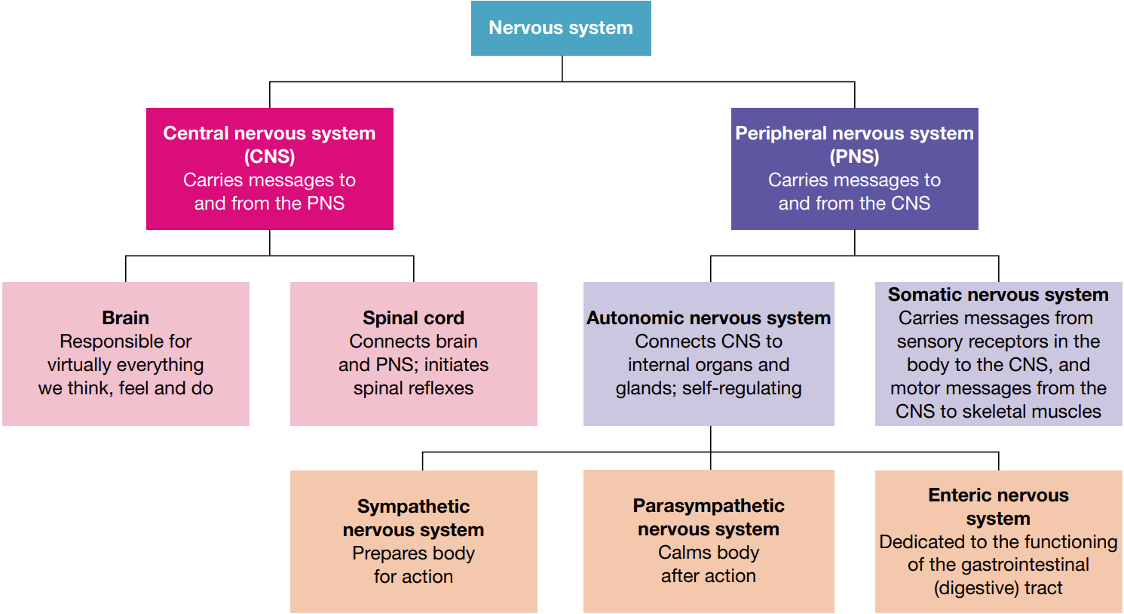
what are the main roles of the nervous sytem?
receive info (inside and outside the body)
process info
coordinate a response to info
neural pathway
a route based on interconnected neurons that form a communication network within the brain and between the brain and other parts of the nervous system and body.
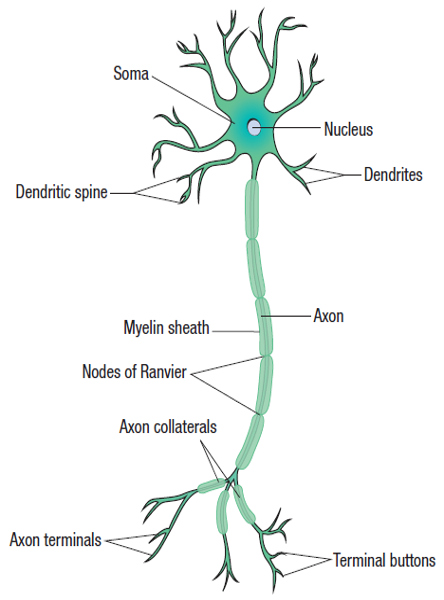
Information travels one way through a neuron, beginning at the soma as an electrical signal.
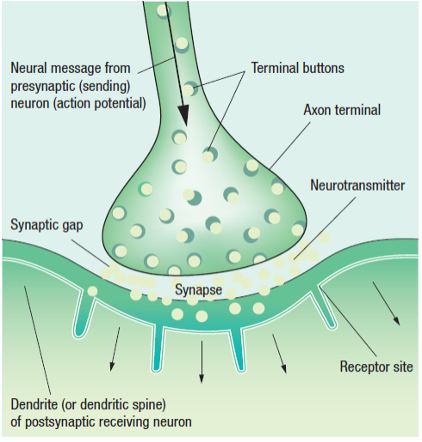
At the axon terminals, the presynaptic neuron releases neurotransmitters into the synaptic gap, which are then received by the dendrites of the postsynaptic neuron.
Multiple axon terminals allow one neuron to send messages to many neurons at once.
neural synapse
the site where communication typically occurs between adjacent neurons
neuromodulator
a neurotransmitter that can influence or ‘modulate’ the effects of other neurotransmitters.
Released slwoly and broadly outside synapses into neural tissue, affecting many neurons at once.
Act more slowly than fast excitatory and inhibitory neurotransmitters.
Influence the brain’s overall state (e.g. alertness and sleep).
Modulate specific brain regions by altering neurotransmission.
Control the release and synthesis of other neurotransmitters.
Modify the effects of neurotransmitters.
neuron
an individual nerve cell specialised to receive, process or transmit information. the entire nervous system is comprised of neurons organised into networks that form neural circuits and pathways.
they transmit info (‘neural messages’) to appropriate part of the nervous system
they have specialised functions and vary in shape and size, depending on where they are located and on specific function, however most neurons typically have structural features in common.
neuron structure diagram
synaptic gap diagram
neurotransmission
the transmission of nerve impulses between neurons or between a neuron and a muscle fibre or other structure
neurotransmitter
a chemical substance produced by a neuron that carries a message to other neurons or cells in muscles, glands or other tissue; compare with neurohormone.
they bind to receptor sites on postsynaptic neurons specialised to receive that specific neurotransmitter
neurotransmitters that DO NOT bind to receptors in the postsynaptic neuron are absorbed back into the terminal buttons by presynaptic neuron in a process called reuptake.
some also occur as hormones (serotonin and dopamine).
parasympathetic nervous system
a sub-division of the autonomic nervous system that calms or restores the body to its normal state of functioning after the need for sympathetic nervous system activation has passed.
heart rate and blood pressure decrease to normal, breathing rate normal, sugar and fat release are minimised, pupils constrict, sweat gland decrease, digestion increased to normal.
dominates most of the time, as its involved in routine activities
takes longer to restore body to normal state compared with sympathetic nervous system’s immediate activation.
peripheral nervous system
entire network of nerves located outside the central nervous system; main function is to transmit sensory information to the CNS from the bodies sensory organs, muscles, internal organs and glands, and motor info from the CNS to the body’s muscles, organs and glands. it done through its 2 main subdivisions (SNS & ANS)
pruning
the elimination of weak, ineffective or unused synapses (and therefore connections to other neurons).
the synapses that are not frequently used will decay and disappear. the entire process is explained by ‘use it or lose it’
this elimination is a naturally occuring process starting in early childhood
MEMORY TOOL: the way a gardener prunes a tree/bus to give the plant a desired shape so it can flourish.
rerouting
when new connections are made between neurons to create alternate neural pathways.
may involve existing synaptic connections and/or new connections from the sprouts
sensory stimuli
any event or object that is received by the senses and elicits a response from a person
sensory neuron
nerve cells that are activated by sensory input from the environment
sensory receptor
specialized nerve endings or cells that detect specific stimuli (e.g. light, sound) from the in/external environment
central nervous system
brain and spinal cord. processes info recieved from bodys internal and external environments and activates appropriate responses. no contact w/outside world.
serotonin
a neurotransmitter or neuromodulator with important roles in mood, emotional processing, sleep onset, appetite and pain perception.
low levels = mental disorders e.g. depression
only has inhibitory effects therefore doesnt stimulate brain activity, counterbalancing excessive excitatory effects of other NTM.
widely described as a mood stabiliser. the right amount is required for us to feel positive, calm and have a stable mood.
released in volume transmission not direct, point to point synaptic junctions, therefore influences larger populations of neurons
somatic nervous system
a sub-division of the peripheral nervous system that carries sensory information to the central nervous system and motor information from it
What are the main roles of the somatic nervous system?
sensory receptors on the lower leg detect the electrical signals/stimulating electrode
sends sensory/afferent messages from the leg to the spinal cord
sends motor/efferent messages from spinal cord to soleus
allows us to receive sensory info and respond to it:
sensory (afferent) info is received at sensory receptor sites in the body (skin, muscles, joints and tendons) and carried along sensory neural pathways by sensory neurons to the spinal cord
motor (efferent) info is carried along motor neural pathways by motor neurons to skeletal muscles to control their activity by causing them to contract or relax, allowing for voluntary movements.
MEMORY TOOL: SAME - Sensory = Afferent, Motor = Efferent
spinal reflex
an unconscious, involuntary response to certain stimuli, initiated within the spinal cord and controlled solely by neural circuits
e.g. if you touch a hot pan, you automatically withdraw your hand to release the handle before sensory information (pain) is experienced.
sensory neurons - interneurons - motor neurons
sensory receptor sites detect sensation and neural information travels to spinal cord
spinal cord transmits neural info from sensory to motor neurons via interneurons
motor neural info is transmitted to skeletal muscle for movement
what type of response is the spinal reflex?
an adaptive response - as enables a faster reaction time, saving time in a situation that may be harmful to the organism (protect).
shows that a response to a particular sensory stimulus can have both an unconscious and conscious component.
spinal cord
a long, thin bundle of nerve tissue connecting the brain and rest of the body via the peripheral nervous system; initiates simple reflex responses independently of the brain.
what are the 2 main functions of the spinal cord?
receive sensory information from the body (via PNS) and send these messages to the brain for processing
receive motor info from the brain and send it to relevant parts of the body (via PNS) to control muscles, glands and internal organs so actions can be taken
occurs through interconnected neurons that form nerve pathways.
sprouting
the creation of new extensions on a neuron to allow it to make new connections with other neurons.
occurs through the growth of nerve endings (sprouts) on axons or dendrites, thereby enabling new links to be made, including rerouting of existing connections.
synaptic plasticity
the ability of a synapse to change in response to experience
enables change involving the strengthening or weakening of connections between the neurons at a synapse.
Strengthening: occurs through continual use of synaptic connections or through the growth of new, additional connections
Weakening: occurs through disuse of synaptic connections, resulting in the decay or elimination of a synapse
synaptic gap
the tiny space between the axon terminal of a presynaptic neuron and the dendrite of a postsynaptic neuron
sympathetic nervous system
a subdivision of the ANS that activates internal muscles, organs and glands to prepare for vigorous activity or to deal with a stressor, fear stimulus, threat or emergency.
what are the main roles of the sympathetic nervous sytem?
provides immediate response to help prepare the body to survive a threat
activates the adrenal glands to release hormones e.g. adrenaline into bloodstream
these hormones circulate throughout your body activating various muscles, organs and other glands in preparation for dealing with stress or a potential threat
heart rate and blood pressure increase to allow move blood to muscles, pupils dilate to allow more light, sweat glands, increase and digestion is slowed down.
unconscious response
a reaction to a sensory stimulus that does not involve awareness; involuntary, unintentional, automatic and we cannot ordinarily control its occurrence
e.g. ANS resposes, as well as spinal reflex responses.
e.g. if you stand on something sharp, you move your foot wihtout thnking
acute stress
a form of stress characterised by intense psychological and physiological symptons that are brief in duration.
this presents and immediate threat to an organisms safety
adrenaline (epinephrine)
a hormone and neurotransmitter produced by the adrenal glands that helps you react quickly to danger, stress, or excitement. e.g. fff response
alarm reaction
the first stage of the General Adaptation Syndrome in which the body goes into a temporary state of shock, then rebounds (counter shock), following initial awareness of a stressor
chronic stress
a form of stress that endures for several months or longer/ a prolonged period of time.
e.g. a school year causing lasting stress throughout the year as try to balance studying for tests with social activities, etc.
does not demand an immediate response (like FFF) but rather a long-term biological response that will energise the body over a longer period of time
cortisol (chronic stress)
Cortisol is a hormone that is released in times of stress to aid the body in initiating and maintaining heightened arousal.
Secreted by adrenal glands.
Boosts energy during stress (releases glucose, raises blood sugar).
Released slowly, stays longer than adrenaline.
Supports prolonged stress (metabolism, energy, reduces inflammation).
Long-term high levels suppress immunity and reduce stress coping.
coping
in relation to stress management, attempting to manage the demands of a stressor in some effective way
coping strategy
a specific method used to manage or reduce the stress produced by a stressor
cortisol
a hormone secreted from the adrenal glands in response to a stressor
counter shock
The body then quickly rebounds from this low level, where the sympathetic nervous system is activated and the body’s resistance to the stressor increases through the release of adrenalin, noradrenalin and cortisol.
-A fight-flight reaction is produced, where heart rate increases, breathing rate increases, blood is diverted to muscles, etc.
external stressor
a stressor which originates outside the individual from situations and events in the environment.
e.g. having too much homework, being nagged by parents etc.
NOTE: internal stressors and external stressors don’t always work in isolation , instead, it is quite common for both internal and external stressors to contribute to somebody experiencing the stress response.
fight-or-flight-or-freeze response
an involuntary, bodily response to a sudden and immediate threat (or stressor) in readiness for fight (confront), flight (escape) or freeze (be silent and unseen). BIOLOGICAL PROCESS
internal stressor
a stressor that originates within the individual
e.g. a personal problem that causes concern about the potential consequences
NOTE: internal stressors and external stressors don’t always work in isolation , instead, it is quite common for both internal and external stressors to contribute to somebody experiencing the stress response.
noradrenaline
a hormone that is released by the adrenal medulla and by the sympathetic nerves and functions as a neurotransmitter
shock (in alarm reaction)
•Shock - At first, the body goes into a temporary state of shock, and its ability to deal with the stressor falls below its normal level.
-Physiologically, the body reacts as if it were injured (blood pressure and body temperature drop, and a temporary loss of muscle tone is experienced).
-Eg. Someone fainting when first given bad news, or a momentary feeling of helplessness.
stress hormone
a hormone thought to be involved in the body's response to stress, especially cortisol, adrenaline (epinephrine), and noradrenaline (norepinephrine)
stressor
a stimulus that produces stress
stress response
the emergency reaction system of the body
neurotransmitters (NTM) vs neuromodulators (NMD)
NTM transmit across a synapse wheres NMD transmit across a larger area of tissue
NTM have a direct effect on their target cell receptors whereas NMD can indirectly influence multiple receptors
NTM have shorter effects whilst NMD have long lasting effects
NTM are used to trigger a specific inhibitory or excitatory response whereas NMD modulate/regulate neural activity
different types of neurons

define learning
involves the acquisition of new info, behaviour or abilities through experience.
it may occur with or without conscious awareness and is evident by change in behaviour, knowledge or brain function.
for learning to have occurred, the new knowledge/skill must be retained in memory
neural plasticity
the ability of the brain’s neural structure or function to be changed by experience throughout the lifespan.
•Neurons change in shape and function to represent and store information so that we can learn and remember, providing the physiological basis of learning and memory.
•The brain of a developing individual is more plastic than that of an adult
E.g. A young person will learn a new language more quickly and recover more quickly from brain damage due to the greater plasticity of their brains.
Hebb’s rule of ‘rewiring’ (donald hebb 1949)
•Interconnected groups of neurons form networks or pathways and The constant activation of a neural pathway results in that pathway being strengthened.
Neurotransmitters are repeatedly sent across synaptic gap.
Pre- and post-synaptic neurons are repeatedly activated at the same time.
This changes the structure of the synapse, strengthening the connection between the two neurons at the synapse.
This makes them more likely to fire together and to transmit their message more forcibly and efficiently.
LTP & LTD
glutamate has a vital role in LTP & LTD
Generally the more often that glutamate can excite an adjacent neuron, the more it contirbutes to LTP and vice versa for LTD
•Although LTP and LTD have opposite outcomes, there are a number of similarities. For instance:
-both are activity-dependent; that is, more or less activity. persistent, experience-driven changes in synapse strength that underlie learning and memory.
-both involve glutamate
-both occur at glutamate synapses
-both involve changes in excitability
-both have long-lasting effects
-both are forms of long-lasting neural plasticity.
stress
a state of physiological & psychological arousal produced by stressors that are perceived by the individual as challenging or exceeding their ability/resources to cope
stressor is a stimulus that causes or produces stress and challenges our ability to cope
stress is a psychobiological process
psychological components: our personal assumptions of what contributes to a stressful situation, their unique processes
physiological components: are mostly consistent between different people experiencing a stress response between different people experiencing a stress response
e.g. when watching horror movies, most people will experience an increase in heart rate at scary points. This increase in heart rate is a physiological response triggered by the nervous system and is a fairly consistent response regardless of the person experiencing it.
psychological stress responses
relates to how we think or feel about a stressor and differs between different people.
the same stressor can cause someone to experience a positive psychological state (e.g. excitement), while at the same time cause someone else to experience a negative psychological state (e.g. worry).
eustress and distress reflect the psychological nature of the stress response.
eustress
a postive psychological stress response
involves emotions such as being happy and excited
usually occurs when the stressor provides a positive opportunity
distress
a negative psychological stress response
involves emotions such as being worried and upset
usually occurs when the stressor is a negative circumstance
eustress and distress
both are psychological stress responses
illustrate the subjective nature of the stress response
cause a physiological stress response that can enhance performance
fight or flight
to prepare body for fighting or fleeing threat, all energy is directed from non-essential body systems to those systems that will help us escape.
both are initiated by the sympathetic nervous system and involves changes like:
increased heart rate and blood pressure
redistribution of blood supply from skin/intestines to muscles
increased breathing rate (to increase oxygen supply) etc.
what is the 1st set of biological processes that occur during the fight or flight reactions?
When threat is percieved, the following biological processes occyr to activate fight/flight reponse:
threat is percieved by the amygdala which sends a signal to the hypothalamus
the hypothalamus activates the sympathetic nervous system
the SNS stimulates the adrenal medulla (inner oart of adrenal gland)
the adrenal glands secrete stress hormones into the bloodstream. these include adrenaline (epinephrine) and no-adrenaline (norepinephrine)
these horones circulate in the blood stream activating various organs and resulting in th bodily changes that characterise the fight and flight reactions (ie. increased heart rate, increased breathing etc.)
what is the 2nd set of biological processes that occur during the fight or flight reactions?
Next, in the 2nd part of the stress response
the hypothalamus stimulates the nearby pituitary gland to initiate a process (called the HPA axis) for secretion of additional stress hormones
these hormones are relesed from the outer layer (cortex) of the adrenal glands
cortisol is the most abundant of these hormones. it acts more slowly and is longer lasting then adrenaline and noadrenaline, but it also prepares the body for action and it helps it stay revved up and on high alert.
the changes with fight/flight occur within seconds therefore allowing us to quickly respond to threat
once the threat has passed, the parasympathetic system calms and restores normal functioning
fight or flight reactions diagram

freeze reactions
the initial part of the freeze state is labeled as the ‘stop, look, listen’ behavioural response.
body movements and vocalisations stop
the racing heart slows, blood pressure drops very quickly
tense muscles collapse & become still
there is a reflexive, ‘orienting response’ of the head or eyes towards the direction of the threat
hyper vigilance. being on guard, watchful or extremely alert
-the apparent frozen state of the body is called the tonic immobility and is to considered to have adaptive value
e.g. prey that remain ‘frozen’ during a threat are more likely to avoid detection or increase the chance of escaping
this state also conserves energy until a predator loses interest. when this occurs, the animal can use excess energy to escape.
in some cases however, freezing when fearful is not adaptive:
-e.g. when fear causes a job candidate a student’s mind during an important exam
biological processes underlying the freeze state aren’t fully understood
It is believed that sympathetic nervous system activation always precedes (comes before) the freeze state and becomes a part of this state.
When the freeze reaction is initiated, the energy-conserving ‘rest and relaxation’ actions of the parasympathetic nervous system dominate over the existing effects of the sympathetic nervous system activation.
This leaves the organism in a physiological state involving high arousal of both the sympathetic and parasympathetic systems
-This allows for both energy conservation and a mobilised state ready for action when an animal takes the opportunity for flight after having been in a frozen state, it can very quickly escape by switching to the highly energised state of full sympathetic system arousal.
parasympathetic nervous system in the fight flight or freeze
•Both the sympathetic and parasympathetic nervous systems are activated as part of this initial, unified response.
•The sympathetic nervous system becomes dominant during the fight-or-flight response.
•The parasympathetic nervous system takes control during the freeze response.
•The freeze response is characterized by:
•Immobility
•Heightened arousal
•Alertness
Tension.
a comparison of the biological symptoms of acute and chronic stress
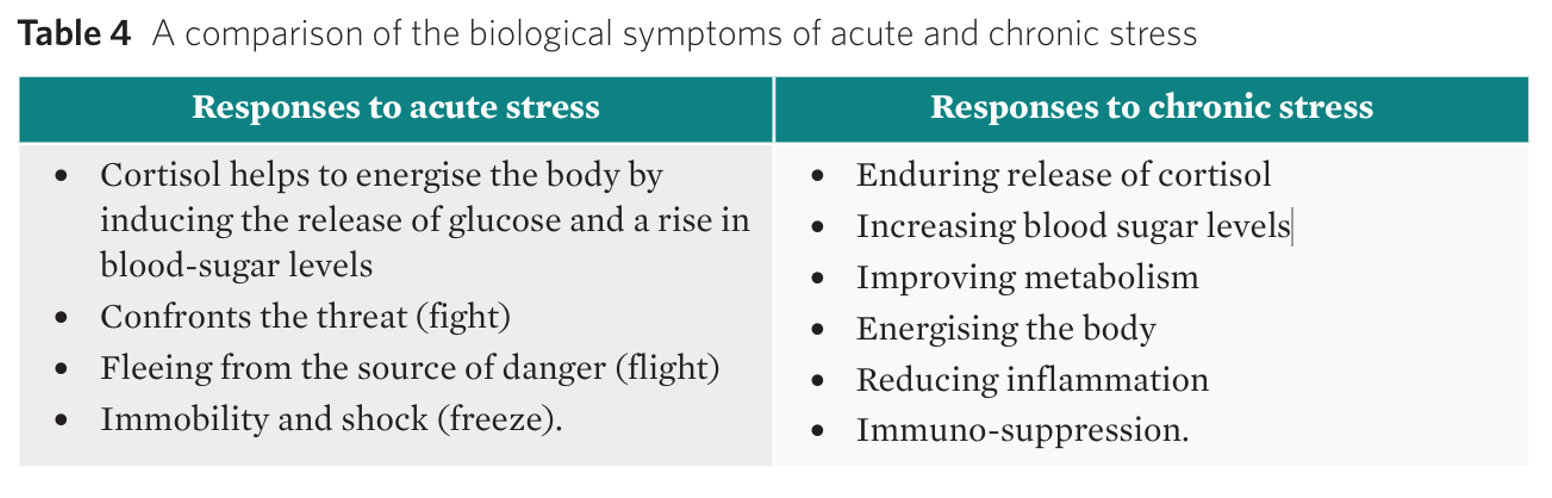
prolonged high levels of stress
•With long-term stressors, the HPA axis continues to be active and cortisol remains in the bloodstream at a high level.
•The effects of the excessive amount of cortisol over a prolonged time include:
-impaired immune system functioning and thereby increased vulnerability to disease
-build up of fat tissue and weight gain
-physical health problems including colds, flu, hypertension (high blood pressure), blood sugar imbalance, atherosclerosis (hardening of the arteries), cardiovascular disease and diabetes.
-impaired cognitive performance, learning problems, impaired memory formation and recall, and mental disorders such as depression, post-traumatic stress disorder and other anxiety disorders
Selye’s general adaptation syndrome (GAS)
is a biological model involving three stages of physiological reactions that a person experiences in response to a persistent stressor.
•It explains the experience of stress from a biological perspective.
•Selye identified a predictable pattern of physiological responses that an individual endures when experiencing stress.
•He developed the GAS, which is a model of stress that reflects this biological pattern through three stages: alarm reaction, resistance, and exhaustion.
diagram of GAS model

stages of the GAS model
•The GAS comprises a brief alarm reaction stage (with shock and counter shock), a prolonged stage of resistance and a final stage of exhaustion.
•Memory tool: The GAS explosion gave me a SCARE
(Shock, Counter shock) Alarm reaction, Resistance, Exhaustion

stage 1 of the GAS model: ALARM reaction
an initial response which occurs when the person first becomes aware of the stressor and results in a state of readiness to respond to the stressor.
•This stage comprises two sub-stages:
-Shock
-Counter shock
stage 2 of the GAS model: RESISTANCE reaction
The body’s resistance to the particular stressor rises above normal.
•The intense arousal of the alarm reaction stage diminishes, but physiological arousal remains at a level above normal with adrenalin and cortisol continuing to be released into the bloodstream to further energise the body.
-Cortisol suppresses immune system activity, so its continuing presence at an abnormally high level interferes with the body’s ability to fight disease and to protect itself against further damage.
-Even though the ability to adapt to and deal with the effects of the initial stressor increases during this stage, resistance to other stressors, such as illness or disease, may decline.
•If the effort to deal with the initial stressor during the
resistance stage is successful, the organism will have
adapted to the stressor and the body eventually
returns to its normal ‘balanced’ state of functioning
stage 3 of the GAS model: EXHUASTION reaction
•If the stressor is not dealt with successfully during the resistance stage, and stress is not relieved, the body may reach a stage of exhaustion
•Stage 3: Exhaustion - the body cannot sustain its resistance and the effects of the stressor can no longer be dealt with.
•Because the organism has been trying to deal with the stressor for a prolonged time, its resources have been severely depleted, its resistance to disease is very weak, and it becomes more vulnerable to physical and mental disorders, including:
-Extreme fatigue, high levels of anxiety, symptoms of depression, sleep disturbances.
-Hypertension, gastrointestinal problems, heart disease, death.
An example of someone progressing through the stages and substages of the GAS model (alarm)
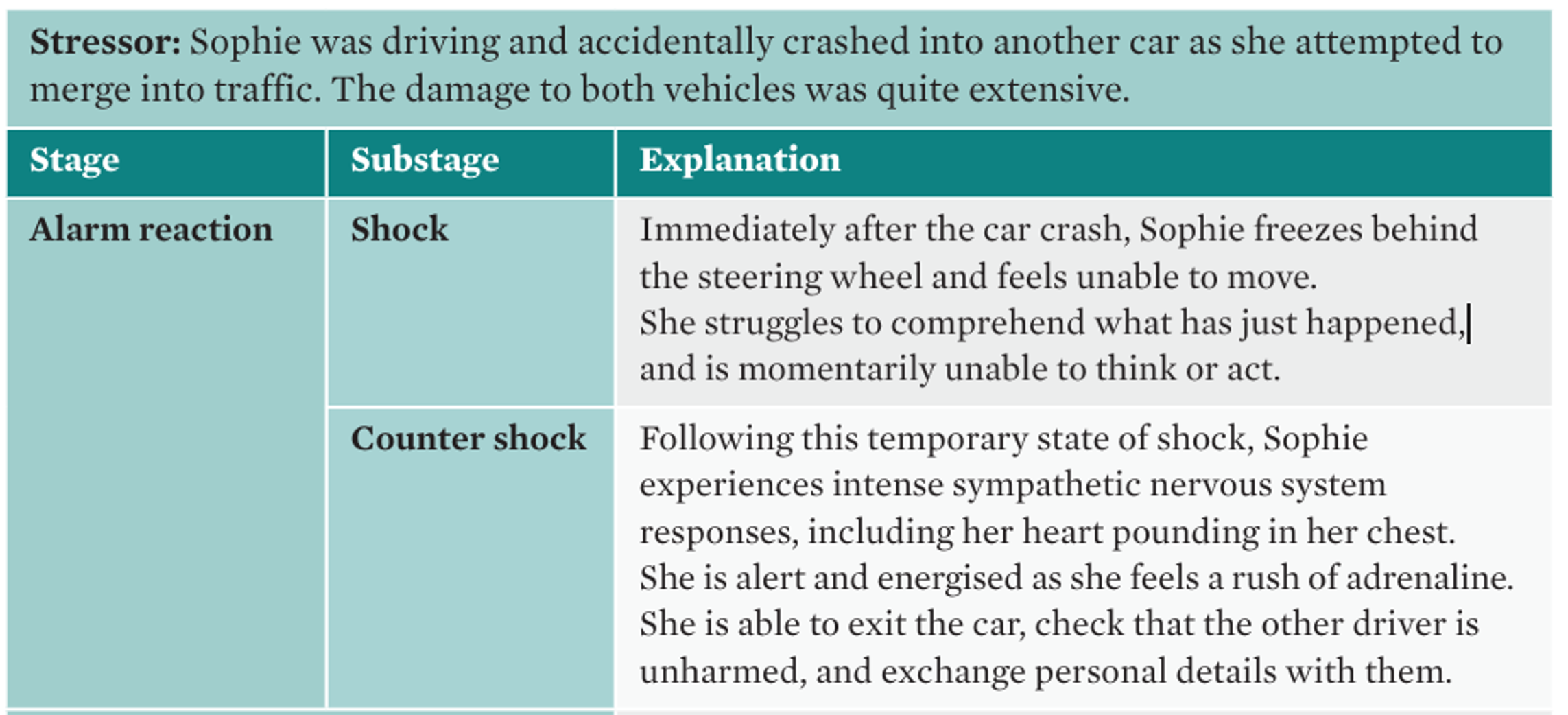
An example of someone progressing through the stages and substages of the GAS model (resistance)

An example of someone progressing through the stages and substages of the GAS model (exhaustion)

strengths of selyes GAS model
Strengths:
Developed understanding of a link between stress and disease (e.g. stress can weaken the body’s ability to resist infection and increase the likelihood of developing a physical disorder)
Identifies biological processes associated with the body’s stress response (e.g. role of endocrine system)
Developed awareness and understanding that the body has limited resources to cope with chronic/prolonged stress
Explains the potentially detrimental effects of the adaptation process following exposure to a persistent stressor.
limitations of Selyes GAS model
It is a ‘one size fits all’ model that assumes everyone has the same physiological responses to any kind of stressor.
It overemphasises physiological/ biological responses to a stressor and ignores psychological responses to different types of stressors does not take into account cognitive aspects of the stress response, specifically the role of the brain in interpreting a situation or event as stressful.
It is primarily based on the results of research with animals and may therefore be of limited relevance to the human stress response.
explanatory power
•Explanatory power’ is the ability of a theory/model to explain subject matter effectively.
•A model or theory can be considered to have more (or less) explanatory power than another to explain a certain situation or outcome.
Lazarus and Folkmans transactional model of stress and coping
•Transactional Model of Stress= Psychological.
•proposes that stress involves an encounter (‘transaction’) between an individual and their external environment and that a stress response depends upon the individual’s interpretation (‘appraisal’) of the stressor and their ability to cope with it.
•When there is an imbalance between a person’s appraisal of the demands of the situation and their estimation of their ability to meet those demands, then they will experience stress
•Appraisal is subjective and therefore a highly personal process. It also depends on our estimation of our ability to cope with the stressor, so two individuals may assess the same potential or actual stressor differently.
Similar to Selye’s GAS model, this model proposes that there are progressive stages that an individual passes through before experiencing stress.
Lazarus and Folkmans transactional model of stress and coping

Step 1: primary appraisal (Lazarus and Folkmans transactional model of stress and coping)
•Primary appraisal - we evaluate or judge the significance of the event and whether anything is at stake
•The individual determines whether the stressor is:
•Benign-positive (harmless/pleasant)
•Stressful (problematic)
•Irrelevant (meaningless)
•Stress will only occur if the individual determines the stimuli as stressful. They will then proceed to determine:
•Is the stimulus likely to result in harm/loss?
•Is the stimulus a threat to safety?
•Is the stimulus a challenge/opportunity for growth?
step 2: secondary appraisal (Lazarus and Folkmans transactional model of stress and coping)
•Secondary appraisal - we evaluate our coping options and resources for dealing with the event.
These may be internal (E.g. strength and determination)
or external (E.g. money and support from family or friends).
•If we perceive our coping resources to be greater than the demands of the situation, then we do not experience stress.
•If we perceive our coping resources to be insufficient for the demands of the situation, then we are likely to experience a stress response.