WFC120 week 4 & 5
 Call Kai
 Learn
 Practice Test
 Spaced Repetition
 Match
 Flashcards
 Knowt Play
1/52

Earn XP
Description and Tags
fq ucd 2026
53 Terms
TRUE or FALSE: All Sarcopterygian and ancient Actinopterygian fishes have functional lungs.
true
Several Sarcopterygian and ancient Actinopterygian fishes are found in water with low oxygen concentrations. What is the anatomical adaptation that allows them to survive in poorly oxygenated water?
lungs or highly vascularized swim bladders
Which type of scales are characteristic of ancient Actinopterygians?
ganoid
External fertilization is a feature of all ancient Actinopterygians. Therefore, they all must be ____________.
oviparous
What has been the main driver of overfishing and poaching for sturgeon?
demand for sturgeon roe (caviar)
Which sturgeon species are found in California?
White sturgeon,Green sturgeon
What caused a spike in sturgeon mortality in 2022 and mobilized sturgeon scientists to increase conservation action?
harmful algal bloom (HAB)
Which of the following is true about Putah Creek?
Lower Putah Creek fish habitat has degraded since 1996
After restoration of salmon spawning habitat and restoration to a more natural flow regime in Putah Creek, Chinook salmon began spawning in Putah Creek. Hitt et al. (2024) found that in subsequent years, the offspring of those salmon returned to Putah Creek to spawn. Which of the following best describes the importance of these findings?
This study demonstrates that the restoration strategies used in Putah Creek effectively allowed a salmon population to establish and complete their life cycle in the restored area.
Examples of fish sampling gear commonly used in scientific study of fishes?
trawl nets, fyke nets, electrofishers, seines, rotary screw traps
hagfish commercial use
food in korea, luxury leather goods, commercial fishery
hagfish conservation status
20% hagfish species at risk, 2 sp endangered (IUCN)
hagfish threats
overexploitation, habitat decline, bottom trawl fishing, no
Which of the following is NOT true about hagfish?
C) Hagfish only eat live prey
lamprey Morphology + Physiology
eyes only in adults, 7 gill pores, oral disc, single nostril, additional photo sensory organ
7 gill pores in lampreys
Water enters + exits via gill pores. Facilitates ‘breathing’ while feeding parasitically
lamprey oral dics
Keratinized ‘teeth’
lamprey additional photo sensory organ
pineal eye
lamprey in larval phase
freshwater, filter feed, 12+ years
lamprey reproduction
semelparous, nonmigratory/nonparisitic, freshwater
anadramodous species
marine phase in parasitic, blood feeding adults
lamprey importance
nutrient cycling, improve water quality, prey, substrate turnover
Which of the following statements are true? (Select all that apply)
A) Unlike lamprey, all hagfish live in marine environments
B) Unlike hagfish, some lamprey feed parasitically
C) Hagfish and lamprey are closely related to true eels
D) Hagfish and lamprey both use slime as a defense mechanism
A) Unlike lamprey, all hagfish live in marine environments
B) Unlike hagfish, some lamprey feed parasitically
lamprey threats
Habitat loss (Dams, Channel alteration, dredging, entrainment)
Climate change
Contaminants (Mercury, pesticides, PCBs (‘legacy’ pollutants))
Some species may be overexploited
lamprey commercial use
fisheries in alaska, russia, europe for human and sled dog food
lampreys are vulnerable to
biomagnification through blood (mercury)
West Coast Lamprey Conservation Efforts
Petition for ESA listing; increased research, passages through dams, habitat restoration, Aquaculture/artificial propagation, Translocations/reintroductions, Salvage - dredging/dewatering
PIT (Passive Integrated Transponder)
tagging for juvenile/adult lamprey. PIT-tagged fish swim past antenna, the unique tag ID is recorded
Parentage-based tagging
Genetic approach instead of a physical tag; measures success of
translocations, helps study reproductive behavior
Chondrichthyes
Sharks + Rays + Skates, chimaeras
Chondrichthyes defining features
Jaws, cartilaginous skeletons, paired fins, electroreception, no swim bladder, internal fertilization
Ampullae of Lorenzini
Network of gel-filled pores in skin, detects electric fields in water, evolved directly from the lateral line system,
Fish w/ electroreception
still have lateral line
Detects electric fields in water
Helps locate hidden/buried prey. Aids in predator avoidance. Enhances mate recognition. Helps in navigation
Evolved directly from lateral line system
Mechanoreception – detects water flow
Chimaeras Morphology + Physiology
Few scales on body. Tooth plates. Single gill opening (operculum). Deep-sea fish. bulky eyes + large heads, tapering tails,
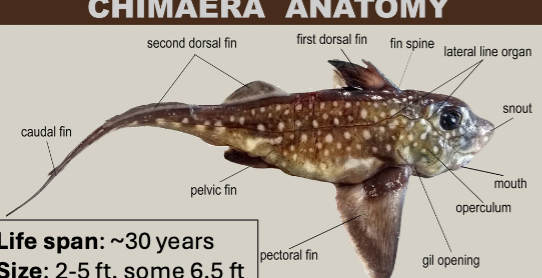
chimera ecology
deep sea fish, internal fertilization, iteroparous, slow growth
chimera ecological importance
population control (benthic inverbebrates), integrate into benthic food webs, substrate turnover
chimera conservation status
8 at risk species, threatened by bycatch, habitat decline, low reproductive output, very low conservation effort (hard to study)
Sharks + Rays + Skates morphology
Covered in placoid scales. Serially replacing teeth. 5-7 gill openings (No operculum). Primarily marine
Which of the following is a NOT a defining characteristic of
Chondrichthyes?
A) Cartilaginous skeleton
B) Internal fertilization
C) Electroreception/Ampullae of Lorenzini
D) Double-chambered swim bladder
D) Double-chambered swim bladder
chimaera Morphology + Physiology
Which of the following is NOT a defining characteristic of the superclass Agnatha?
Absence of paired fins
Absence of jaws
Presence of swim bladder
Cartilaginous skeleton
Presence of swim bladder
Which of the following are examples (covered in lecture) of conservation efforts conducted for West Coast lampreys (typically Pacific lamprey)? (Select all that apply)
Salvage to prevent mortality during dewatering and/or dredging
Catch & release rules and commercial fleet restrictions
Lamprey-specific passage structures at dams
Aquaculture
Translocation and reintroductions
Requirements for specialized equipment on commercial fleets to prevent bycatch
Salvage to prevent mortality during dewatering and/or dredging
Lamprey-specific passage structures at dams
Translocation and reintroductions
Requirements for specialized equipment on commercial fleets to prevent bycatch
Which of the following is NOT true?
1.Chondrichthyes includes chimaeras (Holocephali) and sharks, skates, and rays (Elasmobranchii)
All cartilaginous fishes (Chondrichthyes) are viviparous (live birth rather than egg laying)
All cartilaginous fishes (Chondrichthyes) have ampullae of Lorenzini
Elasmobranchs are covered in placoid scales while chimaeras are mostly smooth and scaleless.
All cartilaginous fishes (Chondrichthyes) are viviparous (live birth rather than egg laying)
TRUE or FALSE. Both chimaeras and hagfish populations are threatened by bottom-trawl fishing practices.
TRUE
What is an anatomic feature that helps cartilaginous fishes (Chondrichthyes) compensate for their lack of swim bladder?
Very large, fatty liver
What is one factor that compounds the risk of extinction for most cartilaginous fishes (Chondrichthyes)?
low reproductive rate
The broad ‘wings’ present on skates and rays are modified ___________.
pectoral fins
According to Dulvy et al. 2017, whats true about fishing bans
complete bans are appropriate for some species, but many shark species are capable of supporting a significant level of fishing if kept within science-based catch limits
Trophic cascades are a potential consequence of population decline/extinction of apex predators (like many shark species). Which of the following best describes the trophic cascade that occurs when an apex predator is removed?
Primary producer populations increase and other species decrease
Mid-level predator populations grow unchecked, and populations decline in species at lower trophic levels
Overpopulation of all species at lower trophic levels (below apex predator)
Mid-level predator populations decrease, and populations boom in species at lower trophic levels
Mid-level predator populations grow unchecked, and populations decline in species at lower trophic levels
Which of the following are features of the class Sarcopterygii (excluding tetrapods)? (Select all that apply)
cosmoid scales
fleshy, muscular fins with robust bony structure
cartilaginous skeletons
relatively low species diversity
cosmoid scales, fleshy, muscular fins with robust bony structur, relatively low species diversity
Which taxonomic group contains all cartilaginous fishes (Chondrichthyes)
EXCEPT chimaeras?
A) Holocephali
B) Elasmobranchii
C) Galea
D) Squalea
B) Elasmobranchii