L5: Febrile Neutropenia - Nav
 Call Kai
 Learn
 Practice Test
 Spaced Repetition
 Match
 Flashcards
 Knowt Play
1/31

There's no tags or description
Looks like no tags are added yet.
32 Terms
What are neutrophils?
type of WBC and essential component of innate immune system that responds to invading pathogens:
directly atk bact and fungi
release cytokines to prod inflamm response at site of infection
How do you calculate absolute neutrophil count? (ANC)
(% segmented neutrophils + % bands) x WBC / 100
ANC < 1500 cells/microL
neutropenia
ANC < 500 cells/microL OR
ANC < 1000 cells/microL and predicted to decline to <500 cells over next 48hrs
severe neutropenia
ANC < 100 cells/microL + prolonged
profound neutropenia
(+ prolonged = high infection risk + fungal)
What is the association betw neutropenia and infection risk?
risk of infection inc w degree and duration of neutropenia
risk highest in profound and prolonged neutropenia
prior to graft during hematopoietic cell transplant
after induction therapy for acute leukemia
febrile neutropenia (neutropenic fever)
severe neutropenia + single oral temp ≥ 101F (38.3C) or temp ≥100.4F (38C) sustained over 1 hour
medical emergency
epidemiology
10-15% of pts with solid tumors
80% of pts w hematologic malignancies
25-30% of cases have complications: HoT, renal, respiratory, HF
11% mortality
important cause of healthcare resource consumption
What are the 3 risk factors for infection?
neutropenia: most important; effect of cytotoxic chemo on hematopoietic progenitor cells
mucosal barrier injury: effect of cytotxic chemo on epithelial cells (mouth and GI tract as mucositis); portal of entry for bact
dysbiosis: gut microbiota altered by chemo agents, total body irradiation, antimicrobial prophylaxis; pseudomonas aeru and yeast overgrowth
infectious etiology is iD in only 40-50% cases, most infections are caused by ___ what are the predominant pathogens? What are late causes of infection in severely immunocompromised hosts?
endogenous flora; gram positive and negative bacteria; fungi
MEMORIZE BACTERIA TABLE

antipseudomonal - beta lactam
what is the clinical presentation of febrile neutropenia?
fever: first and only sign of infection
may be absent due to impaired inflam response
considered a sign of infection until proven otherwise
types of infection
microbiologically documented infections
clinically docuemented infections
fever of unknown origin (FUO)
What should be done for dx and lab testing?
CBC w differential
chemistry tests (electrolytes, renal and hepatic function)
history and physical exam: classic signs of infection may be attenuated/absnet, common sites of infection should be assessed
two sets of blood cultures (b4 ABX)
chest radiograph
What are the risk stratification concepts?
pts receiving treatment for solid tumors are low risk (<7days)
pts receiving treatment for hematologic malignancies are high risk (≥ 7d)
Low risk febrile neutropenia has all of the following:

high risk has atleast one of the following
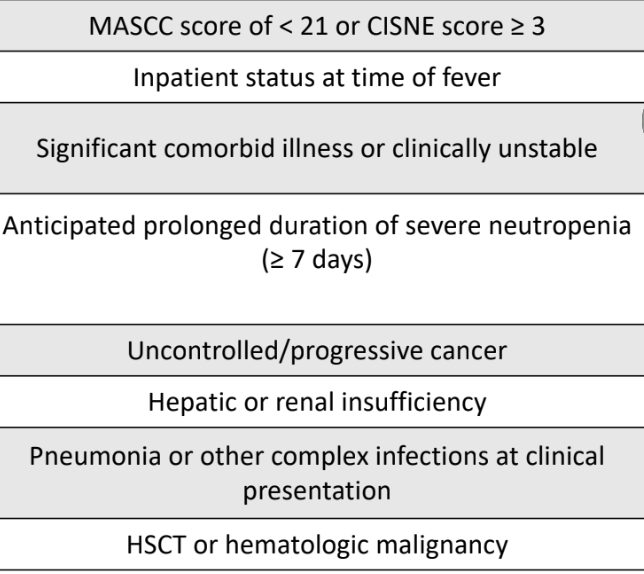
T/F MASCC and CISNE are scoring systems for risk assemssment
true
what is the site of care for high risk pts?
hospitalization and IV antimicrobials
what is the site of care for low risk patients?
outpatient setting w PO or IV antimicrobials if no logistical barriers; must have:
residence in close prox to medical facility
family member or caregiver at home
access to a telephone and transportation
What are the principles of antibmicrobial therapy?
fever should be assumed to be due to infection until proven otherwise
pts should be assessed within 15 min after presenting for febrile neutropenia
first dose of empiric ABX should be admin within 60 min
empiric ABX should always cover pseudomonas aeru
What is empiric therapy in high risk patients?
monotherapy w IV antipseudomonal beta lactam
pip/tazo
cefepime (no good anaerobic cover)
meropenem ± metronidazole (preferred if colonized w ESBL-producing enterobacterales)
mipenem/cilastatin
What is not recommended for empiric therapy in high risk pts?
vancomycin; has increase risk of resistance and nephrotix
What are the indications for addition of vancomycin in high risk patients?
colonization w MRSA or penicillin resistant strep pneumo
skin and soft tissue infection
pneumonia
suspected IV catheter related infection
blood cultres positive for gram positive bact before final ID and susceptibilities
clinical instability (HoT, shock)
What is the empiric therapy in low risk pts?
first dose of IV antimicrobials admin in medical facility: similar to high risk antimicrobial choice
observed for ≥ 4 hrs before discharge
transitioned to PO fluoroquinolone-based regimen on discharge
PO fluoroquinolone based regimens
cipro + amox/clav (pref)
cipro + clindamycin
levoflox
moxiflox (doesn’t cover pseudomonas)
PO reigmens cant be used if pt received fluoroquinolone prophylaxis
What is the follow up therapy during febrile neutropenia for high risk pts?
vanco disc after 48 hrs if no resistant gram positive organisms
pts who become hemodynamically unstable should have their antimicrobial regimens broadened
empiric antifungal therapy (w activity against molds) considered for pts with persistent fever 4-7d
What is the follow up therapy during febrile neutropenia for low risk pts?
outpatients who do not defervesce after 48-72 hrs of ABX may need hospitalization
REVIEW DECISION TREE
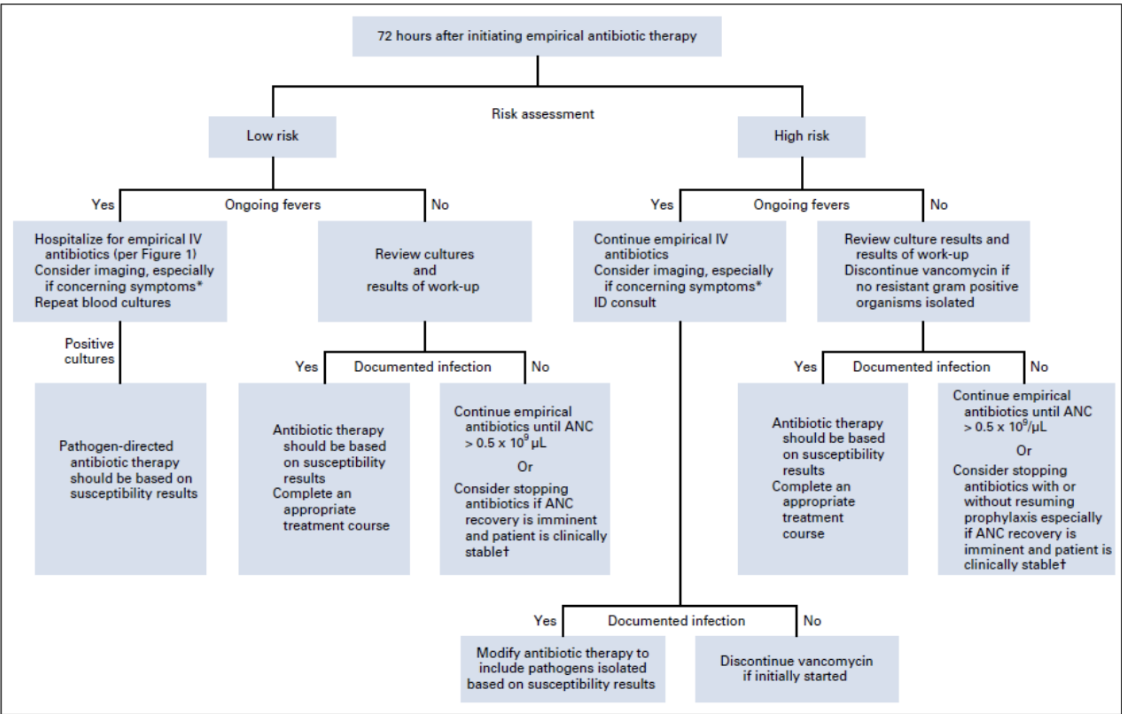
In microbiologically or clinically documented infections, what is the duration of therapy?
continued until a standard course of therapy has been completed and ANC is ≥500 cells/microL
if fever of unknown origin, what is the duration of therapy? (controversial)
treatment continued until afebrile for ≥2d and ANC is ≥500 cells/microL and increasing OR
treatment d/c after ≥3d of IV ABX and afebrile for ≥2d irrespective of ANC (± transition to fluoroquinolone prophylaxis)
take home messages
