MCB Ch 17 Set 1
 Call Kai
 Learn
 Practice Test
 Spaced Repetition
 Match
 Flashcards
 Knowt Play
1/10

There's no tags or description
Looks like no tags are added yet.
11 Terms
After passing the point called Start in yeast or the restriction point in mammalian cells, cells are committed to complete DNA replication and mitosis, even if the signaling molecules that stimulate cell growth and division are removed from the environment. T/F
True
Model organisms such as yeasts played an important role in working out cell-cycle controls in human cells. Why were human cells not initially used extensively as a model system for studying cell-cycle control in humans?
Choose one:
A. It is very difficult to do genetics on human cells.
B. It is difficult to do biochemistry on human cells.
C. Human cells are much too complicated to study.
D. Human cells divide slowly and asynchronously.
It is very difficult to do genetics on human cells.
To a growing cell culture, you add a fluorescent dye that binds to DNA, and then you analyze the cells with a cell sorter, which measures the fluorescence of each cell. The output of the sorter is shown in the figure Part A, with the phases of the cell cycle indicated.
Which one of the distributions shown in Parts B through E would you expect if you grew the cells in the presence of an inhibitor of S phase?

Choose one:
A. Part E
B. Part B
C. Part D
D. Part C
Part D
The cell-cycle control system is based on a connected series of biochemical switches, each of which initiates a specific cell-cycle event. Which of the following statements correctly describe important features that increase the accuracy and reliability of cell-cycle progression?
I The switches are generally binary (on/off), so that when events are initiated, they are completed.
II The control system is robust and reliable, allowing the system to operate even when some components fail.
III The control system resists outside influences, so that it proceeds the same way in many different cell types.
I and II
Cdk activity is regulated in several ways. Sort each of the following forms of Cdk into the active or inactive Cdk category.
Active or Inactive Cdk
-Cdk bound to cyclin
-Threonine in T loop phosphorylated
-T loop in active site
-Cdk alone
-Cdk/cyclin bound to p27
Active Cdk
-Cdk bound to cyclin
-Threonine in T loop phosphorylated
Inactive Cdk
-T loop in active site
-Cdk alone
-Cdk/cyclin bound to p27
PP2A-B55 phosphatase activity is high during interphase but inhibited during early mitosis when M-Cdk activity rises. M-Cdk turns off PP2A-B55 via the phosphorylation of the protein kinase called Greatwall. This regulatory pathway also involves another key protein—the small protein Ensa—which plays a critical role in turning off PP2A-B55.
Which one of the following statements accurately describes how Greatwall and Ensa collaborate to turn off PP2A-B55?
Choose one:
A. Ensa activates Greatwall, which adds a phosphate to PP2A-B55, turning it off.
B. Greatwall inactivates Ensa, an activator of PP2A-B55, turning PP2A-B55 off.
C. Greatwall and Ensa form a complex, which binds to PP2A-B55, turning it off.
D. Greatwall phosphorylates Ensa, which then binds to PP2A-B55, turning it off.
Greatwall phosphorylates Ensa, which then binds to PP2A-B55, turning it off.
You have discovered a mutant form of a protein that is a target for phosphorylation by M-Cdk. Instead of being phosphorylated at its defined time in the orderly scheme of things, it is phosphorylated significantly earlier.
Which one of the following explanations might account for the unusual behavior of your mutant protein?
Choose one:
A. The mutation increases the protein’s affinity for a protein phosphatase.
B. The mutation increases the protein’s affinity for its binding site on M-Cdk.
C. The mutation eliminates the crucial site that is phosphorylated by M-Cdk.
D. The mutation decreases the protein’s stability, so its concentration is lower.
The mutation increases the protein’s affinity for its binding site on M-Cdk.
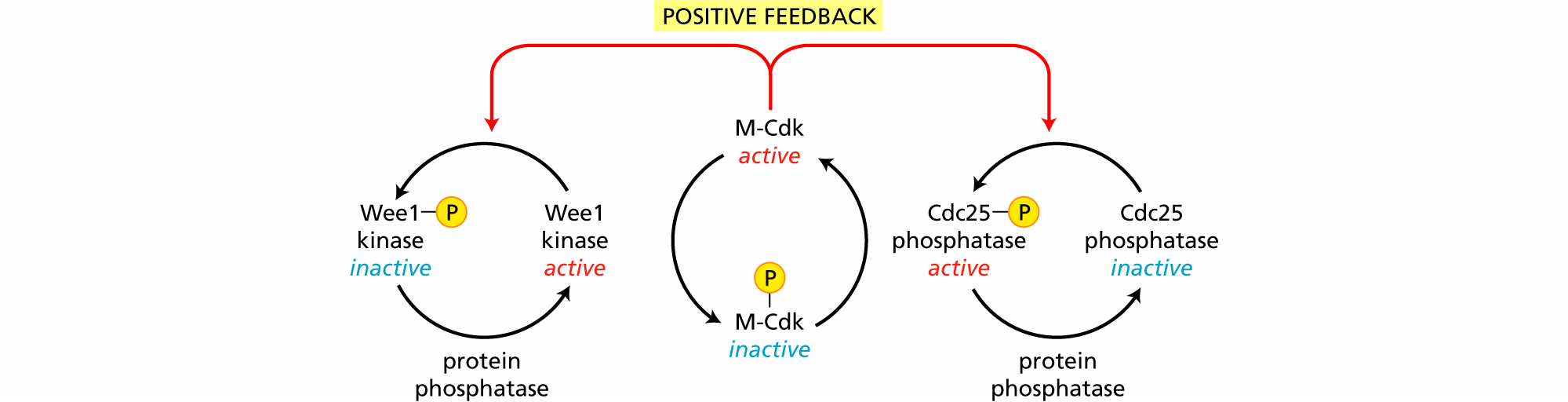
At the beginning of mitosis, a small amount of M-Cdk activity appears, which is rapidly amplified to full activity. M-Cdk accomplishes this rapid activation using positive feedback loops to alter the activity of components in the regulatory pathway shown in the figure.
Which one of the following possibilities would give the most rapid activation of M-Cdk?
Choose one:
A. M-Cdk phosphorylates Wee1 and Cdc25, inactivating Wee1 and activating Cdc25.
B. M-Cdk phosphorylates Wee1 and Cdc25, activating Wee1 and inactivating Cdc25.
C. M-Cdk phosphorylates Wee1 and Cdc25, inactivating Wee1 and inactivating Cdc25.
D. M-Cdk phosphorylates Wee1 and Cdc25, activating Wee1 and activating Cdc25.
M-Cdk phosphorylates Wee1 and Cdc25, inactivating Wee1 and activating Cdc25
What is the name of the ubiquitin ligase that promotes the separation of sister chromatids at the metaphase-to-anaphase transition in all eukaryotic cells?
Choose one:
A. APC/C
B. SCF
C. Cdh1
D. Cdc20
APC/C
You have discovered a new compound that blocks fusion of vesicles from the Golgi apparatus with the plasma membrane. Cells treated with the compound in early G1 phase arrest at Start before they enter S phase. You hypothesize that a previously unknown cell-cycle checkpoint monitors the membrane to ensure that cells enter S phase only when sufficient membrane growth has occurred. Which one of the following potential mechanisms offers a plausible way to achieve this arrest?
Choose one:
A. Activate APC/C
B. Inhibit DNA polymerase
C. Inactivate CKIs
D. Inhibit G1/S-cyclin transcription
Inhibit G1/S-cyclin transcription
G1-Cdk promotes synthesis of which of the following cyclins?
I G1/S-cyclin
II S-cyclin
III M-cyclin
I and II