112 Midterms
 Call Kai
 Learn
Learn Practice Test
 Spaced Repetition
 Match
Match Flashcards
 Knowt Play
1/21

There's no tags or description
Looks like no tags are added yet.
Name | Mastery | Learn | Test | Matching | Spaced | Call with Kai | Chat |
|---|
No analytics yet
Send a link to your students to track their progress
22 Terms
Information
Facts
Data with meaning
Based on a particular circumstance
Communications
Exchange of information
Transfer of information
Done through a medium.
Technology
Practical application of science to
solve real-world problems.
Development of tools.
ICTs
Diverse set of technological tools and resources used to transmit, store, create, share or exchange information.
Why we want ICTS
1. Increase in production (growth in productivity)
2. Helps to increase efficiency (lesser time, transport)
3. Cuts costs (but you need to invest)
4. Security
The internet
A global network of computing devices communicating information.
Other reasons for want of ICTs
1. Data tracking
2. Accessibility and collaboration
3. Data safety and backups
4. Ease of access and convenience
Information Society
one in which information is used intensively as an aspect of economic, social, cultural and political life.”
Characteristics of information society
an economic resource
increased usage of information among the public
presence of information sector/industry
Technological theory of Information Society
Innovations in information processing, storage, and transmission had profound impacts to the social world, brought by birth of telecommunications, the internet, and convergence
Economic theory of Information Society
Quantifiable aspect; identification of information industries
Primary: quantifiable, has an ascribable market price (information machines, books, media)
Secondary: R:D, personnel, gov info
Occupational theory of Information Society
Sociological argument; decline of manufacturing work and rise of the white collar society; automation of work
From handling of physical goods to information; rise of the service sector
Spatial theory of Information Society
How informational networks affects how society works around time and space; argument for globalization and a wired society
Enables economies to operate across boundaries and accounts for the global presence of ICT infrastructure
Cultural theory of Information Society
Effects of increase in information in social circulation; more information and more influence based on your consumption
Notion of hyper-reality and projection of image in the absence of first hand
Creativity and sense of self-reference in terms of interpreting meanings
The dependency paradigm
a macro-level theoretical framework stating that global poverty and underdevelopment are caused by the exploitative integration of peripheral, developing nations into the global capitalist system.
Core-periphery approach
explains regional inequality and uneven development by dividing a system into a dominant, wealthy center (core) and dependent, resource-supplying outlying areas (periphery)
ICT4D
The application of any entity that processes or communicates digital data in order to deliver some part of the international development agenda in a developing country.
Role of ICTs in development
Closing the gap between nations, facilitating the flow information; production, effectiveness, and reduction of costs
Optimistic view
ICTs as a necessity and an opportunity to leapfrog to the development status of the west/global north
Pessimistic view
Increasing inequality and social divide; there are more pressing basic needs such as shelter, food, and healthcare
Pragmatic view
Can help development if used appropriately, where strategies should fit local context
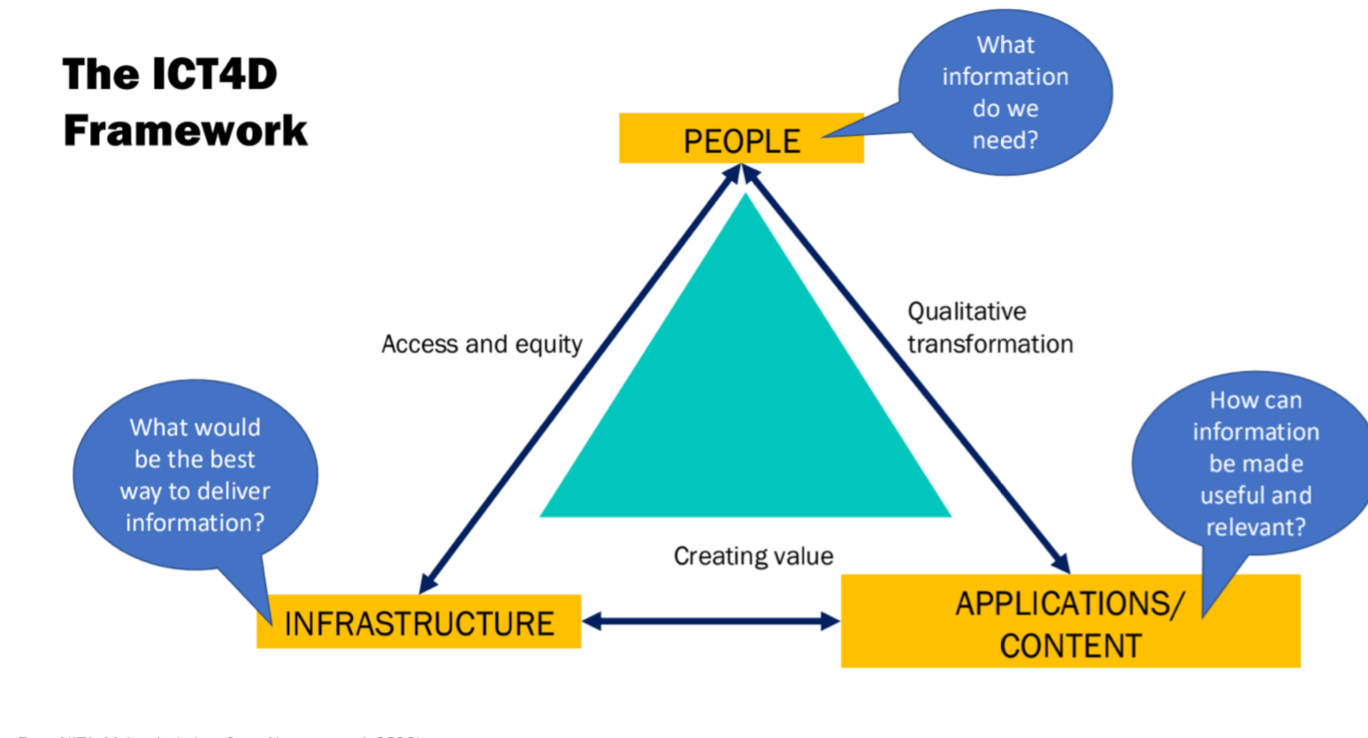
ICT4D Framework