microbio chapter 8 (1 of 3) (exam3 )
 Call Kai
 Learn
 Practice Test
 Spaced Repetition
 Match
 Flashcards
 Knowt Play
1/24

There's no tags or description
Looks like no tags are added yet.
25 Terms
· Explain the central dogma of molecular biology
refers to the flow of genetic information
information is stored within DNA —> through transcription is converted into RNA —> goes through translation to produce proteins
Can’t backtrack!!!!

Define and explain the relationships between the following terms:
o Genetics
o Genes
o Genome
Chromosomes
Genetics: study of heredity including how DNA stores information, how information stored within DNA is accessed, how it’s replicated
Genes: segments of DNA that encode functional proteins
Genome: all the genetic information in a cell (including chromosomes and other forms of DNA like plasmids)
Chromosomes: large pieces of DNA that store essential genetic info
· Describe the molecular structure of DNA
DNA forms a double helix
backbone consist of deoxyribose-phosphate
two strands are held together by hydrogen bonds between complementary bases
A-T (2 H bonds)
C-G (3 H bonds)
Strands are antiparallel
5’ and 3’ ends
order of bases forms genetic instructions of organism

Explain why the complementary nature of DNA is essential for its replication
One strand acts as a template for the production of a new strand
enzymes read the original code and pair nucleotides up to match with their specific partners.
Ensures that both double helixes are exact clones of the original molecule.
high precision
Explain why DNA replication is semi-conservative
each new DNA molecule consists of one original strand from the parent and one completely brand new strand
describe the role of Helicase enzyme in DNA replication
separates the DNA strands- unzips DNA
breaks the hydrogen bonds between base pairs (denatures DNA)
revelas the bases so the strand can be used as a template for the snythesis of a new strand
Forms a replication fork
one fork moves in clockwise direction, other fork is counter-clockwise
As helicase unzips the DNA, stabilizing proteins bind the single stranded DNA
describe the role of primase enzyme in DNA replication
once helicase has unzipped DNA to reveal the bases, RNA primase synthesizes a short RNA primer that is complementary to the sequence of the template strand
the RNA primer is single-stranded (and will eventually get replaced)
the RNA primer is needed because DNA polymerase can’t initiate DNA synthesis on its own
describe the role of DNA polymerase enzyme in DNA replication
once an RNA primer has been synthesized, DNA polymerase adds nucleotides to the growing DNA strand
Reads the template the 3’ to 5’ direction and synthesizes DNA in the 5’ to 3’ direction
describe the role of RNase enzyme in DNA replication
After DNA polymerase begins synthesizing DNA, the RNA primer is removed by RNase
on one strand, DNA is synthesized continuously —> leading strand
DNA polymerase moving towards helicase
on other strand, DNA is synthesized in short patches —> lagging strand
DNA polymerase is moving away from the helicase
Short patches sealed together
describe the role of ligase enzyme in DNA replication
The short patches (okazaki fragments) are sealed together by ligase “glue”

· Explain the occurrence of leading and lagging strands
Describe how replication forks move around a circular bacterial chromosome
Explain how the cell accesses information stored within DNA
Transcription! (what genes should be expressed at what level)
RNA polymerase locates the specific section of DNA that holds the instructions
Unzips the double helix to expose genetic code inside
Reads exposed DNA letters and creates a temporary matching copy called mRNA
Identify the difference between DNA nucleotides and RNA nucleotides
RNA uses a sugar called ribose which has a 2’ OH group instead of deoxyribose. This change makes RNA single stranded rather than a double helix, letting it easily move around the cell
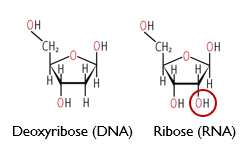
Explain the role of the promoter in transcription
RNA polymerase binds to DNA at a promoter which is a DNA sequence that directs RNA polymerase to the start of a gene
happens in initiation (stage 1/3 of transcription)
· Distinguish between DNA polymerase and RNA polymerase
Explain what is meant by ‘expression level’
Many RNAs are produced from a single gene
Highly expressed = many RNA molecules are produced
· Explain how the genetic code is used to access information from DNA
Accessing information stored within DNA and converting to mRNA will be used as instruction for protein production
· Distinguish between sense codons and nonsense codons
Sense codons: 61 of them for 20 amino acids
amino acids are encoded by multiple codons —> degenerate/redundant
3 nonsense (stop) codons that terminate translation
1 start codon (AUG)
· Describe the structure of ribosomes
made up of a large subunit and small subunit
· Explain the role of tRNAs in translation
each tRNA carries a specific amino acid block, bottom loop contains a three-letter code called an anticodon, anticodon binds tightly to a matching triplet on mRNA, deposits the amino acid at the correct spot, empty tRNA leaves the ribosome to pick up more blocks
· Describe the purpose of the A, P, and E sites within ribosomes
A: The A (aminoacyl) site is where new tRNA molecules carrying amino acids enter the ribosome; the
P (peptidyl) site holds the tRNA with the growing polypeptide chain, and the
E (exit) site is where empty tRNAs exit the ribosome after their amino acids have been added to the chain.
· Explain how and why transcription and translation is coupled in bacteria
Transcription Begins: The enzyme RNA polymerase binds to bacterial DNA and starts making a single strand of messenger RNA (mRNA).
Ribosomes Attach Immediately: As the mRNA strand grows, its beginning (the 5' end) hangs out freely into the cell's cytoplasm.
Translation Starts: Ribosomes in the cytoplasm immediately grab onto this free end and start translating the genetic code into a protein chain, even while the RNA polymerase is still reading the DNA ahead of it.
Translation is performed by ribosomes
mRNA is like a cook book, that contains the messages for protein synthesis (translation)
Ribosomes see the codon (3 mRNA nucleotides that code for an amino acid
3 stages in transcription (RNA synthesis)
Initiation: RNA polymerase binds to DNA at a promoter (sequence that directs RNA polymerase to the start of a gene
Elongation: RNA polymerase adds RNA nucleotides to the 3’ end of the growing RNA strand
Termination: release of RNA polymerase and RNA fom the DNA