lecture 4 dna eukaryotic transcription
 Call Kai
 Learn
 Practice Test
 Spaced Repetition
 Match
 Flashcards
 Knowt Play
1/20

There's no tags or description
Looks like no tags are added yet.
21 Terms
general transcription factors and rna polymerase ii produce a basal level of transcription. how can this level change?
specific transcription factors bind upstream regulatory elements and can increase or decrease transcription.
at what levels can gene expression be controlled, and how do constitutive and regulated expression differ?
gene expression can be controlled at several levels, including transcription and translation. constitutive expression occurs routinely, as with housekeeping genes. regulated expression can be increased (inducible) or decreased (repressible) in response to a signal.
what does it mean for gene expression to be tissue-specific, hormone-responsive, or developmentally regulated?
- tissue-specific: genes are expressed at different levels in different cell types.
- hormone-responsive: gene expression changes in response to hormones or other signaling molecules.
- developmentally regulated: genes are expressed at different levels and times during embryonic development.
where are proximal promoter sequences, enhancers, and silencers located in eukaryotic dna?
- proximal promoter sequences lie between about −200 and the core promoter. examples include the gc box and caat box.
- enhancers and silencers can be hundreds to thousands of base pairs from the core promoter. they’re usually upstream, but can also be downstream.

what binds to enhancers and silencers, and how does each affect transcription?
enhancer: an activator binds and increases transcription.
silencer: a repressor binds and decreases transcription.

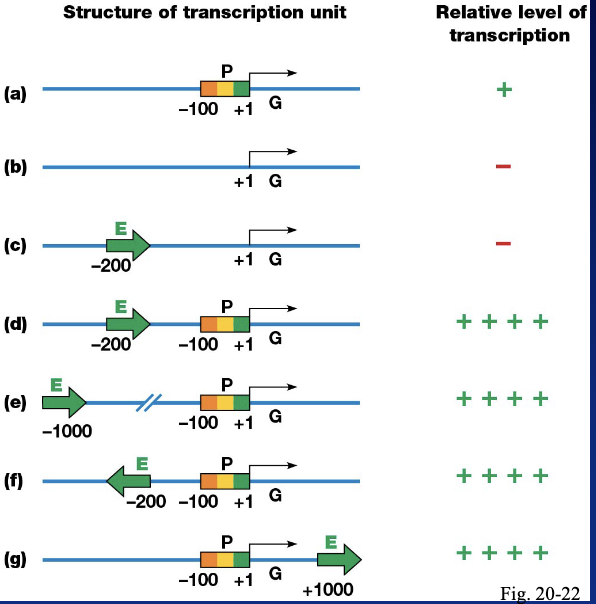
can an enhancer increase transcription without a promoter? does its position or orientation matter?
a promoter alone gives basal transcription. an enhancer alone gives no transcription. together, they give higher transcription, even when the enhancer is far upstream, downstream, or flipped in orientation.
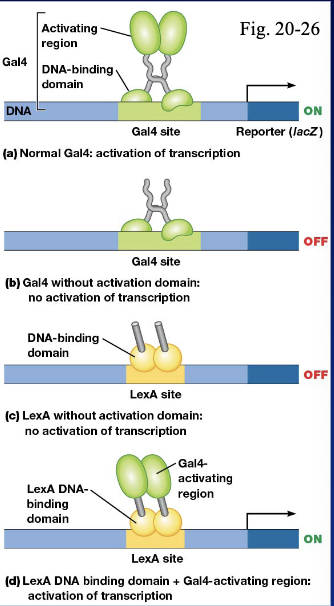
what domains do transcription factors use to bind dna and control transcription?
the dna-binding domain binds a specific dna sequence, such as an enhancer or silencer. an activation domain increases transcription, while a repressor domain decreases it.
how do transcription factors pair up, and what can their regulatory domain contain?
many work as dimers. a homodimer has two identical subunits, and a heterodimer has two different subunits. many also have a regulatory domain with a ligand-binding site or a phosphorylation site.

once an activator binds an enhancer, how does its activation domain help start transcription?
dna can loop, bringing the activator near the promoter. the activation domain can contact general transcription factors or rna polymerase directly, or interact with mediator to help assemble them at the promoter.
how do coactivators recruited by an activator help increase transcription?
chromatin remodeling factors such as swi/snf reposition nucleosomes, and histone modifiers such as histone acetyltransferases modify histones. these changes can make promoter dna more accessible to the transcription machinery.
how can a repressor domain decrease transcription?
it can interact directly with general transcription factors or rna polymerase, or recruit a corepressor, such as a chromatin remodeling factor or a histone modifier (methyltransferase or deacetylase).
how can a transcription factor with a dna-binding domain but no activation domain repress transcription?
it competes with activators for the same enhancer binding site. when it occupies the site, the activator can’t bind there to increase transcription.

why can the same gene be expressed at different levels in different tissues?
different cell types have different combinations of transcription factors. the balance between activators binding enhancers and repressors binding silencers determines how much the gene is transcribed.
how are transcription factors categorized, and what four categories are there?
leucine zipper — e.g., creb
helix-loop-helix
zinc finger — e.g., steroid hormone receptors
helix-turn-helix — e.g., bacterial lac and trp repressors and eukaryotic homeodomain proteins

where do recognition helices bind dna, and what kind of amino acids are common in them?
recognition helices fit into the major groove of dna, where they recognize specific base sequences. they contain many basic amino acids.
what does creb bind, and how does camp signaling lead to cbp recruitment?
creb (camp response element-binding protein) binds the cre enhancer. camp activates protein kinase a (pka), which phosphorylates creb. phosphorylated creb then recruits creb-binding protein (cbp).

once phosphorylated creb recruits cbp, how does cbp help activate transcription?
cbp is a coactivator that binds tfiib, helping recruit the transcription machinery. it also has histone acetyltransferase activity, which can make the dna more accessible.
cortisol binds the glucocorticoid receptor in the cytosol, causing it to release its heat shock proteins. the receptor enters the nucleus, forms a dimer, and binds a glucocorticoid response element on the dna. what does it recruit to increase transcription?
it recruits creb-binding protein (cbp) and chromatin remodeling factors.


homeodomain proteins are transcription factors that regulate the development of entire body regions. what is the homeobox, and what can happen if a homeotic gene is mutated?
the homeobox is a highly conserved 180-base-pair dna sequence that encodes the homeodomain, the part of the protein that binds dna. mutations in homeotic genes can cause major disruptions in body structure.
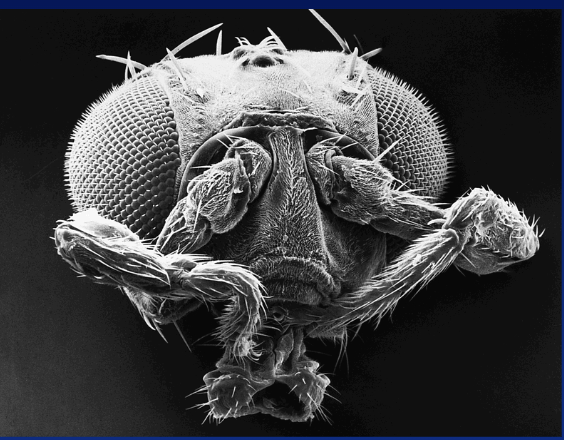
what happens when a mutation causes the antennapedia gene to be expressed in the head of a fruit fly?
legs grow in place of antennae. this shows how homeotic genes determine which structures develop in each body region.