R19 - Inhaler Technologies 2
 Call Kai
 Learn
Learn Practice Test
 Spaced Repetition
 Match
Match Flashcards
 Knowt Play
1/23

There's no tags or description
Looks like no tags are added yet.
Name | Mastery | Learn | Test | Matching | Spaced | Call with Kai | Chat |
|---|
No analytics yet
Send a link to your students to track their progress
24 Terms
How do dry powder inhalers (DPI) work?
The drug (+/- excipients) is in a dry powder state inside a capsule, blister, or reservoir
▪ The patient operates the device to expose a dose
▪ The patient inhales through the mouthpiece
▪ The patient’s inspiratory flow is used to:
- Fluidise the static powder blend
- Deaggregate the particle agglomerates into inhalable particles
What are the issues with powders in DPI?
Particles < 5 μm are extremely cohesive
Milling produces particles with planar surfaces
Moisture increases powder agglomeration
What are the solutions to the limitations of the dry powder inhaler?
Large lactose particles are added to improve deaggregation
▪ Spherical particles in lactose-free DPI (Turbohaler® inhaler)
▪ Turbulence must be created inside the device
▪ Patient must reach a min peak inspiratory flow rate (PIFR) inside the device → challenging for young children, the elderly, women, and patients with severe asthma/COPD
▪ Powder must be protected against moisture (stored in capsules/blisters or desiccant added)
What are the roles of excipients in DPI?
Lactose
▪ bulking agent in blisters or capsules
▪ improves dose uniformity in blisters or capsules
▪ improves uniformity of dose delivered to the patient
▪ helps in the de-aggregation of agglomerates (carrier)
Magnesium stearate
▪ improves filling
▪ decreases particle adhesion to the device
▪ decreases particle cohesion
How does a carrier work?
Small drug particles (1-5 μm) adhere to large lactose particles (50-100 μm)
▪ Large particles are less cohesive
▪ Drug particles are stripped from the large particles due to turbulence and collisions inside the device
▪ Lactose deposits in the oropharynx (sweet taste but may irritate)
▪ Drug deposits in the lungs
Describe the unit-dose devices (DPI-1)?
▪ Drug + excipients in a capsule
▪ Capsule inserted into the device by the patient
▪ Capsule broken by pushing a button
▪ Patient inhales drug/excipient blend through a fast, deep breath and holds their breath
▪ Patient can feel/hear capsule vibrations
▪ Device can be reused
▪ Very fiddly!

What are is the Multiple unit-dose devices ( DPI- 2)?
▪ Drug + excipients in blisters
▪ 60 doses on a foil strip
▪ Blister peeled open by sliding the lever
▪ Very convenient (1-month supply)
▪ Drug protected against humidity
▪ Can’t be reused
▪ Very expensive

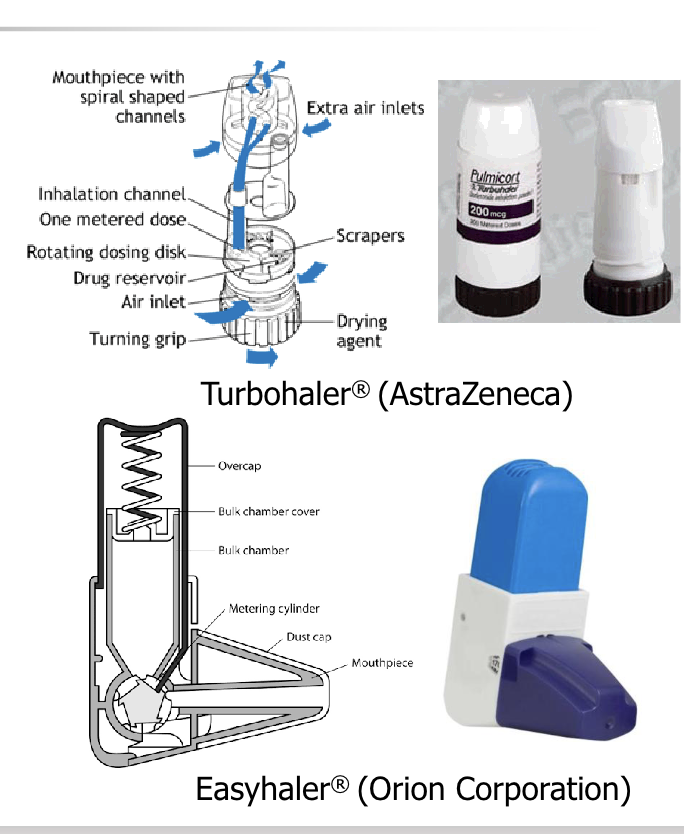
Describe the Multidose reservoir devices (DPI-3)?
Powder equivalent of a pMDI
▪ Bulk powder in a compartment (‘reservoir’) within the device
▪ Drug only (some Turbohaler)
▪ Drug + lactose (Easyhaler)
▪ Drug dispensed into a dosing chamber* by patient’s action (*powder may fall!)
▪ Patient inhales through the mouthpiece
▪ Easier to use
▪ Drug exposed to humidity (desiccant added in Turbohaler)
How does DPI air resistance influence prescribing?
▪ DPI designed to resist the patient’s inspiratory airflow
▪ Low-resistance devices
▪ More comfortable for patients BUT
▪ low level of turbulences
▪ high patient’s PIFR needed to deaggregate powder (60 ml/min*)
▪ usually not suitable for elderly, children, women, severe asthma or COPD, asthma relief
▪ High resistance devices (ex: Handihaler, Accuhaler, Easyhaler)
▪ high level of turbulences
▪ lower PIFR needed (30 ml/min)
▪ better dose uniformity and higher lung deposition
What are the advantages and disadvantages of DPI?
Advantages
▪ Compact, portable
▪ Breath-actuated → no coordination needed
▪ Can deliver higher doses than pMDI
▪ Dose counter
▪ Formulation relatively easy
▪ Dry state → better drug stability
▪ Low carbon footprint
Limitations
▪ Breath-actuated → Efficiency depends on PIFR
▪ Low lung deposition
▪ Poor reproducibility
▪ Can not be used by anyone
▪ Handling and operation specific to the DPI
▪ Affected by ambient humidity
▪ More expensive than pMDI
How does the Respimat® Soft MistTM inhaler (SMI) work?
Sterile drug solution stored in an aluminium cartridge
▪ Patient loads cartridge into inhaler
▪ Patient places device in their mouth
▪ Pre-metered volume transferred into a capillary tube by pressing on the base
▪ Liquid forced through a nozzle by depression of the spring
▪ Generation of a slow Soft MistTM
▪ Patient inhales the cloud through a slow, deep breath

What are the advantages and disadvantages of the SMI?
Advantages
▪ Compact, portable
▪ High deposition in the lungs (± 50 % of emitted dose)
▪ Lower doses needed
▪ Less throat irritation
▪ Less affected by patient’s technique
▪ Dose counter
▪ Formulation relatively easy
▪ Can be reused
▪ Low carbon footprint
Limitations
▪ Fiddly
▪ Some coordination required
▪ Needs priming
▪ Formulation must be sterile
▪ Very expensive
What is important to remember?
Efficiency of inhalers depends on the patient’s PIFR and inhalation technique
▪ 50-80% of patients do not use their inhaler correctly1
▪ 67-90% of healthcare professionals are unable to describe or demonstrate the correct steps 1
summary - What are the four main types of inhalation devices?
Nebulisers – convert liquid medication into a mist.
Pressurised metered-dose inhalers (pMDIs) – use a pressurised propellant to release a measured dose.
Dry powder inhalers (DPIs) – use the patient's inhalation to disperse dry powder.
Soft mist inhalers (SMIs) – use a mechanical spring to produce a slow-moving mist.
How do nebulisers work?
A drug solution or suspension is converted into fine liquid droplets using compressed air or ultrasound. The patient slowly inhales the mist through a mouthpiece or face mask.
What are the two types of nebulisers, and how do they differ?
Jet nebuliser | Ultrasonic nebuliser |
|---|---|
Uses compressed air | Uses high-frequency ultrasound |
Heavy and noisy | Lighter and quieter |
Longer delivery time | Shorter delivery time |
Compatible with most formulations | Unsuitable for suspensions and viscous formulations |
Heat may degrade some drugs |
What are the advantages and disadvantages of nebulisers?
Advantages:
Easy to use with minimal coordination.
Can deliver large doses, e.g. antibiotics.
Suitable for patients who struggle with handheld inhalers.
Disadvantages:
Bulky and not portable.
Long administration time.
Low efficiency (less than 10% reaches the lungs, according to the lecture).
Risk of microbial contamination.
How do pressurised metered-dose inhalers (pMDIs) work?
Drug is stored with a liquefied propellant under pressure.
Pressing the canister releases one measured dose.
The propellant evaporates, producing an aerosol.
The patient inhales the aerosol into the lungs.
What are the advantages, disadvantages and solutions to problems with pMDIs?
Advantages: Portable, inexpensive, rapid delivery and consistent doses.
Disadvantages: Requires coordination, high mouth/throat deposition, low lung deposition and a high carbon footprint.
Solutions:
Spacer: Holds and slows the aerosol, reducing coordination difficulties.
Breath-actuated pMDI: Automatically releases the dose when the patient inhales.
How do dry powder inhalers (DPIs) work?
The drug is stored as a dry powder.
The patient prepares a dose.
A fast, deep inhalation creates turbulence that breaks powder clumps into inhalable particles.
Requires a sufficient peak inspiratory flow rate (PIFR).
What are the three types of DPIs?
Type | Description | Example |
|---|---|---|
Unit-dose | Patient inserts and pierces a capsule | HandiHaler |
Multiple unit-dose | Individual doses stored in sealed blisters | Accuhaler |
Multidose reservoir | Powder stored in a reservoir and measured out | Turbohaler, Easyhaler |
What are the advantages and disadvantages of DPIs?
Advantages:
Portable and breath-actuated (no coordination needed).
Low carbon footprint.
Better drug stability due to dry formulation.
Can deliver higher doses than pMDIs.
Disadvantages:
Requires sufficient inspiratory flow.
May be difficult for children, the elderly or patients with severe asthma/COPD.
Powder is sensitive to moisture.
More expensive than pMDIs.
How do soft mist inhalers (SMIs) work, and what are their advantages and disadvantages?
A mechanical spring forces a sterile drug solution through a nozzle, producing a slow-moving mist.
Example: Respimat.
Advantages: High lung deposition (approximately 50%), less throat irritation, portable and low carbon footprint.
Disadvantages: Expensive, requires priming, some coordination needed and can be fiddly to operate.
What are the key differences in inhalation technique between inhaler types?
Inhaler | Correct breathing technique |
|---|---|
Nebuliser | Slow, relaxed breathing |
pMDI | Slow, deep inhalation while pressing |
DPI | Fast, deep inhalation |
SMI | Slow, deep inhalation |
Remember: pMDIs require good coordination, whereas DPIs require sufficient inspiratory flow. SMIs produce a slower mist, and nebulisers allow relaxed breathing.