4. Spatial Representations of Numbers
 Call Kai
 Learn
 Practice Test
 Spaced Repetition
 Match
 Flashcards
 Knowt Play
1/32

There's no tags or description
Looks like no tags are added yet.
33 Terms
How do people have different visualisations of number?

some people have a strong association to colour/space when they think about a number
or even a ladder

Which task measures the SNARC effect?
spatial-numerical association of response-codes
Dehaene, Bossini and Giraux (1993)
task: parity judgement, numbers can be either odd or even - number directly in centre
‘press the left hand button for odd, the right hand button for even number’
calculate average RT for all correct trials with

then change of instructions: ‘press the right hand button for off, the left hand button for even numbers’
again calculate average RT for all correct trials
different between RT with each hand
What is usually found with tests of the SNARC effect?
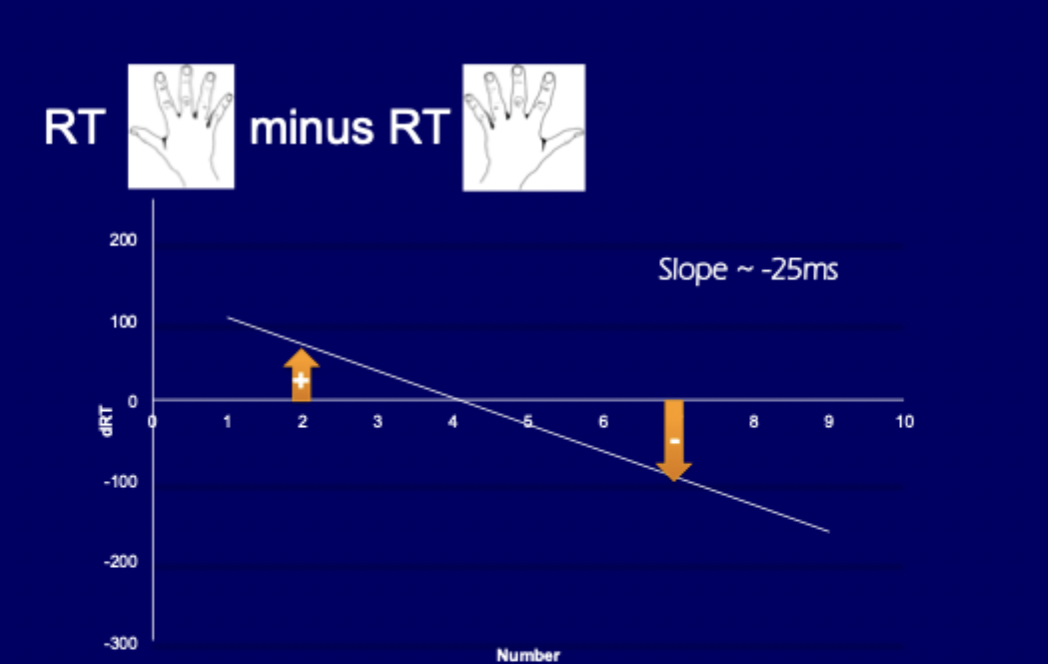
negative slope
faster with left hand for smaller numbers, and right hand for larger numbers
How is the SNARC slope calculated?
SNARC slope quantifies the strength and direction of the SNARC effect
calculated by examining how the difference between right-hand and left-hand reaction times changes as number magnitude increases
negative slope: indicates the typical SNARC effect - smaller numbers favour left-hand responses and larger numbers favour right-hand responses
more negative slope: generally indicates a stronger SNARC effect
positive slope: indicates a reversed SNARC pattern
What did Nuerk et al find regarding snarc effect

a replication
What did Dehane find regarding relativity of the SNARC effect?
nine experiments for single and double digits
the effect is relative to number interval
5 could be small or big depending on condition

What was found in Dehanes 9 experiments for single and double digits?
SNARC effect found
for single and double digits
its relative to number interval (0-5, 4-9)
specific to numerical stimuli (didn’t find it with letters ACE-BDF, consonant vowel classification)
also with number words, in left-handers & with crossed hands
However, what did Gevers et al find regarding whether the SNARC effect is number specific?
effect was found with letters when the task was order relevant, (if a letter comes before or after the middle of the alphabet)
the same with months

What has been found regarding whether the SNARC effect is effector-specific?
Is not effector-specific
seen with classic button response aswell as pointing, eye movements and pedal responses
What is found regarding SNARC manipulating the spatial reference frame?


after seeing the ruler they see classic SNARC effect

the SNARC effect flips after seeing a clock and being asked whether it is before or after 6
What was found regarding SNARC effect & reading direction?
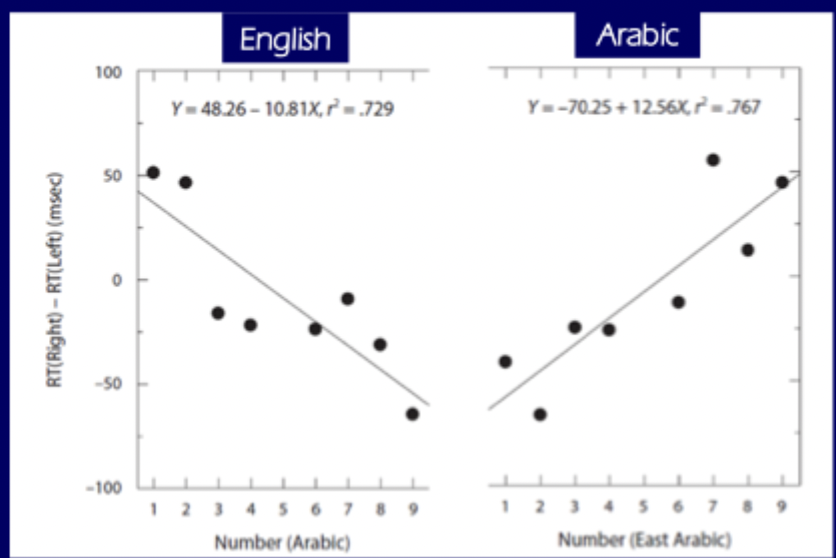
iranian ppts
Arabic ppts
classic SNARC effect seen with more years living in France

flipped effect would be seen in a culture reading right to left
What was found regarding vertical SNARC effect in dutch ppts?
read L-R

for larger numbers ppts are faster to initiate eye movements up rather than down
potential association for small numbers at bottom large at top - can’t really be explained with reading
What was found regarding vertical SNARC effect and reading in japanese ppts reading up and down?
opposite to reading direction
doesn’t seem to be affected by reading direction - much more influence by natural world, higher magnitudes go up

What was found regarding WM and SNARC?
subjects had to memorise 5 digits in correct order
followed by SNARC task

SNARC effect seen with whichever being first in the sequence having faster response with the left, later in the sequence faster response on the right
overriding magnitude SNARC
Neglect patients and line bisection
patients with right hemispheric lesions often show neglect
neglect patients often show a bias in manual line bisection
What is seen in number bisection with neglect patients?


particularly with larger intervals, they always overestimate the midpoint in number intervals
What did Fischer et al find regarding how numbers produce spatial bias?


the magnitude of the numbers in the line produce bias
The POSNER task
people are faster when attention cued to the site
valid vs invalid cue

How did Fischer et al find a POSNARC effect?
digit cue then 50/50 whether digit came up on either left or right
low digit - faster to left target than right
larger number - faster with the right target than the left target

Is there biological predisposition in these number-space theories?
studies on chicks provide evidence for biological predisposition

there preference for small = left not to do with reading
What is involved in the biological predisposition ideas for number-space theories?
innate, affinity between numerosity and space through neuronal recyling
hemispheric brain asymmetries produce an attentional bias towards the left side of space
attentional preference towards the left side of space is combined with a preference for increasing over decreasing sequences of numerosity in infants
explains findings in animals and infants
What does the biological predisposition explanations of number-space theories not explain?
doesn’t explain finding in illiterate

illiterates are 50/50 they don’t really have a preference
What is involved in the experience dependent explanation of number-space theories?
reading direction: long-term association built through experience
working memory
ordinal position in WM in spatially coded
numerical processing uses same architecture
number-space association built up during task execution
What is involved in the development of counting direction?
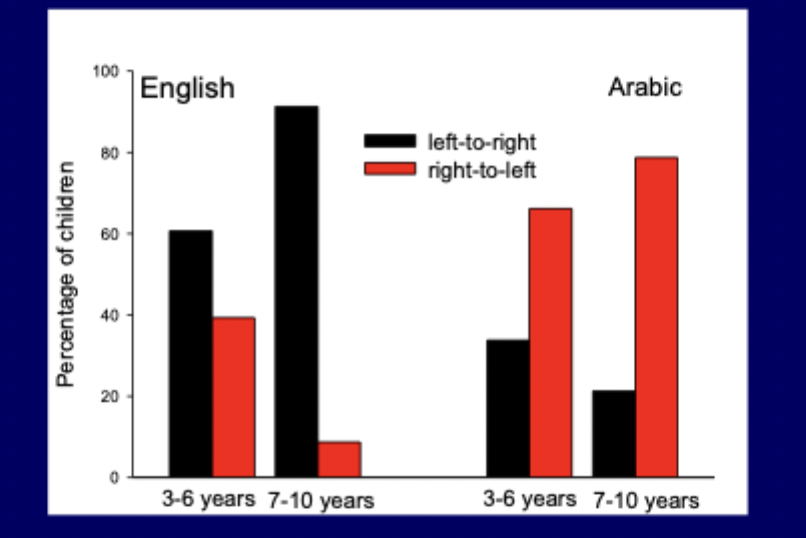
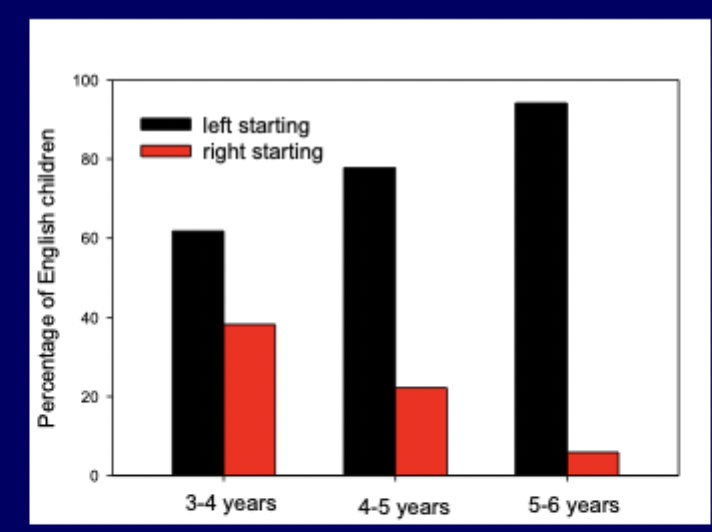
effect gets stronger with more reading and age
What do a combination of developmental accounts show?
recently evidence of SNA in preliterate children and animals
finger counting - probably not
six potential mechanisms

Summary
Spontaneous spatial representation of number
this spatial representation is dynamic
horizontal SNARC shaped by reading direction
number map: numbers increasing in magnitude represented from bottom left to top right
spontaneous spatial representation can easily be changed by instruction
task- irrelevant numbers can shift spatial attention
evidence emerging for combination account
What do Toomarian and Hubbard propose in their paper: “On the genesis of spatial-numerical associations: evolutionary and cultural factors co-construct the mental number line” 2018?
propose that an evolutionarily ancient frontal parietal circuit broadly tuned to multiple magnitude dimensions provides the phylogenetic substrate for SNAs
while enculturation and sensorimotor experience shape their specific profiles
A phylogenetic substrate is an evolutionarily inherited underlying system that provides the foundation for a cognitive ability.
What is involved in brain lateralisation as a mechanism inducing spatial-numerical directionality in pre-literate children?
Brain lateralisation is the specialisation of the brain’s hemispheres, which may create early preferences for associating numerical magnitude with one side of space.
Evidence: Spatial-numerical biases have been observed in 7-month-old infants, suggesting an early predisposition to associate larger quantities with a particular spatial direction.
Limitations: These biases do not necessarily prove innateness, as infants may already have learned spatial regularities from their social and cultural environment.
Handedness: Research has not yet established a systematic relationship between handedness (an indirect measure of brain lateralisation) and spatial-numerical biases.
Cultural influence: Even early spatial biases may be modified by cultural experiences.
Key takeaway: Brain lateralisation may contribute to spatial-numerical directionality in pre-literate children, but evidence is inconclusive about whether these biases are innate or shaped by experience.
What is involved in monitoring adult reading behaviour as a mechanism inducing spatial-numerical directionality in pre-literate children?
Monitoring adult reading behaviour may induce spatial-numerical directionality because pre-literate children learn by observing how adults interact with books.
Observational learning: During shared book reading, children watch adults point to text, follow its direction and refer to pictures.
Learning directionality: From these observations, children learn the spatial organisation of text, pictures and books.
Early internalisation: As adults read to children from around 1–2 years old, children may internalise a directional pattern of attention before they can read independently.
Key takeaway: By observing adults reading, pre-literate children may learn directional patterns of attention that influence how they later associate numbers with space, even before formally learning to read.
What is involved in pretend reading and writing, and rudimentary reading and writing skills as a mechanism inducing spatial-numerical directionality in pre-literate children?
Pretend reading and writing, and rudimentary reading and writing skills may induce spatial-numerical directionality because children begin learning the directional rules of their native writing system before formal schooling.
Pretend reading: By around age 3, children learn how to hold books, turn pages in the correct order and recognise that stories have a beginning, middle and end. They may also begin pointing approximately to individual words.
Pretend writing: Children imitate writing by creating things such as lists and thank-you notes, helping them learn the direction in which writing progresses.
Rudimentary literacy skills: Between ages 3 and 4, children increasingly understand the elements and linear arrangement of writing. Many 4-year-olds can read and write simple words, including their own names.
Development of directionality: Awareness of the direction of their native writing system begins to emerge around the end of age 3 and becomes more developed throughout the preschool years.
Key takeaway: Through pretend reading and writing, children begin internalising the left-to-right or right-to-left direction of their native writing system. This learned directional pattern may influence how they later organise numbers in space, even before formal reading instruction.
What is involved in dominant attentional directional preferences in society (not directly related to reading direction) as a mechanism inducing spatial-numerical directionality in pre-literate children?
Dominant attentional directional preferences in society may induce spatial-numerical directionality because children observe and imitate culturally common directional behaviours, even when these are not directly related to reading or writing.
Influence of culture: Reading and writing direction can shape everyday spatial behaviours. For example, people from left-to-right writing cultures may draw lines from left to right, whereas people from right-to-left writing cultures may show the opposite preference.
Observational learning: Children may learn these directional preferences by observing parents, other adults and their wider social environment.
Early exposure: Children encounter culturally adapted technology, such as tablets, games and apps, which may use different directional layouts depending on the society's writing system.
Developmental differences: Some cultural directional preferences only become evident at school age, suggesting that these biases develop over time rather than being present from birth.
Key takeaway: Pre-literate children may acquire spatial-attentional directionality by observing and experiencing directional patterns in everyday life and technology. These culturally learned preferences may then influence how children associate numbers with space, even before they can read.
What is involved in direct spatial-numerical learning as a mechanism inducing spatial-numerical directionality in pre-literate children?
Direct spatial-numerical learning involves children explicitly learning associations between numbers and spatial positions through instruction and everyday activities.
Number arrangements: Children encounter numbers arranged in particular spatial orders in picture books.
Counting instruction: Adults teach children to count objects in a particular sequence, helping them learn ordered number representations.
Finger counting: Finger-counting habits vary across cultures, creating learned spatial-numerical associations that are not explained by reading direction alone.
Adult modelling and instruction: Children learn these associations by observing adults and receiving direct teaching, potentially beginning around 2–3 years old, when they start counting.
Key takeaway: Pre-literate children may directly learn spatial-numerical directionality through counting, finger-counting habits and exposure to number arrangements, with cultural practices influencing how they associate numbers with space.
What is involved in other spatial-directional processes independent of reading direction as a mechanism inducing spatial-numerical directionality in pre-literate children?
Other spatial-directional processes independent of reading direction involve culturally learned spatial behaviours that may influence spatial-numerical associations (SNAs), even though they are unrelated to reading or explicit number instruction.
Everyday spatial behaviours: Cultural practices can influence how people direct their attention in space. For example, when crossing a road, people in the UK typically look right first because traffic drives on the left, whereas people in much of the rest of Europe look left first.
Potential influence on SNAs: These learned directional habits may influence how children associate numbers with spatial positions.
Interaction with reading direction: The authors hypothesise that other spatial-directional influences may strengthen SNAs when they align with the culture’s reading direction, but weaken them when they conflict with it.
Limited evidence: The authors note that, at the time of writing, they were unaware of studies directly testing these influences.
Key takeaway: Everyday cultural spatial habits, such as looking in a particular direction when crossing the road, may contribute to spatial-numerical directionality in pre-literate children. However, this remains a hypothesis that requires further research.