Urine sampling and urinalysis
 Call Kai
 Learn
Learn Practice Test
 Spaced Repetition
 Match
Match Flashcards
 Knowt Play
1/93

There's no tags or description
Looks like no tags are added yet.
Name | Mastery | Learn | Test | Matching | Spaced | Call with Kai | Chat |
|---|
No analytics yet
Send a link to your students to track their progress
94 Terms
State 5 pros to free catch sampling
quick
easy
non involved/traumatic to patient
allow to get first thing in morning
sample post available
state 4 cons of free catch samples
contamination from ground/environment
owners may use anything to catch it
disinfectants may contaminate sample
not useable for culture
State 5 pros of litter tray sampling
easy
cheap
non-invasive
stress free
ideal for basic urinalysis in rabbits (if trained)
state 4 cons of litter tray sampling
indoor cats only?
how old is sample?
contamination
multi-cat household - can’t guarantee who’s urine it is
State 4 pros for floor sampling
very easy
cheap
non invasive
stress free
state 4 cons for floor sampling
how long has it been left?
contamination
multi-pet household
not suitable for bacteriology
what is the expressed sample?
technique for expressing the bladder to collect a sample of urine - needs assistance but can train owner
state 4 pros to expressed sample collection
easy wtih training
cheap
not too invasive
fresh sample
state 8 cons of expressed sample collection
possible painful
can cause trauma
abdominal muscles
intestines
possible bladder rupture
contaminate external genitalia
need a helper and reasonably full bladder
difficult in large/uncooperative patients
for which animals is catheterisation easiest?
male dogs
in which species/gender may we not use catheterisation?
females
cats
2 uses of catheters?
diagnostic
therapeutic
what size catheter do we want for male dogs?
3.5-12f (french)
describe the application of a catheter into a male dog (8)
choose correct catheter
clip hair, clean penis and flush prepuce
use sterile gloves and lubricant
extrude penis (assistant)
approximate length needed from urethral orifice to pelvic brim
introduce catheter into urethra in sterile manner
advance until urine flows
remove or secure as needed
what may we have to do to a tom can penis to cannulate?
straighten with one hand whilst extruding
what type of catheter can we use for tom cats?
catheter
stylet
sleepy sam
what size catheter do we want for our cats?
3.5f
how do we extrude the penis of a tom cat?
dorsal and caudal pressure
what do we do for the first few ml of urine taken from a tom cat?
discard it
how do we catheterise a bitch?
ventral recumbency - straight body
flush vaginal vault
sterile gloves and lubricant
use a speculum to visualise ventral wall of vagina to identify ureter joining vestibule
how do we perform a blind catheterisation of a bitch?
use finger to palpate uethral papillae at pelvic brim
beware of the blind ending ventral vault

how do we catheterise the queen?
same theory as for the bitch - can use otoscope to visualise the tract - not as easy to palpate however
what size catheter for the queen?
3-3.5f
give 4 pros to catheterised sample collection
easy in male dog
diagnostic and therapeutic
not very invasive
fresh sample
state 6 cons of catheterised samples
possible painful
can cause trauma to urethra/bladder
iatrogenic ascending infections
sample contamination from lower urinary tract
sedation/GA
difficult in females
how is blind cystocentesis performed?
sterilise the sampling field
palpate bladder with non-dominant hand + slight caudal pressure
insert needle into sterilised area, caudally angled aiming for neck of the bladder at 30-45 degree angle
what can we use to guide our needle with blind cystocentesis?
ultrasound
why do we need to aim for the neck of the bladder with blind cystocentesis?
bladder will shrink and retract caudally, therefore if needle is cranial it could cause you to puncture through to the abdomen
3 pros of blind cystocentesis?
diagnostic and therapeutic
no lower tract contamination
fresh and immediate sample
can we do blind cystocentesis conscious?
yes
state 8 pros to blind cystocentesis
possibly painful
can cause trauma
could rupture bladder
could hit other organs
iatrogenic haematuria
needs skilled operator
difficulr in large patients/small bladder
state 6 pros to ultrasound guided cystocentesis
diagnostic and therapeutic
no lower urinary tract contamination
fresh and immediate sample
safer than blind cystocentesis
easier to hit small bladder
can gain information on bladder appearance at same time
state 7 cons of ultrasound guided cystocentesis
possibly painful
can cause trama
possible rupture bladder
iatrogenic haematuria
requires operator skill
sedation/GA
need additional helper
what can ultrasound guided cystocentesis cause in rabbits
urine leakage → peritonitis
why do we NOT do blind cystocentesis in the rabbit
high risk of punturing caecum!
why do we not sample any mass in a bladder via cystocentesis/FNA?
most common bladder mass is transitional cell carcinoma - metastatic - therefore risk of ‘seeding’ into abdomen
for TCC what can we do to confirm sample?
endoscopy/cystoscopy or via urinary catheter
what method do we NOT use for sampling suspected TCC
FNA
cystocentesis
how soon should we analyse a urine sample?
ideally within an hour
how long can we refrigerate urine for?
6-24 hrs
why can we not freeze urine
due to ice crystals potentially damaging any cells present
what 3 appropriate ‘ideal’ containers can we use for collecting urine, why?
plain tube - biochem or sediment analysis/imminent culture
EDTA - prevents cellular degradation
boric acid - holds bacterial population and cellular components static for up to 96 hours
what 4 quick observations can we make of a urine sample?
colour
turbidity
odour
debris
how may strongly coloured urine affect a dipstick test?
may cause false positives but may also be pathology in of itself
which 4 readings should we disregard in dogs adn cats on a dipstick?
leukocytes
nitrites
urobilinogen
specific gravity
what 4 things may cause strongly coloured urine?
marked haematuria
haemoglobinuria
myoglobinuria
bilirubinuria
how do we use a dipstick?
wear globes
apply one drip to each section
tap off excess
leave for the amount of time and hold in line with the bottle and read each measurement
what may the first strip in a dipstick test be?
comparison strip - checks for staining
what should the level of blood be?
negative!!
how should we distinguish between a positive blood sample on a dipstick being caused by blood or by haemoglobin?
spin for PCV to distinguish
what should bilirubin be on a dipstick:
dogs
cats
can be up to 2+ and still normal
negative
what should the ketone level be, what is its limitation?
level should be negative
but only tests for oxaloacetate
what should glucose reading be?
negative
why may we see trace protein on a male animals’ dipstick?
if they’re intact - could be due to sperm
why may we have protein in the dipstick sample and blood?
protein may be due to haemoglobin
false positives are common in cats
what should pH be of urine?
6-7
why may pH or urine vary for each animal?
diet
medications
how do UTIs often affect urine pH?
cause it to increase (more alkaline)
how do we callibrate a refractometer?
put distilled water onto the lens
check the reading is 1.000
alter line height as required
how do we read USG?
place a sample of urine onto a dry refractometer
look and see what it reads as
what value is considered hyposthenuria?
1.001-1.007 USG
what does hyposthenuria tell us?
kidenys are actively diluting urine
what is isosthenuria?
1.008-1.012 USG
what does isosthenuria tell us?
the kidneys are neither concentrating or diluting
what is hypersthenuria?
1.013-1.075+ USG
what does hypersthenuria tell us?
actively concentrating urine
what should the USG be for:
dog
cat
1.015-1.045
1.035-1.060
what do we expect the USG of the following to be, if clinically dehydrated?
dog
cat
>1.030
>1.035
what do we do to visualise urine microscopically?
agitate urine
centrifuge - 1000-1500rpm for 3-5mins
remove without agitating
remove supernatant pellet at the bottom
resuspend pellet in remaining urine by agitating
what stain do we use for visualising urine microscopically?
Sedi stain
what are the 2 methods we can use to visualise urine microscopically?
plains lides
stain with Sedi stain
what do we determine as haematuria microscopically?
up to 5RBCs and 5WBCs per HPF

What are these?
RBCs - A
WBCs - B

What are these?
transitional cells
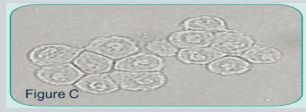
What are these?
squamous cells - urethra and female genital tract

What is this?
hyaline cast

What is this?
cellular cast
what are casts?
moulds of renal tubules
mucoproteins ± cells
when are casts more likely to appear in urine?
low pH
low urine flow rate
high USG
how many casts should be visible per low power field?
1 granular and 2 hyaline MAX
what may many casts indicate in urine?
tubular damage
when do crystals form?
if oversaturated in urine
what crystals are normally found inurine?
calcium oxalate dihydrate

what crystal is an artefact or storage method?
calcium oxalate dihydrate

what crystal is often indicative of altered urine pH?
struvite
what crystals are often indicative of liver disease
bilirubin
ammonium bi-urate
what crystals are often indicative of toxins/drugs
ethylene glycol
calcium oxalate monohydrate
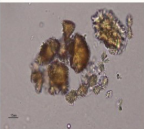
Identify this crystal
ammonium bi-urate

identify this crystal
struvite

Identify this crystal
bilirubin

Identify this crystal
calcium oxalate monohydrate
what do lipid droplets indicate, in which species?
in cats they indicate epithelial degeneration
what will pathogens in urine indicate?
pathology