HDFS 142 - Chapter #6
 Call Kai
 Learn
 Practice Test
 Spaced Repetition
 Match
 Flashcards
 Knowt Play
1/32

There's no tags or description
Looks like no tags are added yet.
33 Terms
Phonological Rules
Govern how sounds are combined to form words.
Syntactic Rules
Govern the way symbols can be arranged.
Semantic Rules
Govern the meaning of statements.
Pragmatic Rules
Tell us what uses and interpretations of messages are appropriate in a given context.
Linguistic Relativity
A language both reflects and shapes the worldview of those who use it.
Sapir-Whorf Hypothesis
The language spoken by Hopi Native Americans represented a view of reality that is dramatically different from most tongues.
- it holds that linguistic terms actively shape the thinking and actions of people.
Convergence
The process of adapting one's speech style to match that of others with whom the communicator wants to identify.
Divergence
Speaking in a way that emphasizes their differences.
Powerless Language
Tentative and indirect word choices with hedging and hesitations.
- tentative, indirect, hedges, hesitations, disclaimers
Powerful Language
Direct and forceful word choices with declarations and assertions.
- direct, forceful, declarations, assertions
Politeness
Communicating in ways that save face for both senders and receivers.
- saves face for both sender and receiver, evasion
Sexist Language
Includes words, phrases, and expressions that unnecessarily differentiate between females and males or exclude, trivialize, or diminish either sex.
Racist Language
Reflects a worldview that classifies members of one racial group as superior and others as inferior.
Ambiguous Language
Consists of words and phrases that have more than one commonly accepted definition.
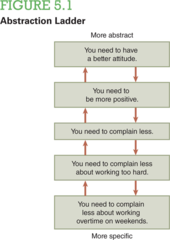
Abstraction Ladder
Shows how to describe the same phenomenon at various levels of abstraction.
Euphemisms
Innocuous terms substituted for blunt ones. Avoids a direct, literal reference to an event, substituting terms describing its consequence or related events.
Relative Language
Gains meaning by comparison.
Static Evaluation
The usually mistaken assumption that people or things are consistent and unchanging.
"It" Statements
Replace the personal pronouns I and me with the less immediate construction it's.
"I" Language
Clearly identifies the speaker as the source of a message.
- Accepts responsibility
"But" Statements
Statements that take the form of "X-but-Y".
- Cancels the previous thought
"You" Language
Expresses a judgement of the other person.
Assertiveness
Clearly expressing their thoughts, feelings, and wants.
"We" Language
Implies that the issue is the concern and responsibility of both the speaker and receiver of a message.
- implies joint concern and responsibility for the speaker and receiver
Evaluative Language
Seems to describe something but really announces the speaker's attitude toward it.
The Nature of Language
- Language is symbolic; words are arbitrary symbols and have no inherent meaning.
- Language is rule - governed.
Shemomedjamo (Georgian)
Someone knowing he or she is full but continuing to eat anyway.
Tartle (Scottish)
Is that moment of hesitance before introducing someone because you can't remember their name.
Backpfeifengesicht (German)
A face that is asking to be slapped or punched. "Gesicht" means "face," and "backpfeife" is a "slap across the cheek."
Significant differences
Men and women show significant differences in the ways they behave socially, use language. Some scholars describe men and women as members of distinct cultures.
Minor differences
Differences are not as clear-cut. Essentially, women's and men's speech is more similar than different.
Non-gender Influences on Language
- Conversation
- Setting
- Power
Accountable Language
Avoids "it" and "but"