Marine Communities Exam 2
 Call Kai
 Learn
Learn Practice Test
 Spaced Repetition
 Match
Match Flashcards
 Knowt Play
1/91

There's no tags or description
Looks like no tags are added yet.
Name | Mastery | Learn | Test | Matching | Spaced | Call with Kai | Chat |
|---|
No analytics yet
Send a link to your students to track their progress
92 Terms
Terms: sexual selection, intra-sexual selection, intersexual selection, clones, gonochoristic, simultaneous hermaphrodites, sequential hermaphrodites, protandrous, protogynous, size advantage model, sexual dimorphism, polygyny, polyandry, sneakers, semelparity, iteroparity, anadromous, catadromous, oviparity, viviparity, lecithotrophy, planktotrophy, teleplanic, poecilogonic
Study Guide: Be familiar with examples of asexual reproduction.
List and describe the pluses and minuses of sexual reproduction. Be able to explain the Red Queen Hypothesis.
List and describe the costs of free spawning. What mechanisms can prevent interspecific fertilization? Contrast broadcast spawning with internal fertilization.
? Define gonochorism. Differentiate between sequential (protandrous and protogynous) and simultaneous hermaphrodites. Be able to give examples of each. Under what environmental circumstances might you expect to find each of the three types of hermaphrodites? Explain the size advantage model and protandry. How do mating systems help to explain protogyny
Using examples, differentiate between intrasexual and intersexual selection.
Explain the process that led to large claws of fiddler crabs and sexual dimorphism in elephant seals.
Be able to tie parental care to sexual dimorphisms.
Differentiate between semelparity and iteroparity and give examples.
Differentiate between anadromous and catadromous fishes and give examples.
T/F: Sponges reproduce both sexually and asexually.
True, this is common.
Asexual reproduction somewhat common in invertebrates, but vertebrates mostly sexual. Some parthenogenesis (unfertilized egg becomes fertilized spontaneously) in some vertebrates (like sharks).
Mammals are all sexual as far as we know.
It is weird that sexual reproduction is so common.
What are the costs to sexual reproduction?
Relative to asexual reproduction, sexual reproduction:
Requires twice the fitness (both parents)
Is less efficient
Loss of “ideal” individuals? (because sexual reproduction takes two parents… the offspring will not be clones).
Slower population growth rate
If there are so many possibly important negatives to it, why is sexual reproduction so common? Give ideas
The Red Queen Hypothesis:
Differences in generation time between host and pathogen
Pathogens adapt faster than hosts
Increased host variation (sexual reproduction) makes it difficult for pathogen to specialize
Genetic variation may slow pathogens down (this is why sexual reproduction is so popular, according to the Red Queen hypothesis)
Evidence: frequency of females (snails) gets smaller in areas with more parasites. Asexually reproducing. Snails are also smaller when parasites are more common.
KEY TAKEAWAY = Sexual reproduction is more common when there are more parasites. Fewer parasites? Asexual reproduction dominates.
Sexual reproduction is more common when there are ___ parasites?
more
_______ = Releasing eggs and sperm into the water, and sperm swim to the eggs. Planktonic larval stage.
Free spawning
Problems:
Fertilization success altered by currents – density matters. Currents can take them away.
Timing matters – males and females need to be in sync.
Sync with tides (like releasing at a full moon/spring tide).
Interspecific fertilization – gamete recognition proteins to help gametes find each other of their own species.
Polyspermy (multiply sperm to an egg)- there are blocks to prevent it.
Re – (this is a low Re world, very viscous) turbulence needed, as in the flagella on sperm.
_____ = You have males and females of a species.
Gonochorism
____ = Male and female parts at the same time.
Hermaphroditism
Ex: barnacles (simultaneous hermaphrodites)
What is the benefit of hermaphroditism?
Kinds:
Simultaneous
Sequential
Good for barnacles (simultaneous hermaphrodites) bc they can’t move and need to mate with whoever is around.
Protandrous [first male] (start as M, switch to F) — clown fish
Protogynous [first female] (F to M) – moon wrasses
What is the benefit of each?
Switching from female to male
protogynous - moon wrasses
Switching from male to female
protandrous - clown fish

At what size should a fish change sex?
Good explanation for protandry = this model says as you increase in size that could carry more eggs, advantage changes to become female.
There comes a size where fish would make more offspring as the other gender.
KEY: when smaller better to make babies by having sperm. When bigger makes more sense to be female and carry lots of eggs.
A form of sexual reproduction where two fusing gametes (sex cells) differ in size and/or form.
Eggs are bigger than sperm.
Anisogamy
Why protogyny?
Related to mating systems
When protogyny occurs, there is often a social structure where the largest male gets the harem.
Under protogyny, when large, can produce most offspring by being male
Why is polygamy more common?
More common when resources are limiting.
Why? Unequal competition
may not be 50/50 males & females
may have one male/female that is dominant competitor and gets lots of resources/habitat/food
____ = multiple females to one male
polygyny
Ex: pinnipeds like elephant seals
some pinnipeds have extreme sexual dimorphism (the sexes look very different. In this case, males are a lot bigger)
____ = multiple males to one female
polyandry
Ex: seahorses
Albatrosses are _____, or have one mate.
monogomous
Polygamy makes sense when you have ____ resources
finite
Male seals often have a large harem of females. Females invest more in parental care. Which sex is the choosy sex?
Female fish has a group of male partners. Which sex is the choosy sex?
Female seals.
Male fish.
Pattern: whoever invests more in parental care is the choosier sex.
Polygamy – Which Sex is Choosy?
Parental care investment important
Often, but not always female
Females usually the choosy ones
Not always. Ex: Seahorses are the opposite.
Choosy sex must determine most fit males to improve offspring life
Choosy sex leads to _____ _____.
Sexual Dimorphism
Choosy sex estimating mate value by secondary characteristics
Leads to sexual dimorphism
Intersexual selection
Females choosing the sexiest male
Intrasexual selection
Males competing with each other
Females choosing the sexiest male
intersexual selection
Ex: colorfulness
Males competing with each other
intrasexual selection
Theres a strong selective pressure for bigger body size for males
Ex: elephant seals fighting for access to the female harem
What organism is a simultaneous hermaphrodite?
barnacles, which is good because they don’t move
Investing in current offspring possibly at the expense of future offspring. Often females, but males also invest. The investing sex is often the choosy sex.
Parental care
Which narwhals mostly have the tusk?
Males, for sexual selection
Reproducing once. Ex: salmon, octopus
semelparous
Reproducing multiple times. Ex: humans, whales, etc.
iteroparous
Salmon are ______, because they migrate from sea to freshwater to spawn.
anadromous
Life History Strategies

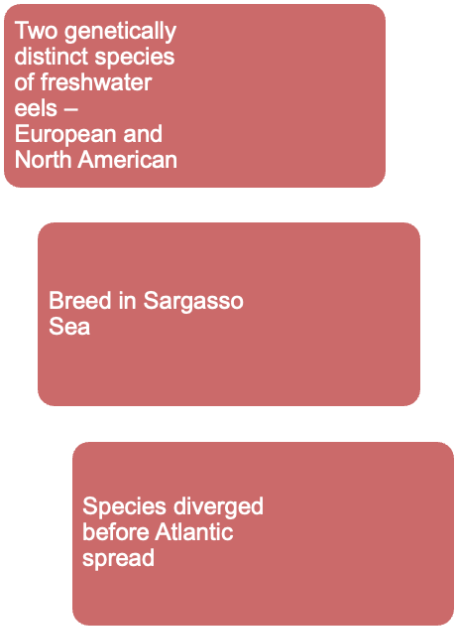
Eels are _____. Opposite of anadromous. Spawn in ocean, spend most of their life in freshwater streams.
catadromous

Study guide lecture 9
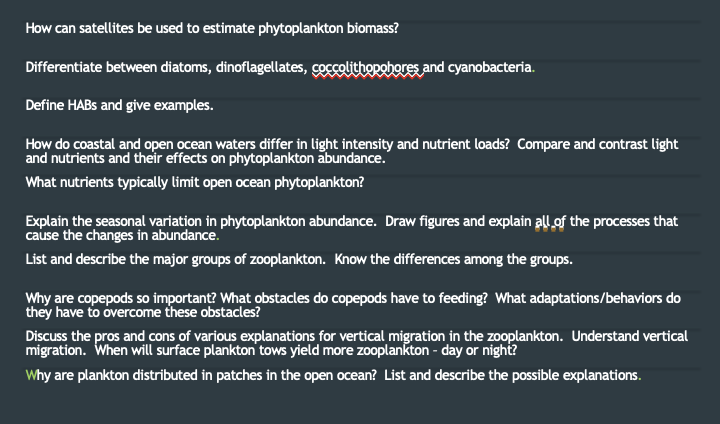
Terms: uplankton, neuston, nekton, prokaryote, eukaryote, femto/pico/nano plankton, micro/meso/macro/mega plankton, diatoms, dinoflagellates, coccolithophores, cyanobacteria, red tides, Langmuir cells, holo/mero plankton, foraminifers, radiolarians, naupliar larvae, copepodite, krill, chaetognaths, cnidarians, appendicularians, ctenophores, patchiness.
wanderers; cannot swim against currents
plankton
seawater - air interface; mostly prokaryotes
neuston
swim against the current
nekton
______ are (mostly) photosynthetic prokaryotes and eukaryotes
primary producers (gC/m3/time) (1o)
phytoplankton
____ are heterotrophic eukaryotes
secondary producers (2o)
zooplankton
Prokaryotic heterotrophs
bacteria
u0.02 - 0.2 µm (viruses)
femtoplankton
picoplankton
u; 0.2 - 2 µm (bacteria)
u2-20 µm (small phytoplankton and bacteria)
nanoplankton
If plankton < 20 µm, water must be observed directly
or filtered: ____plankton > 20 µm
Net
can be caught in plankton nets
u20 - 200 µm (small plants or animals)
microplankton
u0.2 - 20 mm (plants or animals)
mesoplankton
u2-20 cm (mostly animals)
macroplankton
u20-200 cm (mostly cnidarians)
megaplankton
T/F Plankton are good swimmers up and down.
true
How do you quantify phytoplankton?
uChl a (chlorophyll a) is measure of biomass (g Chl a/m3)
uEasy to measure chemically
uSatellites sense color of surface water and use to map phytoplankton distribution
Phytoplankton are (mostly) photosynthetic prokaryotes and eukaryotes
primary producers
What are kinds of phytoplankton?
diatoms
dinoflagellates
coccolithophores
cyanobacteria
uBrown/golden algae (Chrysophyta)
Different from Phaeophyta
uA dominant net phytoplankton
important to temperate spring blooms and in polar and neritic temperate waters
not abundant in tropics
uAbout 100,000 species
uSilica for shell; transparent
Diatoms
uDominant net phytoplankton
mostly in summer in temperate seas
common in tropics
uSize range: 25 µm - 1 mm
uRapid reproduction
u2 flagellae cause cell to whirl in water
uMostly unicellular with lower sinking rates
dinoflagellates
uNanoplankton; 5µm
uDominant in tropics or high-light conditions
uCalcium carbonate plates cover cell
uRemains common in many bottom sediments (cliffs of Dober)
coccolithophores
u prokaryotes
u nitrogen fixation common (nitrogen is most abundant gas in the atmosphere. In the ocean, the most limiting nutrient is nitrogen. Plants can’t use nitrogen gas. Nitrogen fixation is turning nitrogen gas into something that’s usable for them)
u Some produce toxins
u common in GOM (gulf)
cyanobacteria (blue-green algae)
HAB stands for?
Harmful algal blooms
Some dinoflagellates (red tides), diatoms (Pseudo-nitzschia), cyanobacteria (Lyngbya) and other phytoplankton cause harmful blooms
Toxins influence shellfish and marine animals
Mass mortalities of fishes and benthos may result
Some connection to fertilizer runoff??
What limits phytoplankton abundance?
Light
Nutrients
Grazing
Light limiting factor of phytoplankton abundance
Light intensity linear on log scale only 5-10% reaches 20 m
Light penetrates deeper in open ocean than in coastal waters (due to sediment suspended in the water that blocks light)
Nutrients limiting factor of phytoplankton abundance
Nitrogen:
Nutrients – substance used by organism to grow, survive, reproduce
N required for amino acids
N2 gas abundant, but can’t be used by most primary producers
Must be converted to NH4+, NO2- or NO3-
Soils on land are 0.5% N
Seawater averages 0.00005% N
Surface water may have no free dissolved N (got taken up right away maybe)
Nitrogen frequently limits phytoplankton in open oceans
N2 fixed into NH4NO3 through industrial process for creating fertilizer
Massive inputs of N from fertilizers reach coastal oceans today
Other nutrients:
Phosphorus (PO4)
Animal excretion source of P
Iron (Fe)
In open ocean (Pacific), Fe is very limiting
HNLP areas
The Geritol Hypothesis
Silicon (Si02)
silicate limiting only in diatoms
Grazing limiting factor of phytoplankton abundance
Many zooplankton and benthos consume phytoplankton at high rates
Zooplankton somatic growth is slower than phyto and is more temperature dependent
zooplankton “lag” behind phytos in abundance
Phytoplankton blooms may be necessary for successful recruitment of fish and invertebrates with planktonic stages
Reason you don’t have a lot more phytoplankton in more areas?
Not enough nitrogen
Why does diatom density drop in summer?
stratification, grazing, less nutrients
HNLP are areas in the ocean
High nitrogen low productivity
not much phytoplankton, limiting nutrient is iron
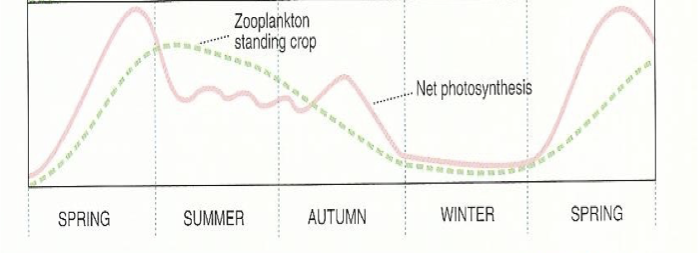
uGiven what you know about sunlight, seasons, stratification, nutrients, and phytoplankton explain the diatom cycle depicted below (temperate bay).
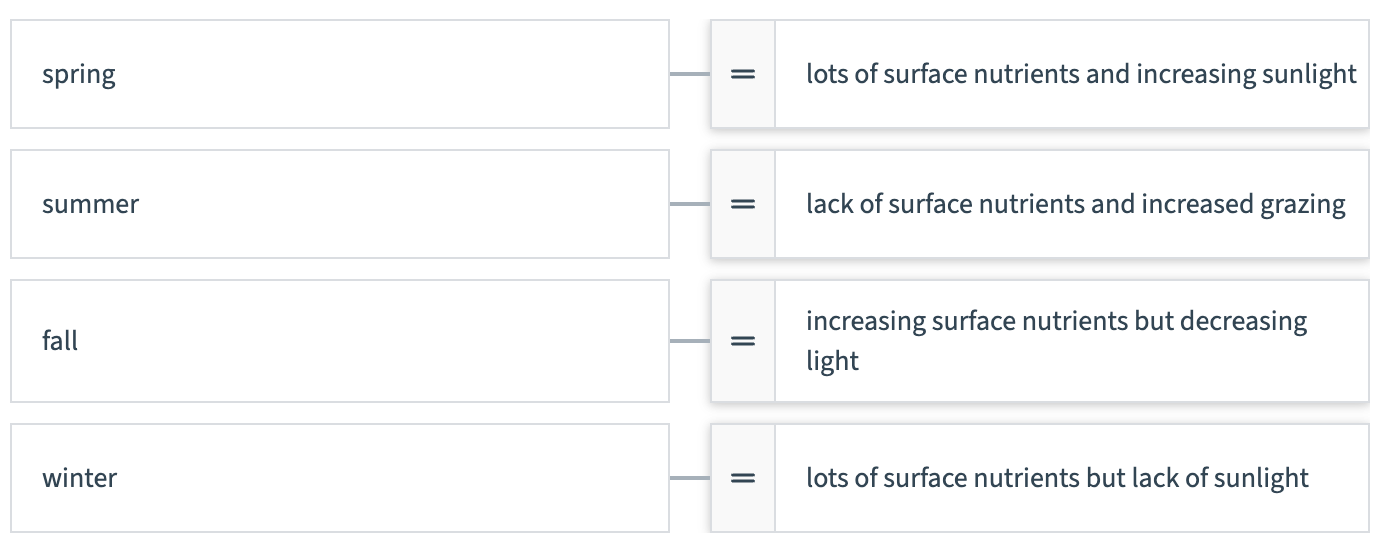
Summer has increased sunlight, so why is there a decline in diatoms in middle of summer? During the summer, this water column is stratified, so most of the dissolved nutrients are trapped below the pycnocline.
Increase in zooplankton (grazing) that eat diatoms.
Goes back up in the fall since it is cooling, water column starts to mix, and diatoms pick up nutrients.
Diatoms bottom out in the winter because: lack of light
Why a huge bloom in the spring, bigger than summer? Getting more light again, water column NOT stratified yet so still lots of nutrients at the surface leftover from winter mixing.
KEY POINTS
Lack of nutrients during seasonal stratification
Lots of grazing

Remember nutrient & sunlight throughout seasons
____ are planktonic animals that are taxonimically diverse
u eukaryotes
u most protist and metazoan phyla
u Smallest are single-celled, nanoplankton-sized, protist heterotrophs (2-20 µm)
u Largest are jellyfish (> 200 cm)
zooplankton
_____ live their entire life cycle as plankton in water column. (5,000 species)
holoplankton (think holo = whole life are planktonic
_____ juveniles and adults are benthic but larvae are planktonic (500,000 species or more)
meroplankton
Many fishes and other nekton have ___ larvae
planktonic
Many unicellullar phyla, includes foraminiferans (calcium carbonate shell), radiolarians (silica shell), microflagellates and ciliates
Protozoans ingest bacteria, and remains create oozes in deep sea
They are basis of paleo-oceanography
data collected by coring the ocean floor
Many eaten by small net zooplankton
protists
protists with calcium carbonate shell
foraminiferans
protists with silica shell
radiolarians
Crustaceans
Most important net zooplankton
“insects of the sea”
Important prey item
Fecal pellets transfer nutrients to bottom
1 - several mm in length
weak swimmers that “jump” when attacked by predators
Live in a high-Re but suspension feed in a low-Re environment on net-sized phytoplankton
copepods

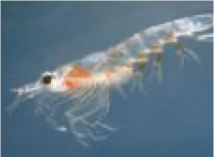
Euphausiids are also known as ___. Important to polar food chains
krill
Arrow worms
1-3 cm in length
predators of fish
larvae and zooplankton
60 species
Chaetognaths
Gelatinous, transparent or translucent
reduced silhouette makes almost invisible
Bodies a fragile sac that breaks up in nets
Larger ones prey on copepods or small fishes; smaller species filter feed
Cnidarians, tunicates
Cnidarians include jellyfish, anemones, corals.
Tunicates include siphonophores. They are actually chordates, in the same phylum that humans are.
The largest migration on earth by biomass is by ___?
zooplankton (not all)
Many zoops migrate daily – called ___ ___ ___
Up to epipelagic at night and down to mesopelagic during day
May migrate 1000 m each way (typically 100-400 m below the thermocline)
Equivalent to human walking 25 miles each night
Highly variable. Not all zoops do this.
Can swim up 15 m/h; swim down 100 m/h.
diel vertical migration
Why do zooplankton migrate? All these could be true.
1) Avoid visual-feeding predators at the surface
Supporting evidence
Experimental support from lakes
Reverse migration to nocturnal predators
Evidence against predation
Zoops swim deeper than necessary to avoid predators
Some transparent zoops also migrate
Reverse migration occurs in places where nocturnal predation (at night at the surface) is more important than predation by visual feeders.
2) Energy savings
Cooler temps below the thermocline slow metabolic rate and conserve energy. They are poikilotherms (look up to confirm)
Savings may be greater than the cost of extra swimming
3) Avoid harmful UV-light
Carotenoid pigments protect some zooplankton but reddish/brown color increases visibility & susceptibility to predators.
4) Phytoplankton recovery
Allows phytoplankton (the food source of zooplankton) to catch up during the day so zooplankton food resources aren’t exhausted.
Zooplankton dive down during the day to give phytoplankton time to do photosynthesis and replicate.
(will you find phytoplankton in mesopolagic? No, they need photosynthesis and mesopolagic doesn’t have much light)

T/F: Both phytos and zoops are patchy.
true
Plankton from tandem tows differ greatly
Satellites visualize patchiness of Chl a
Often offset;
Chl a and copepods abundant in different “patches”
due to grazing
Very little chlorophyll = very little phytoplankton (bc phytoplankton have chlorophyll in them)

Causes of patchiness include physical & biotic factors. What are they?
Langmuir convection cells (move and concentrate/ aggravate plankton in certain parts and not others)
Advection/turbulence may accumulate particles
Localized zooplankton grazing may reduce phytoplankton
Phytotoxins may eliminate zoops
Consequence of patchiness
Patchiness causes large errors in estimates of population size
Increases work load and cost (more samples required)
Causes variation in one sample to the next
Not all phytoplankton are toxic
Something that is planktonic…
can’t swim against current
Lecture 10
Terms: mixing depth, critical depth, light compensation depth, photorespiration, photoinhibition.
Explain the seasonal variation in phytoplankton abundance. Draw figures and explain all of the processes that cause the changes in abundance. How do plankton blooms differ between tropical and temperate waters? Describe the events occurring in a typical bloom.
Explain the Sverdrup and Behrenfield models. How do they differ? How do they compare to the Seasonal Succession Model. Know these in great detail.
Explain how LCD is affected by turbidity, proximity to coast.
Draw and explain the nutrient cycles for N and P. Include pools and sinks.
Why are phytoplankton less abundant in the open ocean?
Know the Redfield Ratio. Be able to identify the limiting nutrient like we did in class.
Explain benthic pelagic coupling. What is it? What mechanisms allow for the coupling? What does it matter?
Why is iron rare in the open ocean? Explain the whale pump and how it can affect phytoplankton abundance.
Why is silicon important for phytoplankton?
What evidence suggests that eutrophication (additional nutrients) favors HABs? How might fertilizers favor dinoflagellates over diatoms?
How do grazers affect phytoplankton distributions?
In temperate bays, diatom abundance is highest in the ___
Spring
Which figure most accurately depicts the seasonality of diatom blooms, surface nutrients, and zooplankton density in a temperate bay.
redraw and understand this


Differences in seasonal patterns do exist among taxonomic groups of phytoplankton
Diatoms passively sink
Dinoflagellates more mobile
Mostly focusing on diatoms

Build a study table of how these models differ in their explanations – remember that the pattern is the same, the explanation is what differs.
the pattern is the same, its just different explanations for the pattern.

Diatom abundances decline in the winter due to_____?
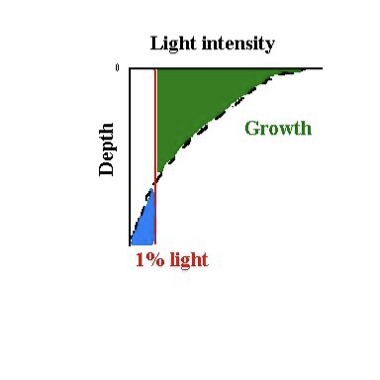
What really goes on in winter & spring?
1% light reaches 100m in clearest of tropical waters, can be cm in turbid polar waters
Affected by season, latitude, and turbidity
Light compensation depth
depth at which the amount of oxygen produced by phytoplankton cell = oxygen consumed by respiration per cell
Implications for phyto individuals and pop below this depth?
Critical Depth Hypothesis (similar idea to light compensation depth, but it is the whole population of diatoms rather than individual)
Mixing depth – depth at which all water is thoroughly mixed due to wind or convection. Deeper in winter.
Critical depth – the depth at which total O2 production (photo) = total O2 consumption (respiration). Net population growth is zero
MD>CD = decreased phyto – too deep (winter) phytoplankton growth rates< loss rates. Diatoms are dragged to depths, not enough light. Tie back to class model of seasonal diatom blooms
MD<CD = increased phyto (spring). Shallower mixing depth, diatoms trapped by surface getting the light they need. Contributes to blooms.
Summer growth still restricted by stratification and nutrients. Fall mixing still explains fall bloom
Sverdrup Model (1953) of Spring Phytoplankton Increase– works best with diatoms – more passive
Issues with Sverdrup model
There are some blooms in the winter when there is little light, great MD, and low temps
Blooms not always tied to MD
Sverdrup doesn’t really look at r
Behrenfeld Model
Focus on differences in winter and spring
Also called Dilution Recoupling Hypothesis
Pattern of seasonal mixing and stratification same
Winter phyto density declines due to dilution from increased MD (not diatom abundance but density bc of greater mixing depth & they are dilutes/spread out over a greater body of water)
Grazers (like zooplankton) also diluted from mixing = reduced grazing on phyto
Abundance of phyto builds over winter (r is positive), although densities are low.
Phyto population primed for spring sunlight
bc everything is diluted, grazing pressure not as high. Zoop have hard time finding phyto bc everything so diluted. Contradictory to other models. He says diatom population is growing in the winter, so abundances of phytoplankton are going up.
how can population be growing but value be small? the y axis is density. even if growing its all spread out over a large volume of water so density will still be low.