Lec. 4 : Bacterial Taxonomy
 Call Kai
 Learn
 Practice Test
 Spaced Repetition
 Match
 Flashcards
 Knowt Play
1/36

There's no tags or description
Looks like no tags are added yet.
37 Terms
Bacterial Binomial Nomenclature Rules:
Genus Name: Capitalized initial letter + Species Epithet: Lowercase initial letter
What descriptive information about the organism do bacterial names encode?
Appearance: eg. staphyl (cluster), coccus (round)
Habitat / Anatomic Location: eg. jejuni (gut / jejunum), pylori (pyloric sphincter)
Characteristic Property: lactis (secretes lactic acid)
Discoverer's Name: eg. E.coli
Basic Taxon:
The species is the fundamental unit of biological classification in taxonomy
A collection of bacterial strains that share many stable, characteristic properties and differ significantly from other groups of strains.
Species
Strains:
Subdivision of species; populations that possess minor genetic differences (e.g., point mutations, gene deletions, inserted operons, or acquired prophages).
Strain Examples: E. coli K12, E. coli ML30, E. coli DH5𝜶
Biovars:
Strains characterized by biochemical or physiological differences (eg. ability or inability to metabolize a certain sugar)
Morphovars:
Strains distinguished by morphological variations (eg. presence or absence of a capsule/capsid)
Serovars:
Strains possessing distinct cell-surface antigens that evoke different antibody responses in host cell (eg. Salmonella surface variants)
Antibiotic Resistance / Virulence Variants:
Strains that have acquired plasmids or genomic islands, conferring drug-resistance or pathogenic toxins
Jaccard Similarity Coefficient (Sj):
Numerical taxonomy evaluates overall similarity between bacterial strains by calculating the Jaccard Similarity Coefficient:

What does SJ= 0.0 indicate?
No shared traits between bacterial strains
What does SJ= 1.0 indicate?
Identical traits between bacterial strains
What does SJ ≥ 0.85 indicate?
Species Threshold (SJ ≥ 0.85 ); Strains belong to the same species
What does 0.65 ≤ SJ < 0.85 indicate?
Genus Threshold: Strains belong to the same genus but different species (e.g., Salmonella typhi vs. Salmonella enterica).
What does SJ < 0.65 indicate?
Inter-Genus Threshold: Strains belong to different genera (genus) altogether (e.g., Salmonella vs. Escherichia).
Dendrograms:
A tree-like diagram representing phenotypic similarity by plotting SJ values

Gram Staining:
Gram-positive vs. Gram-negative cell wall behavior.
Traditional Characters Used in Classification and Identification
Morphological Features
Biochemical and Physiological Traits
Serology and Phage Typing
Serology:
Classification and identification method that uses specific antibodies (antisera) to identify unique surface antigens on unknown bacterial isolates.
Phage Typing:
Classification and identification method that exploits the narrow host range of bacteriophages (bacterial viruses). Exposing an unknown bacterial lawn to different known phages and plaque formation reveals which phages it can be infected by, allowing the bacterial species or strain to be determined.
Which genomic characterization method compares melting temperature and density during centrifugation?
Base Composition (% G + C Content):
Genomes with higher % G+C require higher temperatures to denature/melt
G-C pairs are denser than A-T pairs; higher % G+C increases DNA density during centrifugation.
DNA-DNA Hybridization:
DNA from two organisms is mixed to see how well their strands pair
How do total genome hybridization and probe hybridization (methods for determining genome characteristics) compare?
Total genome hybridization compares the organisms’ entire genome; probe hybridization uses a short, labeled DNA oligonucleotide (probe) complementary to a gene unique to a specific pathogen
What does fluorescence or radioactivity indicate in probe hybridization?
The labeled probe has successfully hybridized (bound) to its complementary target gene, indicating that this gene, unique to a specific pathogen, is present
What can be determined if complete hybridization results from total genome hybridization?
Identical strain/species

What result would you expect from total genome hybridization between related species within the same genus?
Partial Hybridization

Which method of genomic characterization is most useful when interested in one particular gene?
Probe Hybridization: uses probe to detect specific gene/sequence in another organism
Gene Sequencing:
Directly determine nucleotide sequence of conserved marker genes (common target is the 16S rRNA gene) or essential protein-coding genes.
Which genomic characterization method establishes evolutionary lineages rather than comparing physical/chemical DNA properties?
Gene Sequencing is a direct genomic method that transitions to phylogenetics while indirect methods (G+C content and Hybridization) are traditional taxonomy
dichotomous key:
Flowchart utilizing paired, mutually exclusive choices (yes/no) based on physiological and staining traits to identify an unknown isolate

What supports the concept that greater structural complexity does not mean more evolved?
Prokaryotes originated ~3.5 billion years ago and successfully colonized every ecological niche on Earth; eukaryotes appeared only ~1.0 billion years ago.
Do you eukaryotes have a peptidoglycan cell wall?
No eukaryotic cells do not have a peptidoglycan cell wall. Peptidoglycan is found only in the cell walls of bacteria.
How much larger are eukaryotic cells relative to prokaryotic cells?
10 times larger (~10 µm) than prokaryotic cells (~1 µm)
Common Arrangements of coccus (spherical / ellipsoidal) bacteria:
single
diplococcus (pair)
Streptococcus (linear chains)
Tetrad (groups of 4)
Sarcinae (cubes of 8)
Staphylococcus (grape-like clusters)

What shape does “Bacillus” describe?
Rod-like / Cylindrical

Common Arrangements of Bacilli:
Single rod / Coccobacillus (oval)
Diplobacillus (pairs end-to-end)
Streptobacillus (chains end-to-end)
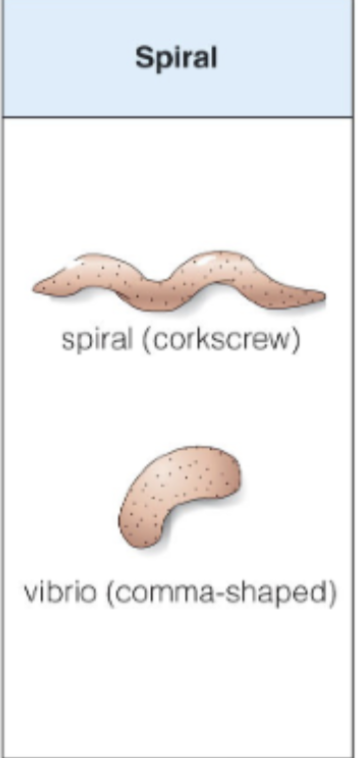
Common Arrangements of Spiral / Helical bacterial shape class:
vibrio (comma-shaped)
Spirillum (rigid helix; corkscrew)