1. Local anaesthetic MED CHEM
 Call Kai
 Learn
Learn Practice Test
 Spaced Repetition
 Match
Match Flashcards
 Knowt Play
1/22

There's no tags or description
Looks like no tags are added yet.
Name | Mastery | Learn | Test | Matching | Spaced | Call with Kai | Chat |
|---|
No analytics yet
Send a link to your students to track their progress
23 Terms
Describe the Na+ selective pore in voltage-gated Na+ channels.
- Between transmembrane domains 5 and 6.
- Contains a voltage gate which only allows ions of the correct charge and size to enter.
- Voltage sensitive a-helix which changes its shape when responding to a variation in charge. Moves up and down the pore to enable opening and closing of the voltage gate
- A channel inactivating segment which blocks the inner opening of the pore and form the inactive state of the channel.

Describe the opening of voltage gated Na+ channels
- At resting, the channel is closed as voltage gate (purple) block Na+ movement.
- Depolarisation of membrane causes voltage sensitive a-helix (pink) responds to this change in voltage via a conformational change of shape and moving towards the outer opening of the pore opening the voltage gate.
- This opens the channel allowing Na+ to flow into neurone.
- The pore then becomes inactive (refractory period) where the voltage gate remains open however cannot pass through the channel inactivating segment (blue) in the inner opening.
- Channel returns to resting state as the membrane repolarises where voltage sensitive a-helix returns to original position allowing the voltage gate to close.

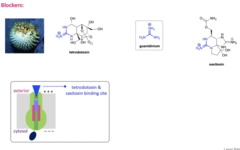
What are examples of natural Na+ channel blockers?
- Tetrodotoxin
- Saxitoxin
- Batrachotoxin
How do tetrodoxin and Saxitoxin work as natural Na+ channel blockers?
- Contain a guanidinium which block the entry in the Na+ ion channel.
- Prevents channel responding to stimuli (depolarisation) and therefore leading to paralysis and death in 'large' quantities
How does Batrachotoxin work as natural Na+ channel blockers?
- Binds irreversibly to the voltage senstive a-helix in Na+ channel.
- This causes channel to permanently open even without stimulation (depolarisation).
- Prevents ability to respond to stimuli and therefore causes death.

Describe the action of local anaesthetics.
- Inhibit voltage gated Na+ channel which prevents propagation of action potential and therefore nerve response.
- Leading to a loss in sensation and pain without a loss in consciousness.
- They are reversible and must have no effect on motor functions.
- Also have a rapid onset of action.
What are the structure types of local anaesthetics?
- Ester types
- Amide types
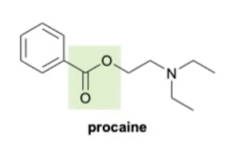
What is an example of an ester type local anaesthetic?
Procaine (DOA of 17 mins)
What is an example of an amide type local anaesthetic?
Lidocaine (DOA of 70 mins)

How does pH of binding site affect local anaesthetic activity?
- Determines if drug is protenated (hydrophilic) or neutral (lipofilic/hydrophobic).
- More lipofillic the better the activity as it can cross the cell membrane more easily.
- Local anaethetics are more affective at alkaline pH's e.g., during inflammation.
Why are local anaesthetics more effective at alkaline pH's?
- The amine is less protonated and therefore less positively charged.
- This makes the molecule more lipophilic, allowing it to cross the cell membrane more easily.

What are the pathways for local anaestehtcis to block Na+ channels/.
- Hydrophilic pathway
- Hydrophobic pathway
Describe the hydrophilic pathway on an open ion channel.
- The uncharged (lipophilic) LA crosses the cell membrane.
- Inside the cell, it becomes protonated (charged).
- The charged form enters the open sodium channel from the intracellular side.
- It binds inside the channel, blocking sodium influx and preventing nerve conduction.
- This is use-dependent block which only works when the channel is open.

Describe the hydrophobic pathway on a closed ion channel.
- The uncharged (lipophilic) LA diffuses through the cell membrane.
- It enters the sodium channel through lateral openings in the closed or inactivated state (no need for the channel to be open).
- It can bind to the resting or inactivated channel from within the membrane.
- This allows channel blockade without prior activation, unlike the hydrophilic pathway.

Why do both the hydrophilic and hydrophobic pathways require an uncharged LA (uncharged tertiary amine)?
- Only the lipophilic, uncharged form can cross the lipid membrane to reach the intracellular binding site.
- The charged form cannot cross the membrane effectively.

Why is pKa of LA important?
- Hydrophilic and hydrophobic pathways require an uncharged tertiary amine because only the un-ionised (uncharged) form of the local anaesthetic (LA) can diffuse across the membrane.
- Only possible in the neutral form allowing it to cross the membrane.
- Lower pKa leads to slower onset of action as more hydrophilic/charged.
Describe the SAR type LAs.
- Aromatic group
- H-bond donor or H-bond acceptor linker e.g., ester or amide.
- Tertiary amine connected to alkyl groups or in a ring system is essential.

What is the role of the aromatic group in local anaesthetics?
- It is essential for π-π stacking interactions with the sodium channel.
- It is lipophilic, helping the drug cross membranes.
- Adding electron-donating groups (e.g. -OH, -OCH₃) at the ortho or para positions increases activity by enhancing electron density, which improves binding affinity and stabilises interaction with the receptor.

Why are amides preferred over esters in local anaesthetic structures?
- Local anaesthetics often have an H-bond donor or acceptor linking aromatic group and tertiary amine, such as an ester or amide.
- Amides are preferred because they are less susceptible to hydrolysis by esterases, making them more stable and longer-acting.
What is the function of the tertiary amine in local anaesthetics?
- The tertiary amine, often attached to alkyl groups or part of a cyclic structure e.g., piperidine, is essential for:
- Ionic and van der Waals interactions with the sodium channel
- Protonation at physiological pH, which gives the drug aqueous solubility and enables it to bind effectively once inside the cell.

How do electron-donating groups (EDGs) enhance local anaesthetic activity
EDGs (like -NH₂ or -OCH₃) on the aromatic ring at ortho or para positions increase electron density via resonance.
- This allows stabilisation of a charged resonance form, making the LA more effective at binding to the sodium channel.
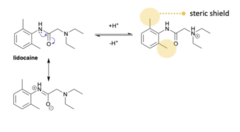
What is the function of bulky alkyl groups near the amide nitrogen in local anaesthetics like etidocaine?
- They act as a steric shield, preventing access by amidase enzymes.
- This reduces hydrolysis, increases metabolic stability, and extends the duration of action.

Why is resonance stabilisation important in local anaesthetics?
- It allows the nitrogen's lone pair to delocalise into the carbonyl and aromatic ring, creating a more stable electronic structure.
- This improves binding affinity to sodium channels, enhances potency, and contributes to a longer duration of action.
- Also methyl groups on aromatic provide a steric clash to amidase enzymes.