ACER 9/21 Lecture #6: Atomic Orbitals (QM of Hydrogen)
 Call Kai
 Learn
Learn Practice Test
 Spaced Repetition
 Match
Match Flashcards
 Knowt Play
1/12

There's no tags or description
Looks like no tags are added yet.
Name | Mastery | Learn | Test | Matching | Spaced | Call with Kai | Chat |
|---|
No analytics yet
Send a link to your students to track their progress
13 Terms
How do you calculate potential energy for Ĥ in the Schrödinger equation? Why do you need to calculate potential energy?
V(r) is the potential energy
r is the separation between the electron and the nucleus
-e is the charge of the electron
+e is the charge of the proton
ε0 is the electric constant/vacuum permittivity, which measures how easily an electric field can pass through an empty space (a vacuum).
The potential energy is needed to solve the Schrödinger equation because the Hamiltonian operator in the Schrödinger equation is the sum of potential and kinetic energy.

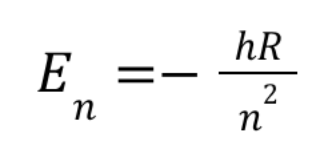
How do you calculate the specific energy of an energy level for hydrogen atoms?
This equation can be derived from modifying the Rydberg equation.
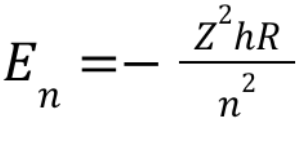
How do you calculate the specific energy of an energy level for all one-electron atoms?
One-electron atoms that are ionized to have only one electron use a modified equation from the one used for hydrogen atoms.
Z is the atomic number, aka the number of protons
hR is another Rydberg constant, found by multiplying the Rydberg constant for frequency (1.097 × 10⁷ m-1) by the Planck constant h and the speed of light c, or by multiplying the Rydberg constant for wavelength by just the Planck constant.
This is E in the Schrödinger equation.
Polar Coordinates
Since we’re looking at a 3D sphere (not a 2d or 1d shape), we have to use spherical polar coordinates Ψ(r,θ,φ) instead of Cartesian coordinations ψ(x,y,z).
r is the distance from the nucleus (the center of the sphere)
θ is the angle from the z-axis
Φ is the angle about the x-axis
How do you calculate wavefunction ψ to solve the Schrödinger equation?
Based on the polar coordinates Ψ(r,θ,φ):
Ψ(r,θ,φ) = R(r) x Y(θ,φ)
R(r) is the radial wavefunction. Wavefunction changes with radius.
Y(θ,φ) is the angular wavefunction
What are the 4 quantum numbers? (What are they for? Don’t need to list them.)
When solving the Schrödinger equation in detail, we find that four quantum numbers are needed to describe the exact location and energy of each electron in an atom.
How many and which quantum numbers are needed to label a wavefunction (name an orbital)?
3 quantum numbers: n, l, and ml
What does it mean if two orbitals is degenerate?
Those two orbitals share the same energy shell and energy
List the electron subshells indicated by l = 0 to l = 6
l = 0: s
l = 1: p
l = 2: d
l = 3: f
l = 4: g
l = 5: h
l = 6: i
What does the angular momentum/azimuthal quantum number indicate for l = 0 and l = 1? What does that mean?
The orbital angular momentum.
l = 0 indicates that an electron is in the first subshell s. Subshell s has zero angular momentum.
l = 1 indicates that an electron is in the second subshell p. Subshell p has a non-zero angular momentum, which means that the electron is rotating around the nucleus.
Radial Distribution Function (what is it, why is it used)
often used instead of the whole separated wavefunction R(r) x Y(θ,φ) because it only gives the radius where the electron is rather than the 3D longitude and latitude
P(r) is the radial distribution function which gives the total probability of finding the electron at that radius in an infinitely thin shell
r is radius, distance from the nucleus
R(r) is the radial wavefunction

Radial Nodes
points when wavefunction = 0
can be seen as x-intercepts on radial wavefunction graphs and radial distribution graphs
How do you draw a visual representation of wavefunction/probability density/electron orbital for an s-orbital?
A 3D sphere (draw a shaded circle to represent about 90% of an electron’s probability density) with a dot in the center to represent the nucleus. The closer to the nucleus, the darker the shading and the greater the probability density.
A circular dotted line around the nucleus at the radius where a radial node is.
The spaces between these node lines alternate between ψ+ and ψ- (this can be arbitrarily assigned since it’s just for mathematical representation). Indicate these cross-sections by shading differently.