ACCOUNTABILITY (W 1.6)
 Call Kai
 Learn
Learn Practice Test
 Spaced Repetition
 Match
Match Flashcards
 Knowt Play
1/8

Earn XP
Description and Tags
NON-FINANCIAL KPIs: CUSTOMER LIFETIME VALUE (CLV)
Name | Mastery | Learn | Test | Matching | Spaced | Call with Kai | Chat |
|---|
No analytics yet
Send a link to your students to track their progress
9 Terms
what do you know about the different elements of the customer journey?
customer journey has 2 different aspects:
deep drivers
trigger → experience, need & behaviour
orientation → experience, need & behaviour
purchase → experience, need & behaviour
inexperienced → experience, need & behaviour
experienced → experience, need & behaviour
relationship → experience, need & behaviour
brain heuristics
buyer journey (trigger → purchase)
user journey (inexperienced → relationship)

how do results financially vary across the customer journey?
in the acquisition stage the profit is usually negative or small
during the lifetime the profit increases
at the end of the lifetime the profit declines, if the usage reduces or the contract is being ended

what are some ways you can influence the customer lifetime value?
successfully target profitable customers
developing existing customers through cross- & up-selling
retain profitable customers

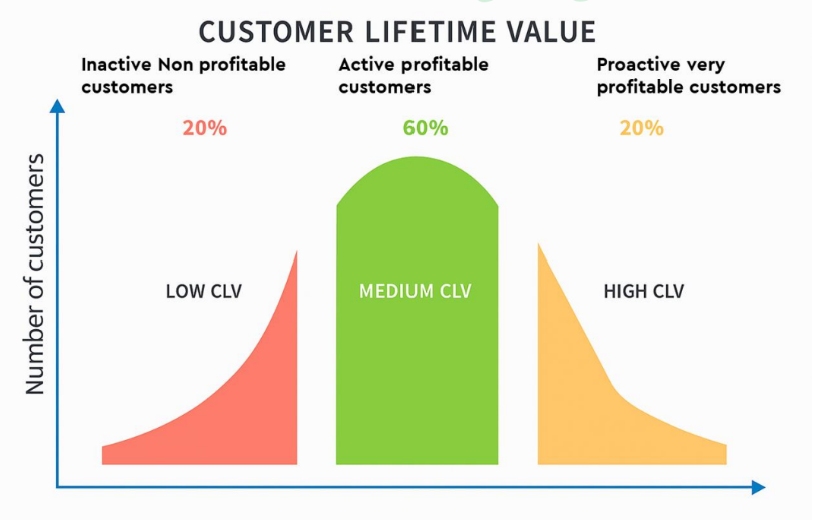
what are the rough CLV percentages between the customers?
if you manage to de-average the customer, there’s usually a big difference in value they provide
ex. of a low CLV customer is an energy consumer that switches every year to get a discount
good for the customer but not always for the company
they need customers that stay longer for a (more) positive CLV
what do we need, in order to calculate CLV?
we need understanding of interest & the time value of money
2 types of interest:
simple interest → interest is calculated on principal amount only
compound interest → interest is calculated on principal amount plus added interest
example of both calculations: if the capital amount is €1,000, interest rate 10% & time 5 years, then:
simple interest: €1,000 + 5 × 10% = €1,500
compound interest: €1,000 × 1.10^5 = €1,610.51
why do we use compound interest?
it’s used to calculate the future value of an investment

what’s the opposite of future value?
it’s the present value

how do we calculate CLV with the simple method?

how do we calculate CLV with the advanced method?
this formula uses the expected retention probability to determine lifetime
a higher retention rate increases value
improvements in margin (higher revenue or lower costs) increase value
