EESA Water Midterm
 Call Kai
 Learn
 Practice Test
 Spaced Repetition
 Match
 Flashcards
 Knowt Play
1/159

There's no tags or description
Looks like no tags are added yet.
160 Terms
Why is it important to study water?
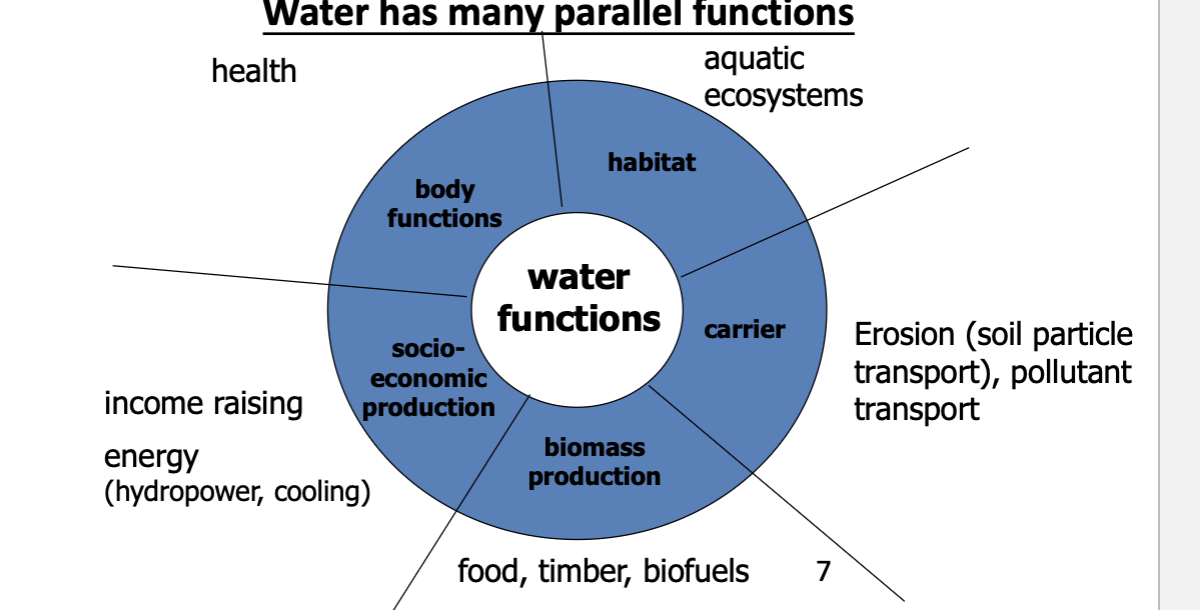
Because Water resources are vital limited and threatened. Our lives and our prosperity depend on water (bloodstream of the biosphere)
What are different water crisis (why is it important to study water)
Scarcity, pollution, wasteful use, environmental degradation, climate change, water conflict, floods, inadequate human access to safe water and sanitation
What is one of the greatest threats to Canada’s supply of fresh water (why is it important to study water)
Our belief that our supply is unlimited: we must improve the management of water supplies
What are the 3 challenges for future sustainable use of water resources?
How much water will we need in the future? Where will the additional water come from? How will we achieve the sustainable use of water resources?
What is outgassing?
Gasses that are trapped in the planet’s interior and released through volcanos
What is water’s origin?
When volcano’s released gasses, the earth cooled the water vapour and condensed it, turning into oceans

What is a Qanat?
The concept of transporting water great distances
What are aspects of water and the environment?
Physical (rivers, lakes, etc.) , historical (past to improve future), social aspects, legal aspects
How much water does the Earth contain?
1.39 billion km^3
What is the distribution of water like on Earth?
It’s not evenly distributed and varies season to season; 1/3 of the world lacks fresh drinking water
What are water disparities?
The unequal distribution of freshwater across different regions and populations
What are consequences of water disparities?
Store water in reservoirs during wet periods, rely on groundwater resources (if they are available, transport water supplied great distances
What causes currents?
Persistent prevailing wings blowing over the ocean creating gyres (circular ocean currents)
What is the Coriolis effect?
Earth's rotation causes ocean currents to change direction instead of moving in a straight line
What are glaciers? How are they formed? (Glaciers, permanent snow, sea ice, and polar ice caps)
Glaciers are large masses of snow that are so heavy they turn into ice; form from compressed snow becoming so thick that gravity causes them to move
What is a Cryosphere? (Glaciers, permanent snow, sea ice, and polar ice caps)
Refer’s to Earth’s frozen ground and water; 10% glaciers and 20% permanent snow
What do Polar Ice Caps generate? (Glaciers, permanent snow, sea ice, and polar ice caps)
Generate cold, dense water creating deep ocean circulation
Do ocean currents affect the world’s climate? (Glaciers, permanent snow, sea ice, and polar ice caps)
Yes: they alter ocean temperatures by moving cold and warm water around regulating the Earth’s climate by distributing heat
What is Groundwater?
Water stored underneath the Earth’s surface; replenished when precipitation falls on land surface and seeps down into an aquifer
What is an Aquifer?
A geological formation (rock, sand, or gravel) containing water; allows groundwater to flow through and stores it
What is the main source of water to sustain ecosystems?
Groundwater; sustains ecosystems, riparian zones (areas around water such a trees, grass, vegetation), lakes, rivers (potable water for roughly 30% of Canadians)
What is an Ephemeral Stream?
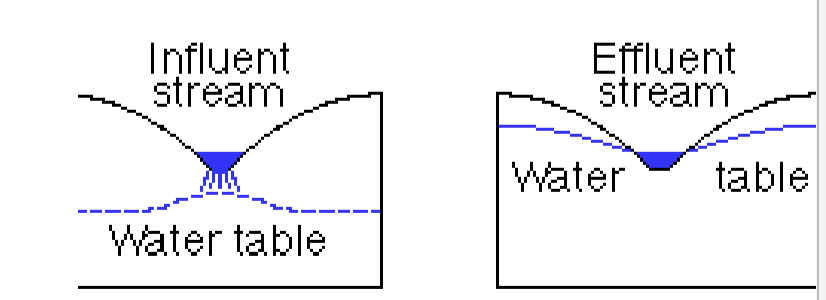
A stream not fed by a continuous water source or flow only after storm events; temporary stream of water (i.e., dry rivers in Australia)
What are Lakes?
Inland body of water found in topographic depression (low land of area surrounded by higher land); Canada contains nearly half of the world’s lakes
What is Fossil Water?
Water remaining as a result of glacial melting

What is Lake Stratification?
When lake water separates into different densities and temperatures; heaviest at 4 degrees Celsius
What is Lake Turnover?
Occurs in spring and fall; occurs when water temperature and densities become similar and distributes nutrients and oxygen throughout the lake
What are Wetlands (natural sponges)?
Areas saturated by surface or groundwater for a long enough time where the ground turns into wetland soil or vegetation (flood mitigation, water purification, habitat, food, breeding and nesting)
What is an Atmosphere?
A gaseous envelope that surrounds a planet where water vapour moves into the air through evaporation from land and water bodies

What are Watersheds?
The topographic area within which apparent surface water drains to a specific waterbody
What are Human Effects of Freshwater Ecosystems?
Dams and river diversions, population growth, deforestation, urbanization, pollution
What are Megacities?
Massive, densely populated, urban centres of 10 million or more people; increasingly found in less-developed regions
What are the Environmental Issues of Megacities?
Danger from flooding, increase contamination of surface and GW supplies, resource depletion, poor air quality
What is Virtual Water?
The total amount of water used in the production of anything; eventually clean water supplies will be inadequate to supply the needs of the increasing population
Is water always in motion?
Water is constantly in motion during the water cycle (evaporation, condensation, precipitation, streamflow, GW), but not all water is in motion; the Sun is the main energy source driving the water cycle
What is a Phase Change? What causes it?
When water changes from one state to another (solid to liquid to gas). The amount of heat energy causes a phase change; needs to be sufficient enough to affect the hydrogen bonds between molecules
What is the Hydrologic Cycle?
The continuous movement of water between the Earth’s surface, atmosphere, and ground; mainly driven by the Sun
What are the 6 main processes of the water cycle?
Evaporation, transpiration, condensation, precipitation, infiltration, runoff
What is transpiration?
The biological movement of water from the soil into the plant and then out from the leaves as water vapour
What is high water potential?
Water that has more energy to move to an area with less water potential i.e., downhill stream
What is osmosis?
The movement of water across semipermeable membrane from a region of lower solute concentration (higher water potential) to a region of higher water potential (lower water potential)
What is stomata?
Tiny openings on the underside of leaves; their role is to take up CO2 to release water vapour
What is orographic air mass movement?
Moist air forced upwards by mountains; cools, condenses, and produces precipitation
What is frontal air mass movement?
When warm air rises over colder, denser air and cools to produce precipitation
What is convective air mass movement?
When the Sun heats the ground, causing warm air to rise, cool, and form rain clouds

What is cold front?
When large masses of fast moving cold air displace warm and moist air

What is warm front?
When higher warm air mass meets the heavier cold air, the warm air mass rises over the cold air mass and cooling takes place
What is a water table?
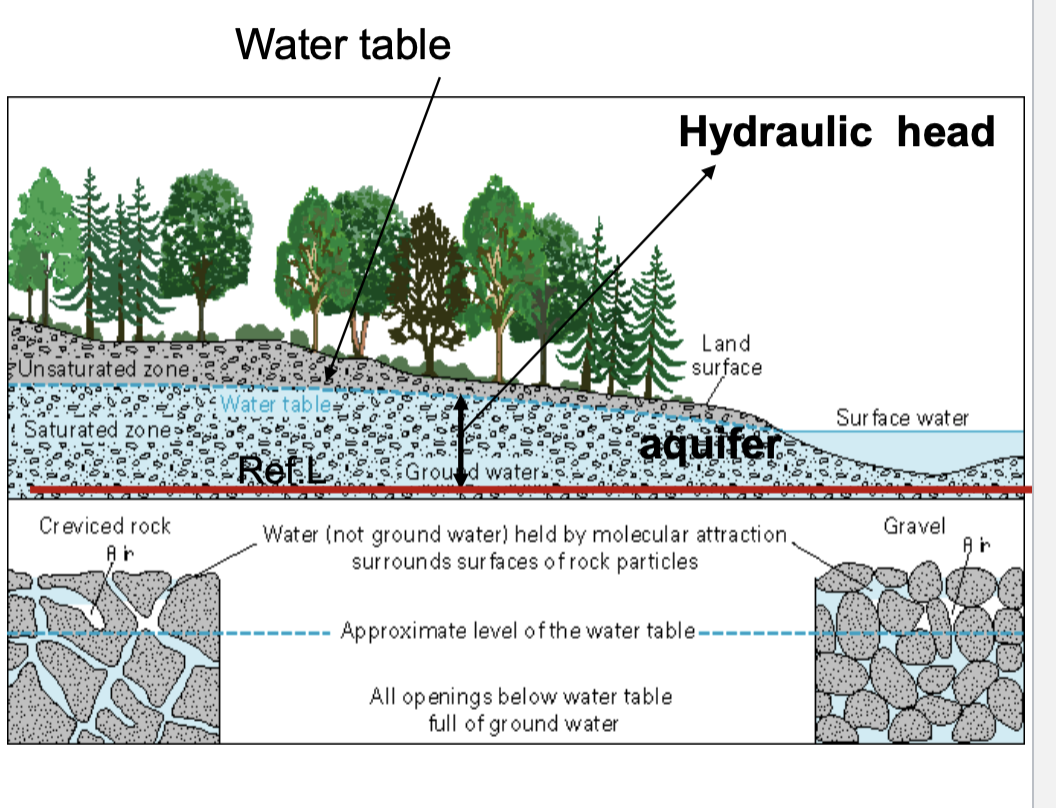
The top water surface of an unconfined aquifer at atmospheric pressure
What is an artesian aquifer (confined aquifer)?
An aquifer which GW is confined under pressure that is greater than atmospheric pressure
What is an unconfined aquifer?
An aquifer whose upper surface is a water table free to move around
What is an unsaturated zone (vadose zone)
A subsurface zone above the water table where the pore spaces may contain a combination of air and water
What is a saturated zone?
A zone below the water table where the pores spaces are filled with water (no air)
What is a confining bed?
Low conductivity material (impermeable rock or clay)
What are aquicludes?
An underground layer that stores water but is completely impermeable
What are aquitards?
An underground layer that transmits water at a very slow pace
What is hydraulic head?
The elevation of the water table above the reference line
What is hydraulic conductivity?
Aquifer porosity, or how easy GW moves through an aquifer
What is unconsolidated gravel and sand?
Loose particles that are not cemented together; high porosity, very easy for water to move through
What is consolidated material?
Materials such as sand and silt cemented together; low porosity, not easy for water to move through
What is creviced rock?
Solid rock containing cracks or fractures where water can move easily through

What is streamflow? What are the 2 different streamflows?
The volume of water that a stream carries per unit time (m3/s or ft3/s); storm flow and base flow
What is source flow?
The movement of water from its source into a river or stream

What is overland flow (run off or surface flow)? What are the 2 types?
Water from rainfall or snowmelt that flows over the land’s surface instead of soaking into the ground; Horton (infiltration-excess) and saturation-excess overland flow

What is hortonian flow (infiltration-excess)?
When rain falls faster than the soil can absorb (rain water cannot absorb all the rain water)

What is saturation-excess overland flow?
When the soil is already completed saturated with water so the soil cannot absorb any more water and overland flow forms
What are macro pores?
Large spaces or openings in soil that allow water to move quickly through the ground
What is source water?
Water from natural sources that is used to supply drinking water
What are watersheds?
Topographic area where surface water runoff drains into a stream or a body of water
What are the advantages of a watershed?
A coherent unit that can be managed together, a shared resource (encourages everyone to respect the water supply), activities on land affect the watershed i.e, removing trees causes erosion and increases runoff
What is a water budget?
The balance between water entering, leaving and being stored in an area, such as a water shed

What is the water budget formula?
(P = R + ET) or (R = P - ET), P: precipitation, R: run off, ET: evapotranspiration
What does the term “blue water” mean?
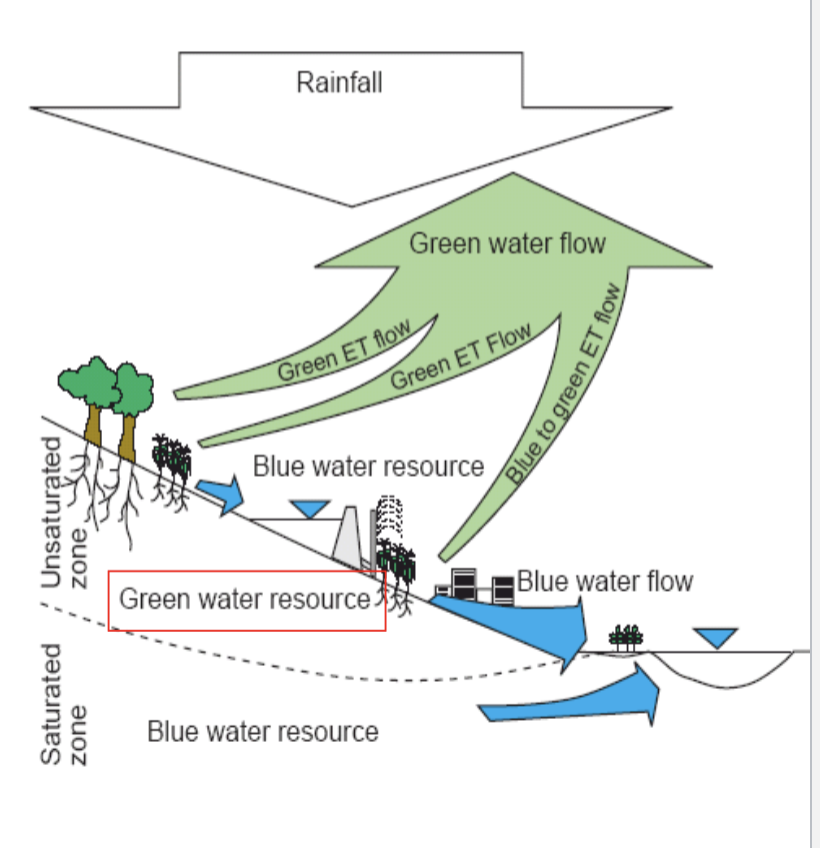
Visible, liquid water that flows in rivers, lakes, and groundwater

What does the term “green water” mean?
The invisible flow of water vapour from the surface into the atmosphere through evaporation and transpiration from plants (precipitation that never makes its way to surface water)
What is blue water used for?
Provides humans with drinking water, used for electricity, irrigation, fishing boating, water sports; returns to aquatic ecosystem as waste water
What is blue water used for in irrigation?
When blue water is artificially supplied to water crops when rainfall isn’t enough i.e., when a farmer pumps water from a nearby lake to water their crops
What is productive green water (transpiration)?
Water absorbed by plant roots to grow and produce biomass (plant material) where the water is eventually into the atmosphere through transpiration (productive since it contributes to plant growth)
What is unproductive green water (evaporation)?
Water that directly evaporates into the atmosphere i.e., ponds, soil, wet leaves, roofs (unproductive since it doesn’t contribute to plant growth)
How did humans affect the hydrological cycle?
Humans utilized local water supplies; transported water from other locations (cycle altered by urban development and cultivation of land and crops)
What is channelization? Why do humans channelize rivers?
When humans straighten or modify rivers instead of allows them to flow naturally. To reduce flooding in urban areas, make room for roads and developments, and control where water flows
What are the negative affects of channelization?
Loss of natural river features, habitat damage, changes temperature and humidity
What is a terminal lake?
A lake that has no outflow to a river or ocean (endorheic: drainage system where water flows into a lake or basin but doesn’t reach ocean)
What are water stocks?
Amount of water stored in a particular place at a given time; lakes, rivers, glaciers (measured in volume m³ or km ³)
What is sustainable vs unsustainable water use?
Water withdrawn at a rate that can be replenished vs water withdrawn faster than it can be replenished i.e., the Colorado River Basin experiences water shortages due to high water demand
What is spatial vs temporal variability?
Differences across locations (where water varies) vs differences over time (when water varies)
What is a climate moisture index (CMI)?
A measurement of how wet or dry a region is by comparing precipitation with potential evapotranspiration
What is potential evapotranspiration (PET)?
How much water could evaporate and be released by plants if water were available
What is the formula when precipitation is greater than or equal to PET (P ≥ PET)?
CMI = 1 - (PET/P)
What is the formula if PET is greater then precipitation (PET>P)?
CMI = (P/PET) - 1
What is hydropower?
Electricity generated by using falling water to spin turbines (19% of the world’s total electricity)
What is off-stream water use?
When water is taken from a body of water and used somewhere else
What are the 4 main types of off-stream water use?
Thermoelectric power plants, industrial use, domestic use, agricultural use

What do thermoelectric power plants do?
Use water to cool steam during electricity production; taken from river, used for cooling, returned to same river.
What is the difference between consumptive vs non consumptive use?
Water taken from a source and not returned in a usable form (water depletion) vs water used but most of it returns to an aquatic system (return flow)
What is virtual water (VW)?
Water that is embedded in a product
What is VW trade?
When countries import other export products that require water to produce; arid regions should import water-intensive products to conserve their limited water supplies, helps global distribution of water resources
What is a water footprint?
Total water used directly and indirectly by the population (not always the same as water use); expressed as m³ per person

What are factors that affect the size of a country’s water footprint?
Total consumptions of industrial products and food, types of products consumed, efficiency of agriculture and industrial production
What is water pollution?
Physical or chemical change in water that changes the health of humans or organisms
What is sewage?
Waste water from drains or sewers from human waste that threatens public health and causes high biochemical oxygen demand (BOD)
What are disease-causing agents?
Wastes of infected individuals such as bacteria that spread infectious diseases