Q1 U01+U02 IA
 Call Kai
 Learn
 Practice Test
 Spaced Repetition
 Match
 Flashcards
 Knowt Play
1/165

There's no tags or description
Looks like no tags are added yet.
166 Terms
kinetic energy
energy of motion
slower movement = lower kinetic energy
temperature
measure of average kinetic energy
hotter temperature = higher avg kinetic energy = more motion
matter
anything that has mass and takes up space (volume)
particle
a tiny piece of matter
law of conservation of matter
matter can’t be created or destroyed, only transformed
solid
a state of matter characterized by its definite shape and definite volume, where particles are closely packed together.
In solids, particles vibrate in fixed positions, resulting in a rigid structure.
liquid
a state of matter that has a definite volume but indefinite shape (takes the shape of its container), where particles are less tightly packed than in solids and can move past one another.
gas
a state of matter that has indefinite volume and indefinite shape, where particles are far apart and move freely.
rank the states of matter from least to most kinetic energy
solid < liquid < gas
rank the states of matter from lowest to highest temperature
solid < liquid < gas
solid → liquid phase change
melting
liquid → gas phase change
evaporation or boiling
gas → liquid phase change
condensation
liquid → solid phase change
freezing
solid → gas phase change
sublimation
gas → solid phase change
deposition
freezing point
temperature to cross to freeze from a liquid to a solid
melting point
the temperature at which a solid becomes a liquid.
boiling point
temperature at which a liquid turns to gas
solid properties
rigid shape, definite shape, definite volume
liquid properties
not rigid, indefinite shape, definite volume
gas properties
not rigid, indefinite shape, indefinite volume
how does matter change phases
by adding or removing heat
pure substances
matter made of only ONE type of atom or molecule and is the same all the way through
2 types of pure substances
elements, compounds
atom
smallest unit of an element that still has that element’s properties
smallest building block of matter
molecule
two or more atoms chemically bonded together
elements
contain only 1 kind of atom
cannot be chemically broken down
some elements are diatomic molecules in their natural state (contain 2 of the same atoms)
compounds
molecules that contain 2 or more different elements
can be chemically broken down
subscript when writing the formulas gives the number of atoms of each element in a compound
2 types of elements
atoms and molecules (diatomic elements)
2 types of compounds
molecules and crystalline substances (salts)
physical change
when a substance changes its state, shape, or size but is still the same substance (molecules themselves stay the same)
usually REVERSIBLE
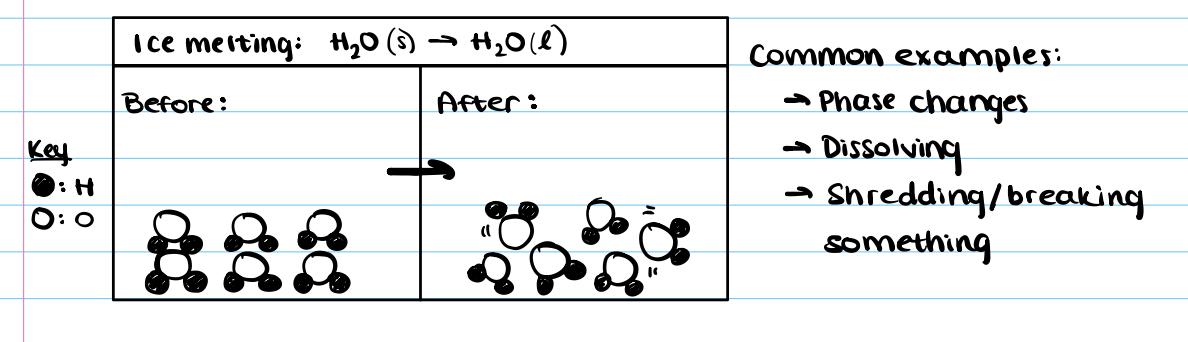
common examples of physical changes
phase changes
dissolving
shredding/breaking somethign
chemical change
when molecules in substances combine or break apart to form a new substance with unique properties

any chemical reaction is a _______ (physical or chemical) change because:
CHEMICAL change - because reactants react to make completely new products
mixtures
matter with 2 or more substances PHYSICALLY combined, not chemically bonded
substances mixed keep separate identiteis and most of their own properties - separated based on PHYSICAL properties
2 types of mixtures
homogeneous and heterogeneous mixtures
homogeneous mixtures
look the same throughout
particles are evenly spread and too small to pick out individually
substances that mix this way are SOLUBLE in each other
heterogeneous mixtures
do NOT look the same throughout
individual pieces are visible
substances that mix this way are INsoluble in each other
separation method: filtration
separates solids that didn’t dissolve from a liquid
separates based on particle size
It involves passing the mixture through a filter, allowing liquid to pass while trapping solid particles.

separation method: evaporation
used to separate a dissolved solid from a liquid by boiling the liquid away, leaving the solid behind.
separates a dissolved solid when you only want to keep the dissolved solid (want the solid back) but don’t want the liquid
used to recover salts

separation method: distillation
separates two liquids with different boiling points
a separation technique that involves heating a liquid to create vapor and then cooling the vapor to create a liquid, allowing for the separation of components based on different boiling points.
It is particularly useful for separating homogeneous liquid mixtures, especially when the components have significantly different boiling points.

separation method: layer separation / decanting
separates liquids/substances that don’t mix (heterogeneous mixtures) and settle into clear distinct layers
A technique used to separate immiscible liquids by pouring off the top layer, leaving the denser liquid behind. This method relies on differences in density to achieve separation.
ex: can be used to separate oil and water

separation method: chromatography
used to separate mixed components that you need to tell apart
particularly useful for separating ink colors or plant pigments
the higher up a pigment moves on the chromatography strip, the more soluble it is in the solvent

physical property used to separate in chromatography
solubility
more soluble = moves further up the paper
how do pigments separate in chromatography
Pigments separate in chromatography based on their solubility in the solvent. More soluble pigments move further up the chromatography strip, allowing for effective separation and differentiation of colors.
Pigments move up the paper through capillary action (travel through tiny tubes in the papers like how water travels through roots and tiny tubes in trees to reach the tops of leaves)
mixture separation plan order
is there something magnetic → YES: use magnets to separate
are there separate/clear solid and liquid phases → YES: filtration (removes solid particles)
is there a dissolved salt present? YES:
want to keep the liquid → distillation
don’t want to keep the liquid → evaporation
mixture of 2 liquids? YES:
uniform (HOMOgeneous) → distillation
layered (HETEROgeneous) → layer separation
whatever’s left should now be PURE SUBSTANCES ONLY
subatomic particles
components of an atom
ex: protons, neutrons, and electrons
what are the 3 main types of subatomic particles?
protons, neutrons, and electrons
charge of proton
+1
charge of neutron
0 (“neutral”)
charge of electron
–1
mass of proton
1 amu
mass of neutron
1 amu
mass of electron
≈0 amu
what are the two parts to an atom?
nucleus and orbitals

the nucleus of an atom contains which subatomic particles
protons and neutrons
the orbitals of an atom contain which subatomic particles
electrons
ion
“charged atom”
cation
positive ion
(think: “cations are PAWS-itive”)
anion
negative ion
(think: "aNions are N-egative")
if number of protons = number of electrons → is this a neutral atom or an ion?
neutral atom
if number of protons does NOT equal number of electrons → is this a neutral atom or an ion?
ion
if number of protons > number of electrons → is this a cation or anion?
cation (think: “cations are PAWS-itive”)
if number of protons < number of electrons → is this a cation or anion?
anion (think: "aNions are N-egative")
isotopes
same element but with different masses
same protons but different neutrons
what do all isotopes of the same element have in common?
same number of protons
what do all isotopes of the same element differ in?
the number of neutrons in each isotope
how to calculate charge
charge = (number of protons) - (number of electrons)
how to calculate mass
mass = (number of protons) + (number of neutrons)
most of an atom’s mass is contained in the ____
nucleus
changing the number of protons changes the ____
element’s identity
changing the number of neutrons changes the ____
mass (creates different isotopes)
changing the number of electrons changes the ____
charge (creates different ions)
atomic symbol
contains information about how many subatomic particles make up an atom
contains information on: mass, charge, and the atomic number

the atomic symbol like the following allows us to determine what information: 612C−4
atomic number: 6
mass: 12 amu
charge: –4
number of protons: same as atomic number (6)
number of neutrons: mass - protons = 12 - 6 = 6
number of electrons: protons - charge = 6 - (-4) = 10
periodic table
a table providing information on all known 118 elements including their atomic number, symbol, and atomic mass

average atomic mass
represents all isotopes of the element and their natural abundance in nature
like a “weighted average” of all isotopes
how will the average atomic mass compare to the mass of the most abundant isotope?
the avg atomic mass will always be CLOSEST to the mass of the most abundant isotope
mass spectrum
graphical method of representing the mass number of an isotope vs. its percent abundance
typically represented as a bar chart
tallest peak = most abundant
isotopes further to the right = more mass = more number of neutrons (for that element)

mass spectrometry
technique used to measure the masses of ions and analyze the composition of chemical samples.
used to make the mass spectrum

steps to calculate average atomic mass
convert all % abundances to decimals (move decimal points 2 spots to the LEFT)
multiple: (isotope mass) × (decimal abundance)
add up everything together

how to use a mass spectrum to determine an unknown element’s identity?
calculate the average atomic mass using the percent abundances and corresponding masses on the mass spectrum
compare to the Periodic Table - the unknown element will have an average atomic mass that MATCHES the one you calculated
how to calculate mass of an atom
To calculate the mass of an atom, you can use the formula: mass=number of protons+number of neutrons
units of amu
units for mass of an atom
amu (atomic mass units)
how to tell if two atoms are isotopes of each other
same number of protons
different number of neutrons
*NOTE: don’t worry about number of electrons
how to identify the element
look at its atomic number (the number of protons)
how to write an atom’s atomic symbol
ProtonsMassSymbolcharge
NOTE: symbol is the 1-2 letter abbreviation from the periodic table
groups / families
columns of the periodic table

elements in the same group have the same _______
REMINDER: group = column
same number of valence electrons
same chemical properties (similar reactivity)
period
rows on the periodic table
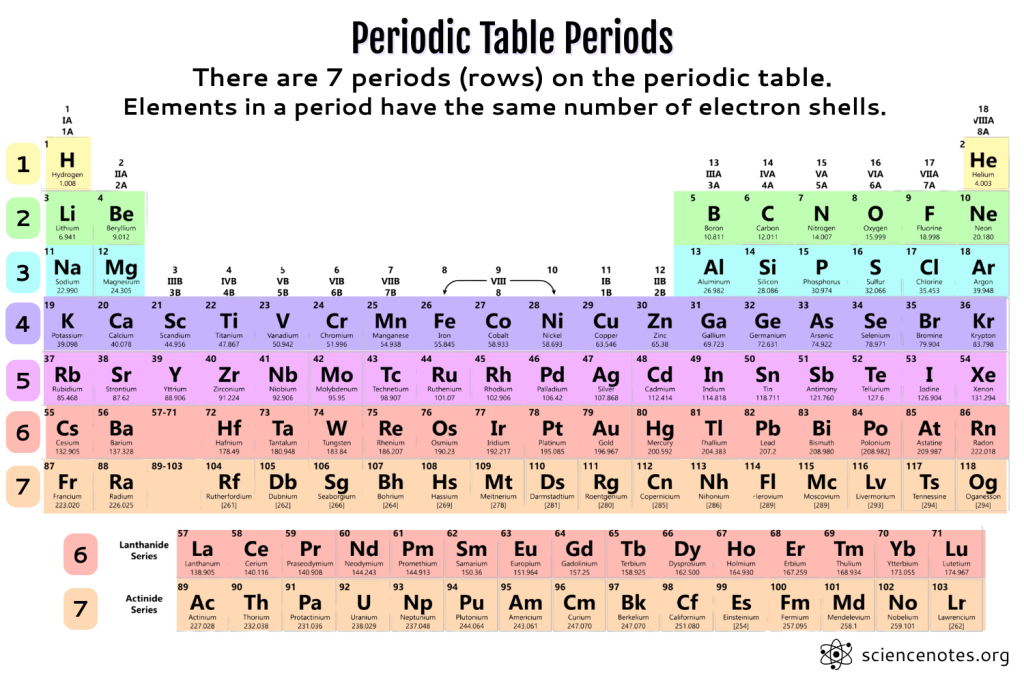
elements in the same period have the same _____
REMINDER: period = row
number of shells (number of energy levels) for electrons
valence electrons
electrons in the outermost shell

shielding electrons
electrons in inner shells

orbital
A 3-D region in of space an atom around the nucleus where an electron is most likely to be found (about 90% of the time)
part of the Quantum Mechanical model of an atom

Bohr model vs. Quantum Mechanical (Schrödinger) model
Bohr model (older) describes electrons in fixed orbits around the nucleus
Quantum Mechanical (Schrödinger) model (modern) describes the most likely (but not exact) position of electrons within an orbital
shell
represent a specific energy level of an electron

subshell
a sublevel an electron shell that can hold a specific number of electrons, categorized by the types of orbitals (s, p, d, f).
a group of orbitals with the same energy
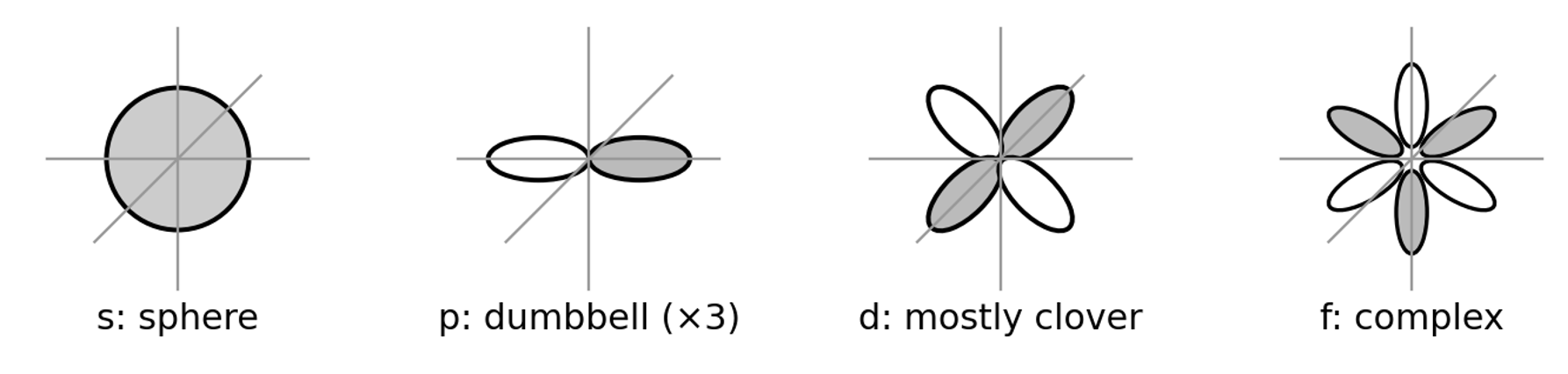
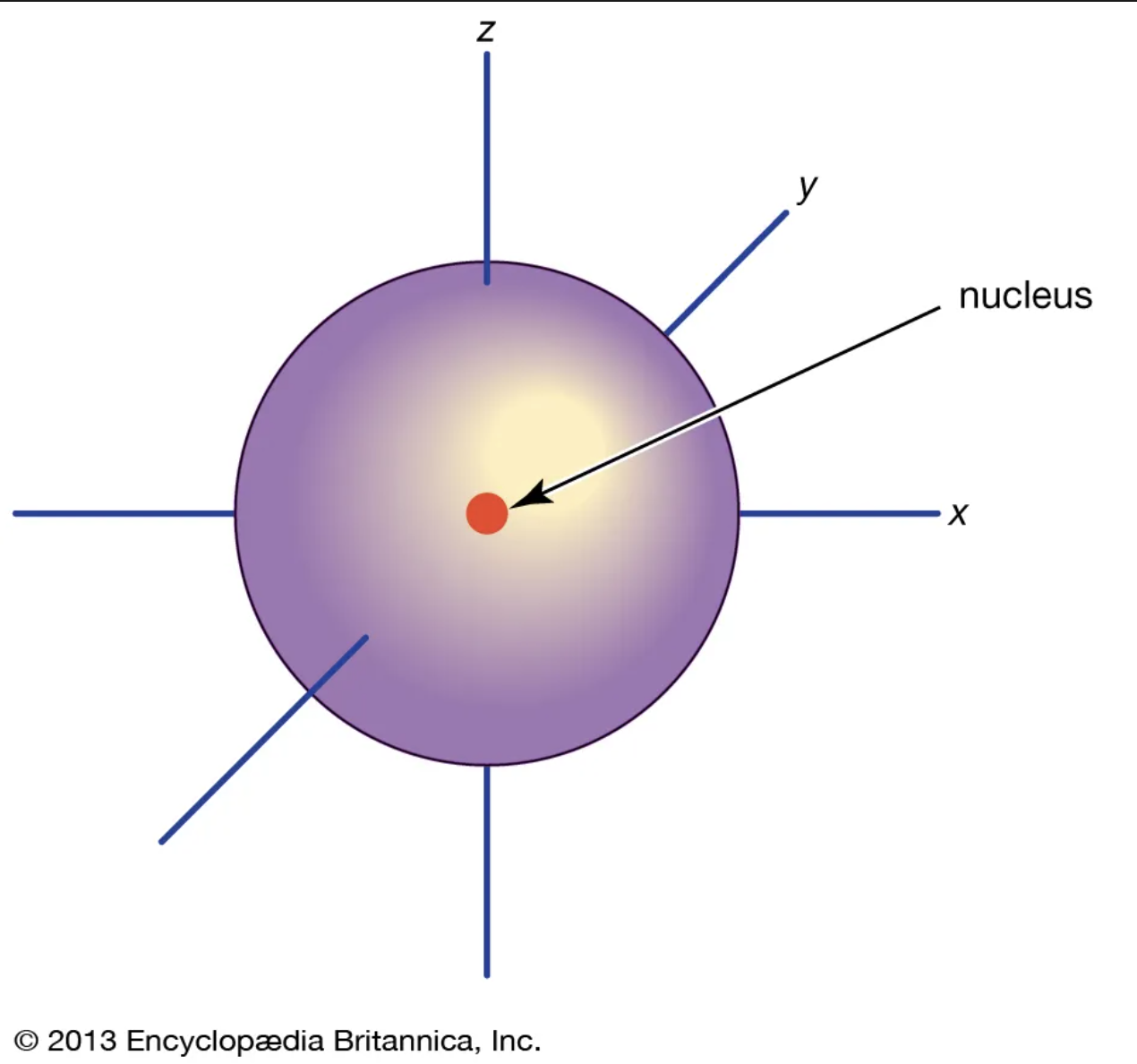
s subshell: number of orbitals
1 orbital that can hold a total of 2 electrons
p subshell: number of orbitals
3 orbitals that can hold a total of 6 electrons
