Haemoglobin
 Call Kai
 Learn
 Practice Test
 Spaced Repetition
 Match
 Flashcards
 Knowt Play
1/11

There's no tags or description
Looks like no tags are added yet.
12 Terms
Why do multicellular organisms require mass transport systems?
‣ High metabolic rate.
‣ Need a large/rapid supply of oxygen & glucose.
‣ Surface area to volume ratio is usually low.
‣ Diffusion would be too slow for sufficient delivery of oxygen/nutrients & removal of waste products.
Describe the structure of haemoglobin
Globular protein.
‣ Has quaternary structure → consists of 4 polypeptide chains.
‣ Each polypeptide chain has a haem group containing Fe2+, which binds oxygen.
What does the affinity of haemoglobin for oxygen depend on?
‣ The partial pressure of oxygen.
‣ As partial pressure of oxygen increases, the affinity of haemoglobin for oxygen increases.
Why is the oxyhaemoglobin dissociation curve s-shaped?
The first oxygen binds to haemoglobin, causing a change in the shape/quaternary structure.
‣ The shape change of haemoglobin makes it easier for the other subunits to bind oxygen so gradient of the curve steepens.
‣ The gradient of the curve reduces again because binding of the 4th oxygen is more difficult due to the majority of binding sites being occupied.
How haemoglobin varies between organisms, enabling an organism to be adapted to its environment
Different organisms have different types of haemoglobin, with a different primary sequence and so a different tertiary structure
‣ due to a different sequence of amino acids.
‣ So haemoglobin in different organisms/ species can have different oxygen transporting capacities.
Explain how oxygen is loaded, transported and unloaded
Partial pressure of oxygen is high in the lungs so oxygen binds to haemoglobin, forming oxyhaemoglobin.
‣ Oxyhaemoglobin is transported in the blood in red blood cells.
‣ Loading of oxygen takes place in the lungs at a high partial pressure of O2.
‣ Oxygen is unloaded to respiring cells and tissues at a low partial pressure of O2.
‣ Unloading/dissociation of oxygen is linked to higher carbon dioxide concentration.
Explain the advantage of the oxyhaemoglobin curve being shifted to
the left for an animal that lives e.g. at high altitude
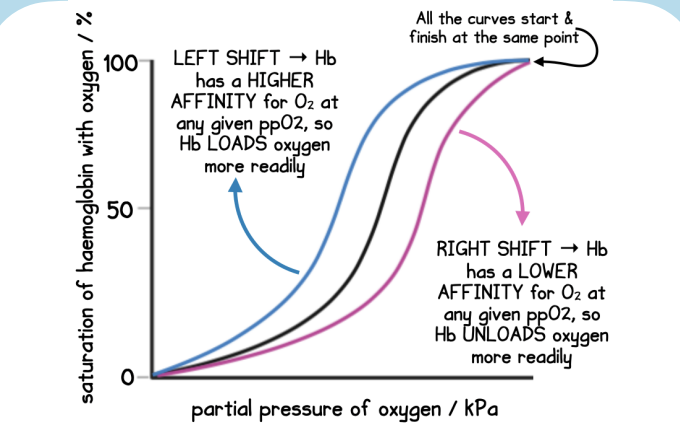
‣ Organisms that live in environments with a low partial pressure of oxygen (e.g. high altitude) have haemoglobin with a HIGHER AFFINITY for oxygen than human haemoglobin.
‣ So haemoglobin LOADS OXYGEN more readily.
‣ Enabling it to be more saturated with oxygen at low partial pressures of oxygen.
‣ Allows the organism’s haemoglobin to become fully saturated at lower partial pressures of oxygen.
State the name given to a change in the oxygen dissociation curve due to increasing carbon dioxide concentration
Bohr shift.
Explain how increasing the partial pressure of CO2 increases the supply of oxygen to tissues
Shifts oxyhaemoglobin dissociation curve to the right.
‣ Increased carbon dioxide in the blood reduces the pH of the blood.
‣ This alters the structure of haemoglobin, reducing the affinity of haemoglobin for oxygen.
‣ Oxygen is unloaded more readily to respiring tissues.
‣ Allowing a higher rate of respiration.
Explain the advantage of the oxyhaemoglobin curve shifting to the
right during vigorous exercise
Haemoglobin has a lower affinity for oxygen at a given partial pressure of oxygen.
‣ So oxygen unloads more readily to respiring cells.
‣ Oxygen can be used for rapid respiration,
‣ which allows more ATP to be produced for muscle contraction.
Relationship between size of mammals & oxyhaemoglobin dissociation curves
The smaller the mammal, the more right-shifted the oxyhaemoglobin dissociation curve.
‣ Smaller mammals have a larger surface area to volume ratio.
‣ So lose body heat at a higher rate.
‣ So have a higher metabolic rate to maintain body temperature (respiration is exothermic).
‣ So have a higher oxygen demand.
‣ Their haemoglobin has a lower affinity for oxygen at any given partial pressure of oxygen, so unloads oxygen more readily.
‣ Providing oxygen for the higher rate of respiration.
Draw an oxyhaemoglobin dissociation curve to show a right shift & a
left shift