UAS-Airspaces (Week 4)
 Call Kai
 Learn
 Practice Test
 Spaced Repetition
 Match
 Flashcards
 Knowt Play
1/33

Earn XP
Description and Tags
For Hocking College NRM-1128, Intro Unmanned Aerial Systems. Originally created by Luke Gilkey
34 Terms
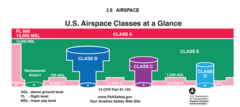
Class B Airspace
Setup around the busiest airports (remember B for Busiest)
Generally
3D POV: Upside down wedding cake.
from the surface to 10,000ft. MSL
Looks like a big circle on a chart.

What is Class B's chart symbology
Solid blue line.

Why is the "upside down wedding cake" important to remember for class B?
That is because Class B airspace has "shelves" in altitudes.
So if you are directed to a certain spot on a chart and asked "If I am flying my drone at 200 ft. AGL, what airspace am I in?" you may not be necessarily in class B airspace though it appears you are due to your point being in the blue circle.
It all depends on your location, and any other airspace classifications within that area.

Do you need approval before you can fly your UAS in Class B airspace?
YES
What is the Mode C Veil?
Mode C veil surrounds class B airspace.

Is the Mode C Veil considered an airspace?
No.

What are all manned aircraft required to be equipped with when inside the Mode C Veil?
Mode C Transponder.
It's a piece of equipment that data to the controller in charge of the airspace.
Class D airspace
Airspace around an airport busy enough to warrant a control tower.
Surface to 2,500 ft. AGL.
3D POV: Single cylinder
Looks like a blue dashed circle on the chart.

What is Class D's chart symbology?
Dashed Blue Line.

What happens to a Class D airspace if the tower (that is operated part-time) shuts down for the day/night?
Airspace reverts to either class E or G.
Do you need approval before you can fly your UAS in class D airspace?
YES
What is class E airspace?
Everything that is controlled that is not class A, B, C, or D.
Represents most airspace in the national airspace system.

Why should you pay special attention to class E airspace?
Most confusing to pilots.
How is class E airspace unique in terms of chart symbology?
Class E airspace can begin at different altitudes, and each can be marked differently depending on where the airspace begins.
Class E airspace starting at the surface:
Dashed magenta lines.

Do you need prior authorization before operating your UAS in class E airspace (that begins at the surface)?
Yes
Class E airspace beginning at 700 ft AGL.
Faded magenta line.
(it rises to 1,200 ft. AGL)

Class E airspace beginning at 1,200 ft. AGL
Faded Blue Line
One way to remember class E:
E at Surface: Dashed Magenta Line (Prison bars, restricted)
E at 700 ft. AGL: Faded Magenta Line (Faded, more freedom)
E at 1,200 ft. AGL: Faded Blue Line (Fading into the blue sky, no need to worry about it as a UAS pilot).
Do you need prior authorization before operating your UAS in an airspace marked by a faded magenta line?
No
Faded magenta is Class E airspace beginning at 700 ft. AGL
The height limit for a UAS is 400 FT. AGL.
Important note: this could be an issue if you were required to exceed that limit legally.
For example: if you were assigned to inspect a tower at 1,300 ft. AGL, you are permitted to fly 400 ft. AGL (or above the tower).
If you are in this situation, then get authorization.
What is Class G airspace?
Uncontrolled airspace.
Generally below class E airspace (THIS MIGHT BE IMPORTANT FOR TRICK QUESTIONS ON THE EXAM)

Do you need authorization before flying in class G airspace?
No.
Airspace Chart Symbology:
Class B: Solid Blue Line
Class D: Dashed Blue Line
Class C: Solid Red/Magenta Line
Class E (At Surface): Dashed Magenta Line
Class E (At 700 ft.) Faded Magenta Line
Class E (at 1,200 ft.): Blue Faded Line

What is LAANC?
FAA's
Low Altitude Authorization and Notification Capability
What do the grid numbers in LAANC mean?
They are the altitudes at which the FAA may authorize you to fly.
They do not inherently give you permission to fly, you must get authorization.
Why is LAANC important to you as a drone pilot?
You use this to submit a authorization request.
Many requests are granted/denied in real time.
You are hired to record a building that stands at 200 ft. AGL.
You notice on the chart that you are in an airspace marked out by a blue faded line.
Do you need authorization to fly?
No.
Blue Faded Line= Class E airspace at 1,200 ft. AGL.
Building=200ft. AGL.
Height limit is 400 ft. AGL (which means you can fly at 600 ft. AGL as long as you are over that building).
No conflict.
Only conflict possible is if there is some airspace marked on the chart that begins at the surface, but normally its class G airspace.

What airspaces are contained in this photograph?
Class D airspace (Dashed blue line)
Class E (beginning at 700 ft AGL)

What airspace are you in if you are located at the parachute jump area (marked by the red parachute icon on the chart)?
Class D airspace.
Dashed Blue line

What airspace are you in if you are located at "697" (right hand corner)?
Class E Airspace
Faded magenta line= Class E at 700 ft. AGL.
You are standing at Hanscom airport (upper left hand corner), and your friend (Franky Longtooth) points out that you both are standing in class B airspace.
Is he right?
Not necessarily.
Remember, class B airspaces has "shelves" of altitudes in it's airspace.
Though it may appear like you are from a brief look at the chart, you must remember the 3D perspective and carefully examine the chart for more info.

What airspace is Hanscom airport located?
Class D airspace.
Dashed Blue line=Class D


How do you locate airspace altitude information on sectional charts?
They are often marked by numbers in fractions (70/30 for example).
So for example, if an airspace begins at the surface (SFC), and extends to 7,000 ft AGL, it would be marked as
70/SFC
70=7,000 ft
SFC=Surface
If it began at 3,000 ft. and extended to 7,000 ft, it would be:
70/30
Etc.

If you were wanting to fly your drone at Minot (bottom right hand corner), do you need prior authorization?
Identify your closest airspace.
No.
Your closest airspace (besides class G, which is under this) is class E airspace.
Faded Magenta line begins at 700 ft AGL
The class B airspace's altitude in that area is marked at 70/30 which means it begins at 3,000 ft AGL and extends up to 7,000 ft. AGL.
Class E airspace does not conflict because it extends from 700 ft. AGL-1,200 FT AGL.
Height limit for UAS is 400 ft AGL which avoids class E airspace.