2 - Recombinant Insulin
 Call Kai
 Learn
 Practice Test
 Spaced Repetition
 Match
 Flashcards
 Knowt Play
1/169

There's no tags or description
Looks like no tags are added yet.
170 Terms
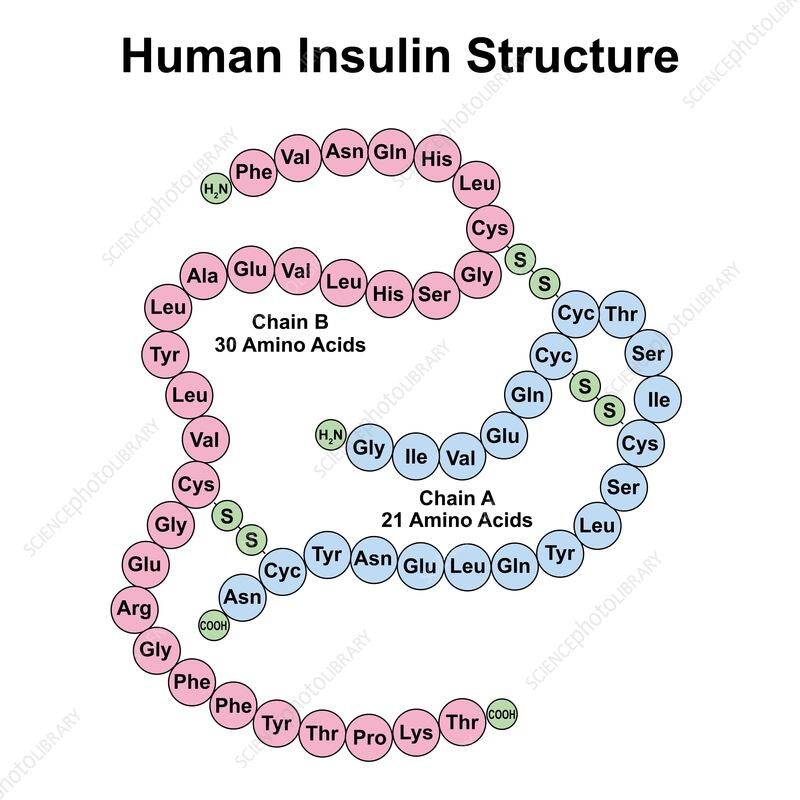
Structure of insulin?
51 amino acids total
Alpha chain = 21 AA
Beta chain = 30 AA
Connected by disulfide bonds
MW = 5808 Da
heterodimeric protein of 51 amino acids possessing 3 disulfide bonds.
What is the history of insulin development from the 1950s–1982?
1950s → NPH and Lente animal insulins introduced as longer-acting forms
1982 → Human insulin cloning led to replacement of animal insulins
What insulin formulations were developed from 1996 to present, and why?
Short- and long-acting insulins to control glucose in T1D and advanced T2D
What is the history and future of inhaled insulin and newer insulin therapies?
Inhaled insulin approved in 2006, withdrawn, and redeveloped in 2015; future therapies aim to improve glucose control
Overall, insulin as had → nearly 100 years of clinical use
How similar is human insulin to bovine and porcine insulin?
90% amino acid sequence identity
Insulin is an evolutionarily conserved protein → stayed very similar throughout evolution across different animal species
How does C-peptide differ between species?
C-peptide amino acid sequence differs significantly between species
Bovine insulin → 3 amino acid substitutions vs. human insulin
Porcine insulin → 1 amino acid substitution vs. human insulin
What is C-peptide in insulin?
Proinsulin is the inactive precursor of insulin
Proinsulin is then split into insulin + C-peptide
The insulin is made of two chains → A and B
C-peptide is the piece that connects the A and B chains before they are separated
Why were animal insulin preparations sometimes immunogenic?
Allergic reactions were sometimes caused by impurities in animal insulin preparations
Can recombinant human insulin cause allergic reactions?
Recombinant human insulin rarely causes reactions against the insulin protein itself
Preservatives in both animal and human insulin can cause allergic reactions
Where is insulin produced?
In the beta cells of the pancreatic islets of Langerhans
Makes up about 1% of pancreatic cells.
What is the first form of insulin produced in the islets of langerhans?
Preprohormone
What happens after preprohormone is formed?
A signal peptide is removed in the cisternae of the ER and it gets packed into secretory vesicles in the golgi
Becomes proinsulin
What happens after proinsulin is formed and gets packed in the golgi?
It gets folded into its native structure, and is locked by the formation of 2 disulfide bonds

What happens when C-peptide is removed from proinsulin?
It gets removed by prohormone convertases PC1 and PC2
These cleave on the C-terminal side at the dibasic sites
What does carboxypeptidase H (CPH) do after c-peptide is removed?
Removes the two basic residues from the C-terminus of the B-chain
This forms the 51 AA fully function insulin protein

What does the intramolecular disulfide bond in insulin's A-chain connect?
The 6th and 11th amino acids (A6 and A11) within the same A-chain
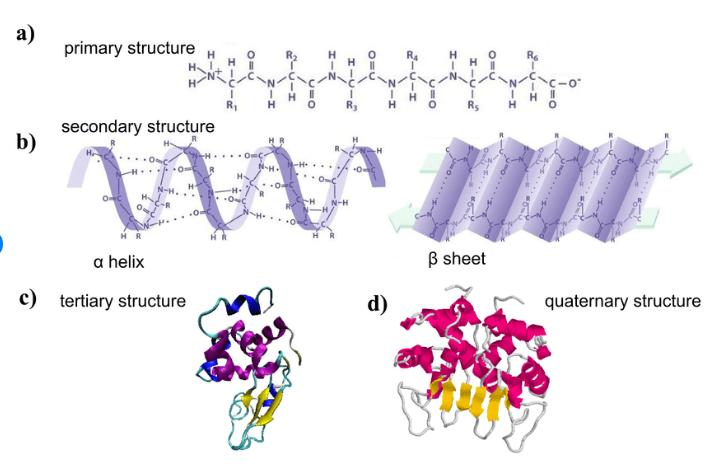
What is the secondary structure of insulin's A-chain?
Two α-helices (A2–A8 and A13–A19)
Separated by a loop (A9–A12)

What is the secondary structure of insulin's B-chain?
One α-helix (B9–B19)
Followed by a turn (Gly B20)
Then a β-strand (B21–B30)
What holds insulin's A-chain and B-chain together in its tertiary structure?
Two interchain disulfide bonds at →
A7–B7
and
A20–B19
What stays the same across vertebrate insulin, and what differs between species?
The 6 cysteine residues stay in the same positions
But the C-peptide sequence varies between species
What is the average daily human insulin dose?
Approximately 2 mg/day
What is the estimated worldwide annual need for insulin?
Approximately 4,600 kg or 10,000 lbs per year
One pig pancreas yields 150 mg
Approximately 30 million pigs would be needed to meet global demand
What are the advantages of recombinant insulin production?
Produces human insulin
Allows potentially unlimited insulin production
Allows creation of insulin analogues by genetically modifying the human insulin sequence
Why is S. cerevisiae (baker's/brewer's yeast) useful for producing insulin?
Unicellular eukaryotes that can fold, proteolytically process, and glycosylate proteins
Does not produce toxic compounds
Has a well-characterized genome, the entire genome has been sequenced
Used in food production and pharmaceuticals, including insulin and insulin analogues
How is recombinant insulin produced in S. cerevisiae?
Through secretory expression of heterologous proteins into the culture media during continuous fermentation
What is the purpose of the α-factor (leader peptide) in yeast insulin production?
Allows the insulin precursor to be continuously secreted from S. cerevisiae
What enzyme cleaves the α-factor leader peptide in yeast insulin production?
Kex2 (a peptidase)
Allowing single-chain insulin to be secreted into the culture media
What modifications increase the fermentation yield of single-chain proinsulin in yeast insulin production?
Delete Thr (B30)
Replace the C-peptide with Ala-Ala-Lys
How is single-chain insulin converted into insulin in yeast insulin production?
Trypsin and carboxypeptidase B → digest and remove Ala-Ala-Lys
Turning single chain insulin into insulin
Why is Thr (B30) added back during recombinant insulin production?
It is temporarily deleted to improve yeast production yield
Then added back using trypsin-mediated transpeptidation to restore the correct human insulin sequence
Where is single-chain insulin secreted during yeast fermentation?
Into the culture media → where it is subsequently processed using trypsin and carboxypeptidase B
How does porcine insulin differ from human insulin?
Porcine insulin has Ala instead of Thr at B30
Originally → Trypsin-mediated transpeptidation replaces Ala with Thr → converting it to human insulin
How are recombinant human insulin analogues produced in E. coli?
By cloning the insulin gene into a plasmid
How did early recombinant insulin production in E. coli work?
The A-chain and B-chain were produced separately
Then combined to form the correct disulfide bonds
How does the improved method produce recombinant human insulin in E. coli?
Clone a synthetic human insulin gene with a shorter C-peptide into an expression vector
Allow the protein to fold properly
Specific proteases cleave the protein to produce insulin
ow are rapid-acting and long-acting insulin analogues created with E. Coli?
Site-directed mutagenesis changes specific codons, substituting amino acids in the insulin sequence
What is the purpose of regulating insulin secretion from pancreatic β-cells?
Maintain stable blood glucose during fasting and feeding
What factors coordinate the regulation of insulin secretion?
Nutrients
GI hormones
Pancreatic hormones
Autonomic neurotransmitters
Which nutrients promote insulin secretion?
Glucose
Amino acids
Fatty acids
Ketone bodies
What is the primary insulin secretagogue?
Glucose
Insulin secretion closely follows extracellular glucose concentration
What is the incretin effect?
The same amount of glucose causes greater insulin secretion when given orally versus intravenously
Which GI hormones are responsible for the incretin effect?
GIP and GLP
Which autonomic nerves innervate pancreatic islets?
Adrenergic and cholinergic nerves
How do α2 and β2 adrenergic receptors affect insulin secretion?
α2 stimulation → inhibits insulin secretion
β2 agonists → enhance insulin release
How does vagal nerve stimulation affect insulin secretion?
Enhances insulin release
How does sympathetic activation affect insulin secretion, and why?
Suppresses insulin secretion by stimulating α2 adrenergic receptors
What situations can activate the sympathetic nervous system and suppress insulin secretion?
Hypoxia
Hypoglycemia
Exercise
Hypothermia
Surgery
Severe burns
What is the resting state of pancreatic β-cells during fasting in insulin release?
The beta-cell is hyperpolarized

How does glucose stimulated insulin begin in insulin release?
The transport of glucose into the beta cell via GLUT2

What happens to glucose after it enters the beta cell via GLUT2 in insulin release?
It gets phosphorylated by glucokinase to generate G6P
This is the rate-limiting step in glucose metabolism
What happens after G6P is generated in insulin release?
It enters the glycolytic pathway causing changes in the NADPH and the ratio of ADP/ATP → increasing ATP

What happens after G6P increases ATP in insulin release?
The elevated ATP inhibits an ATP-sensitive K+ channel → closing the KATP channel
This leads to cell membrane depolarization

What does the KATP channel consist of?
Inward rectifying K+ channel → Kir6.2
A close associated protein → SUR1
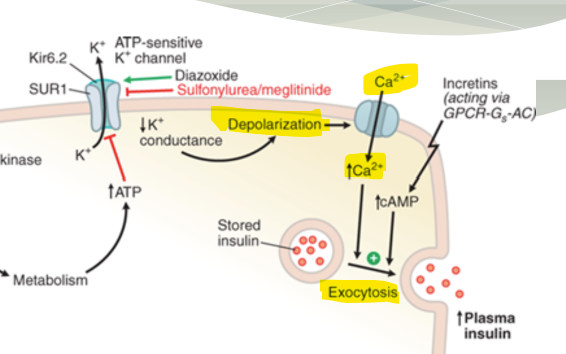
What happens following membrane depolarization from increased ATP in insulin release?
It leads to opening of a voltage dependent Ca2+ channel and increase intracellular Ca2+
This results in exocytotic release of insulin from the storage vesicles
How is each insulin receptor monomer structurally organized?
Each monomer contains 8 distinct domains.

How are the insulin receptor α- and β-chains connected, and how are the two monomers held together?
Within each monomer → One disulfide bond connects the α- and β-chains
Between monomers → Two disulfide bonds extend from each α-chain to maintain the dimer

What is the overall 3D structure of the insulin receptor ectodomain?
An inverted “V” shape with four ligand-binding sites
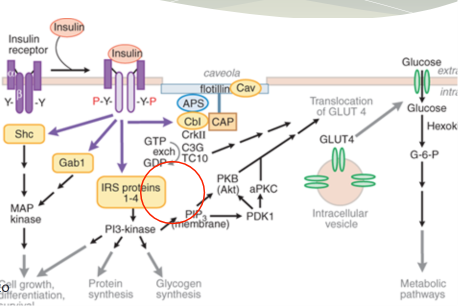
What happens when insulin binds to the α-subunits of the insulin receptor in muscle / adipose tissue?
It triggers transphosphorylation of the β-subunits → activating the insulin receptor

What happens after the insulin receptor is activated in muscle / adipose tissue?
It initiates signaling → by phosphorylating a set of intracellular proteins / IRS receptor
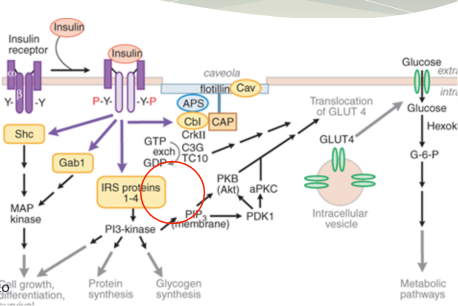
What happens after the IRS receptor is phosphorylated in muscle / adipose tissue?
The phosphorylation of the IRS receptor regulates downstream kinases Akt
Akt2 coordinate the translocation of glucose transporter 4 (GLUT 4) → to the plasma membrane

Where is GLUT4 in muscle / adipose tissue?
In basal state → it resides in the intracellular space
After being activated by Akt2 → it gets rapidly moved to the plasma membrane

What happens after GLUT4 is activated and moved to the plasma membrane in muscle / adipose tissue?
It allows glucose to enter the cell

What happens after glucose enters the cell in muscle / adipose tissue?
Hexokinase II converts the glucose into → G6P

What is hexokinase II regulated by?
It is regulated transcriptionally by insulin

What happens after G6P is produced in the muscle / adipose tissue?
It can either →
Be used to produce energy
Become isomerized to G1P and eventually stored as glycogen
This is how insulin increase glycogen synthase activity!!
What is insulin resistance?
Cells in muscle and fat tissue do not respond effectively to insulin
Reducing glucose uptake and causing blood glucose to rise
How does insulin resistance affect glucose production in the liver?
The liver continues producing and releasing glucose through gluconeogenesis → increasing blood glucose
How does insulin resistance affect fat cells and circulating lipids?
Reduces uptake of circulating lipids
Increases production and release of triglycerides and fatty acids into the blood
How does insulin resistance contribute to weight gain?
Stimulates formation of new fat tissue and accelerates weight gain
How do pancreatic β-cells initially respond to insulin resistance?
Increase insulin production to compensate for elevated blood glucose
Causing hyperinsulinemia → high blood insulin
What causes the transition from insulin resistance to type 2 diabetes?
Pancreatic β-cells can no longer produce enough insulin to compensate for insulin resistance
Resulting in persistent hyperglycemia
What conditions are commonly associated with insulin resistance?
Visceral adiposity (abdominal fat)
Hypertension
Hyperglycemia
Dyslipidemia
What lipid abnormalities are associated with insulin resistance?
Elevated triglycerides
Increased small, dense LDL particles (sdLDL)
Decreased HDL cholesterol

What form does natural human insulin exist in at concentrations below 0.1 mM?
Monomer (single insulin molecule)
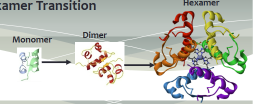
What happens to insulin at concentrations above 0.1 mM?
Insulin oligomerizes into dimers and hexamers
What coordinates and stabilizes the insulin hexamer?
Two zinc atoms
Where can natural human insulin form zinc-containing hexamers?
Storage vesicles in pancreatic β-cells
Blood
How does insulin's oligomeric state affect its pharmacology?
Influences its pharmacokinetic profile and receptor binding
Which form of insulin binds to the insulin receptor?
Only the monomer form
What was Lente (zinc) insulin used for?
One of the earliest dosage forms of porcine insulin → designed for slow release
Stimulates the basal insulin produced by beta-cells representing 50% of the daily insulin requirement
Prandial insulin (mealtime) makes up for the remaining 50%
Why were short-acting, non-hexameric human insulins developed?
To improve mealtime (prandial) insulin by allowing faster absorption after injection
Which amino acids are essential for binding to the insulin receptor?
A1Gly
A4 Glu
A5Gln
A19Tyr
A21Asn
B12Val
B16Tyr
B23Gly
B24Phe,
B25Phe
TyrB26
What amino acid is not essential for binding to the insulin receptor?
B27-30
This has been the preferred site for structural modifications for modifying the pk profile of insulin

What conditions cause insulin fibril formation?
Elevated temperatures
Contact with hydrophilic surfaces
Shear stress (repeated up-and-down plunger movement)
Can also form in → infusion pumps
What are the characteristics of insulin fibrils?
Inactive
Do not resuspend once formed
What additives help prevent insulin fibril formation?
Phosphate buffer and other additives
What happens to insulin at low concentrations (less than 5 IU/mL) in tubing?
Insulin can adsorb / stick to the tubing → reducing the amount delivered
Adding albumin blocks insulin from adsorbing to tubing!
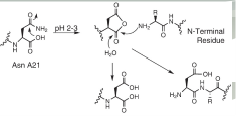
What happens to insulin during long-term storage at low pH (≤4)?
Deamidation occurs at Asn A21 → potentially causing crosslinking of the A and B chains
At 4°C → 1–2% per month
At 25°C → 90% after 6 months
Why was insulin glargine (Lantus) modified at position A21?
Glycine replaces asparagine (Asn) at A21 → to prevent low-pH deamidation at that site

What happens to insulin at neutral pH?
Deamidation occurs at Asn B3 → forming isoaspartate-containing insulin
That can trigger an immune response
Which insulins appear cloudy?
NPH and lispro protamine
All pre-mixed/combo insulins
What is Humulin R (U-100), and how is it made?
Regular insulin
Short-acting human insulin produced using recombinant DNA technology in E. coli
It is a clear colorless solution
When should regular insulin (Humulin R) be administered relative to meals?
Approximately 30 minutes before a meal
The patient should eat within 30 minutes of administration
What are the onset, peak, and duration of regular insulin?
Onset → 30–60 minutes
Peak → 2–3 hours
Duration → Approximately 6 hours
What is the typical daily dose range of regular insulin?
0.5–1 unit/kg/day
Individualized based on patient needs
What insulins can regular insulin be used with?
Intermediate-acting insulin
Long-acting insulin
Oral antihyperglycemic agents
How should unopened Humulin R be stored?
Refrigerate at 2–8°C (36–46°F)
Do not freeze
What is the major risk of regular insulin overdose?
Hypoglycemia
How is severe insulin-induced hypoglycemia treated?
IM/SC glucagon
Concentrated IV glucose
Why is continued carbohydrate intake and observation important after severe hypoglycemia?
Hypoglycemia can recur even after apparent clinical recovery