Gas Chromatography
 Call Kai
 Learn
 Practice Test
 Spaced Repetition
 Match
 Flashcards
 Knowt Play
1/50

There's no tags or description
Looks like no tags are added yet.
51 Terms
Gas Chromatography
ANALYTES MUST BE IN GAS PHASE (straight-forward interaction)
fundamental limitations = volatility, thermal stability
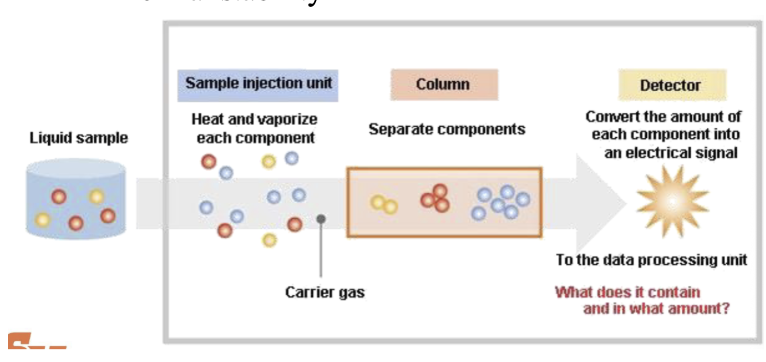
GC Sample Types
1) Gas
gas-tight syringe
Headspace Sampling (HS)
2) Liquid
volatile solvent injected into injection port → if not volatile, will lead to contamination
some degree of sample prep needed (matrix dependent)
3) Solid (more limited)
Headspace Sampling (HS)
Headspace Sampling (HS)
extraction is from a liquid or solid sample after being heated (it evaporates into the “headspace” — the gas in the headspace is what we use)
temp between 60-90 degrees C → won’t get macromolecules like proteins
functional group expected with this = alcohols (BAC) or accelerants (organic solvents = very volaile)
can do this with MS or FID
good for chemical profiling in full scan mode
Good for GC Analytes
boiling point up to 400 degrees C
non-polar or slightly polar
thermally stable
BAD for GC Analytes
do not vaporize at GC normal operation conditions → degrade at injection port and contaminate
highly reactive
thermally unstable
strongly polar
Derivatization
if your target analytes are not volatile or thermally stable → process of chemically modifying a compound to produce a new molecule suitable for GC analysis
more volatile (non-polar), more thermally stable (no degradation), or more useful detection characteristics (molecular weight information)
increases sensitivity and chromatographic performance for specific compounds
as soon as you derivatize, fragments can immediately change (happens before injection)
Why are substances with reactive/acidic hydrogens (acids, alchs, amines) difficult to analyze?
they react with the surface of the injection port or the analytical column and result in tailing peaks and low response
Acidic Hydrogens = proton donors (lose a proton to the medium)
What are the three reactions used for Derivization?
Silylation
Acylation
Alkylation
Silylation
introduction of a silyl moiety (RCO-) by substitution of an active H (-OH, -COOH, -SH, -NH, -NH2)
Reagents: BSTFA, MSTFA, MTBSTFA
Works with: amides, -OH, -CO2H, -NH2
Amines = harder to derivitize the second time
ex) Amphetamines, benzodiazepines, cannabinoids, BE (cocaine metabolite)
Cocaine does not need to be derivatized

Acylation
introduction of an acyl moiety (RCO-) by substitution of an active H (-OH, -COOH, -SH, -NH, -NH2)
Reagents: TFAA, PFPA, HFBA
ex) Amphetamines, cannabinoids, BE (cocaine metabolite)
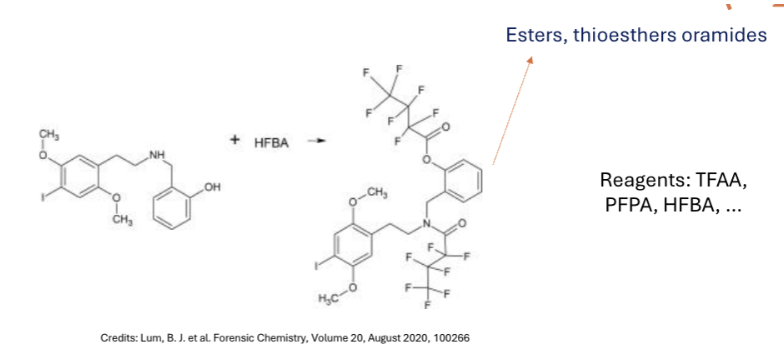
Alkylation
substitution of an alkyl or aryl group at an active H (-OH, -COOH, -SH, -NH, -NH2)
Ends with: ethers, esters, thioethers, thioesters, N-alkyl amines or N-alkyl amides
Reagents: BF3/MeOH

Oven
three components of GC under temp control
sample injection chamber/port
column
detector
Elements that Affect Separation
Solid Phase (type and thickness)
Carrier Gas (type and linear velocity) = He or H
Column Internal Diameter
Column length
Oven temperature → only parameter you can change in terms of separation outside of the column
Why is carrier gas important?
key aspect for the determining performance of the system and method → efficiency is a function of linear velocity
affects column efficiency and resolution
must be chemically inert (why O2 is bad)
performance (want a smaller H)
cost
safety
van deemter plot
He or H more comparable than N2
solutes diffuse more rapidly through H2 and He (decreased resistance to mass transfer)
Sample Introduction System
For optimum column efficiency, the sample should be introduced onto the column as a “plug of vapor” → usually inject 1-2 uL
Syringe used to inject sample through a rubber septum into a flash vaporizer port at the head of the column
Injection port temp is ~50 degrees C higher than the boiling point of the least volatile component of the sample
Manual Injection
rinse syringe with appropriate solvent
rinse syringe with sample
slowly draw up desired volume (1-2 uL) & avoid air bubbles
carefully insert the syringe through the septum
will get less than 1 uL most of the time (some will be air) = LIMITATION
let needle breifly heat up
QUICKLY depress plunger & pull syringe out
solvent you select for washes should have same polarity of sample your injecting
want to make sure any residual solvent is dissolved
number of washes up to user
YOU are autosampler
Autosampler Injection
more robust and reproducible compared to manual injection (instantaneous injection)
can analyze 100 samples with identical sample volume and injection speed
wash and waste vials
eliminates human error because its a machine (harder to personally control each sample = coordination of time and when its time to inject sample)
autosampler could glitch
Inlet Liner
important part within injection port (glass tube) = increases the inert surface area for vaporization
limit sample degradation
enhance vaporization
guiding syringe needle into the correct position → choice of inlet liner can have a noticeable effect on chromatogram
injection port is heated independently of the GC oven (independent)
location where sample is volatized
can you liner ~100x before replacing (very general though, depends on what sample is being used) → if more complex sample (keep eye on it & sample inlet temp)
Ways to Inject Liquid Samples
Splitless Injection Mode
Split Injection Mode
Splitless Injection Mode
entire sample is injected into the column → no separation
split vent = closed
constant inlet flow
most commonly used in forensic tox
PROS = lower detection limits because more sample is introduced
CONS = overloading column, band broadening, leak = O2 entering through hole
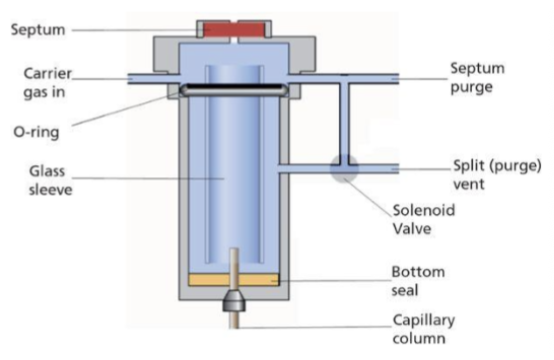
Split Injection Mode
set ratio of sample is sent through the injection port to the column
split vent is open = part of your sample will not enter the column (large portion of sample discarded)
you determine what ratio of sample you want
PROS = concentrated samples, protects the column, sharper peaks
CONS = higher detection limit because less sample is introduced

Headspace Injection
mechanism to extract volatile components from non-volatile matrices (sample prep as well)
set temp & time for equilibrium between liquid and gas phases
heated syringe injected directly into injection port (incubation at temps higher than room temp (60-90 degrees C)) → sample is agitating, volatile samp will vaporize
GOAL = break equilibrium between liquid and gas phase so we can sample just the gas phase with needle
if not volatile = won’t work (ex. sugars, proteins, etc)
SYRINGE MUST BE GAS TYPE TO PREVENT LOSS
ex) BAC & fire debris analysis

Isothermal Oven Temp Program
best for separation of highly similar compounds
unable to provide adequate separtion within reasonable run time for samps containing compounds of widely different boiling points
RESULT = decreasing resolution as a function of retention time
less common for most analytical apps
PROS = when analytes are chemically similar they have similar boiling points (can separate without changing temp)
Temperature Oven Temp Program
column temp raised in a linear manner during separation (can control how long oven stays at a temp and rate
increases analyte vapor pressure
changes retention factor (k)
it sharpens peaks
decreases retention times of late-eluting components
start with slower manner for temp raising and increase over time
more common for analytical apps
PROS = can separate compounds with different chemical properties (gives better resolution and sharp peak shapes), impacts retention factor (can measure column efficiency)
Types of Columns
Packed Columns
Capillary Columns
Packed Column
liquid stationary phase coated on particles
metal columns
original GC columns
greater sample capacity
replaced by capillary columns in 1980s (dont use anymore)

Capillary Columns
superior efficiency (>300,000 N)
narrower columns, thinner films, and longer columns
three types = WCOT, SCOT, PLOT

Wall-Coated Open Tubular (WCOT)
narrow columns made of fused SiO2 coated on the outside with a polyamide polymer
quite common
entire coiled onto a cage for easier handling
internal diameter: 0.25, 0.32, or 0.53 nm (depends on application)

Support-Coated Open Tubular (SCOT)
thin film (~30 uM) to support material coats column
liquid stationary phase applied to a solid support material
analyte retained by liquid film

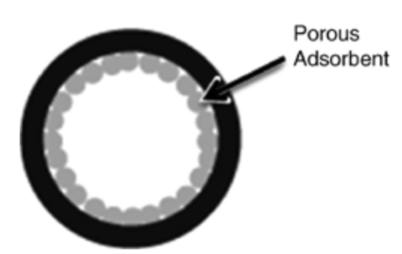
Porous Layer Open Tubular (PLOT)
stationary phase is made up of very small particles coating inside walls of capillary
increase surface area = analyte has a lot of opportunties to react with stationary phase
Column Bleeding
when stationary phase starts to elute from the column
Important Attributes to Selecting Type of Column
low volatility
thermal stability → wide temp range, if it goes above = column bleeding
chemical inertness
like dissolves like
Thicker Stationary Film Thickness (greater than or equal to 1.0 um)
PROS
increased retention for volatiles → more opportunity for analyte to interact with stationary phase
increased capacity for GC-MS and GC-IR
CONS
less efficient
higher temperatures required — leads to noise
higher bleed (with higher temps because more liquid can leave column)
reduce resolution for late eluters (especially those with high boiling points)
Thinner Stationary Film Thickness (less than or equal to 0.5 um)
PROS
highest efficiency
lower elution temperature (less bleed)
fast analysis
CONS
low capacity → don’t have as many sites for analyte to interact with
peak fronting & column overload/saturation
limited trace analysis
**if you have low concentration of analyte, want to inject MORE to give better chance of interaction
Solvent Delay
used to avoid a solvent peak → cut the peak from our detection
initial time of your run that in a GC-MS your detector is off (anything reaching the source at that time isn’t ionized at detector)
Narrow Column Internal Diameter (0.15 mm)
better for fewer compounds
lead to higher hep pressures (gas needed at injection port to push gas/analyte inside the column
PROS = higher resolution
CONS = requires higher operating pressure, less column capacity
Wider Column Internal Diameter (0.50 mm)
better for complex mixtures
PROS = requires lower operating pressure, greater column capacity
CONS = lower resolution
Shorter Column Length (<15 m)
faster run times
better for chemically active samples
better with simple mixtures
**shouldn’t have reaction in GC, but maybe expose analyte to shorter run to an analyte that’s stubbornly stuck inside the column
Larger Column Length (>60 m)
slower run times
better for less active samples
better for complex (50-60 compounds) mixtures
Detectors
GOAL = rapid response to an analyte eluting from the column followed by a quick return to its original state in prep for the next compound
choice of detector depends on the nature of compounds being separated
each type has a different response to compounds
each type has different uses based on response and specific detector characteristics
IDEAL Detector Characteristcs
adequate sensitivity
good stability and reproducibility
similar response towards all analytes or at least highly predictable and selective response (selectivity)
linear response to solutes that extends over several orders of magnitude throughout overall concentration (dynamic range)
temp range from room temp to at least 400 degrees C
short response time independent of flow rate
high reliability and ease of use
non-destructive
5 Most Common GC Detectors
Flame Ionization Detector (FID)
Thermal Conductivity Detector (TCD)
Electron-Capture Detector (ECD)
Nitrogen-Phosphorous Detector (NPD)
Mass Spectrometry Detector (MS)
Flame Ionization Detector (FID)
**most widely used and applicable detector
elute from the column directed to a small air-hydrogen flame → combustion leads to formation of ions and electrons (burn all organic components)
Carbon atoms (except CO) produce ions (CHO+) = how current is made
detection involves monitoring the current by collecting these charge carriers
USED FOR BLOOD ALCOHOL IN TOX LABS
Mass-sensitive rather than concentration-sensitive (flow rate insensitive)
concentration doesn’t matter cuz everything goes to flame
Make up gas = N2 → quickly sweeps effluent into flame & reduces band broadening
Hydrogen gas = combustion fuel (REQUIRED)
Advantages =
high sensitivity
high linear dynamic range (~10^7)
low detector noise because flame only sensitive with compounds containing C and H
quantitative analysis
simplicity + ease of operation
applications = cocaine
Limitations =
destructive (cant combine with another detector)
only applicable to compounds with carbon atoms = depends on carbon content
non-specific response
requires additional gases and flow controllers (H2 gas is dangerous)
applications = small analyte with halogens and amines DONT WORK

Thermal Conductivity Detector (TCD)
one of the earliest detectors = BASED ON DIFFERENCES IN THERMAL CONDUCTIVITY
sample conductivity compared to a reference conductivity from the carrier gas (He or H2)
any analyte mixed with helium lowers conductivity of the gas stream
detector measures change in voltage from filament (electrically heated tungsten-rhenium filament in temp-controlled cell)
when the analyte elutes, thermal conductivity decreases, the filament temperature increases, and the resistance changes (impacts voltage)
Advantages =
universal detector = all compounds change thermal conductivity
simplicity = no training required
large dynamic range (~10^5)
non-destructive detection (not in terms of sample, but of analyte)
Limitations =
low sensitivty
sensitivity affected by flow rate → inversely proportional to flow rate
works best with packed GC columns

Electron-Capture Detector (ECD)
most common in environmental applications due to halogen selectivity
eluents pass over a radioactive beta-emitter (63-Ni) that ionizes the sample through electron capture by electronegative analytes
without analyte, constant current passed between a pair of electrodes
current decreases in the presence of analytes that capture electrons
Selective for halogens, peroxides, quinones, organometallics, and nitro groups
relatively insenstive to hydrocarbons, alcohols, and ketones
Carrier gas = N2
Advantages =
selective for halogens (I, Br, Cl, F), nitro-, and sulfur-containing compounds
detection of polynuclear aromatic compounds, anhydrides, and conjugated carbonyl compounds
Limitations =
targeted applications because of non-universal detector
dynamic range only about 2 orders of magnitude
contains radioactive source

Nitrogen-Phosphorus Detector (NPD)
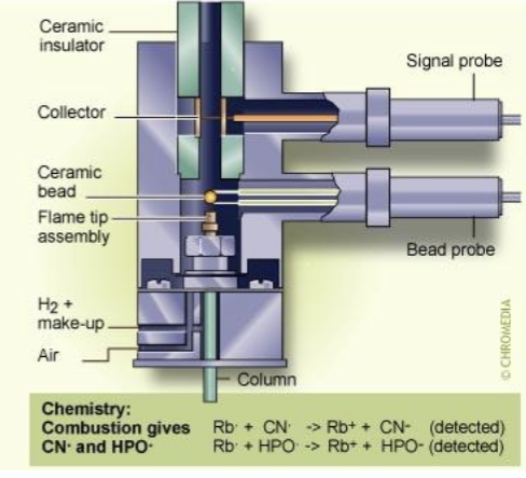
similar principles as FID, but specific to nitrogen and phosphorus compounds
type of thermic ionic detector → rubidium sulfate (Rb2SO4) containing glass/ceramic bead greatly enhances the formation of ions from nitrogen and phosphorus containing compounds
about 500-fold more sensitive than an FID in detecting phosphorus-containing compounds & 50-fold more sensitive to nitrogen-containing compounds
Advantages =
increased sensitivity for nitrogen & phosphorus containing compounds
quantitative analysis with reference standards
works well for ketamine!
Disadvantages =
destructive
very sensitive to hydrocarbon impurities in carrier or make up gas = increased background noise
required additional gases and flow controllers
bead must be replaced over time because it gets eaten overtime
CANNOT USE deuterated internal standards because they will co-elute
Mass Spectrometry Detector (MS)
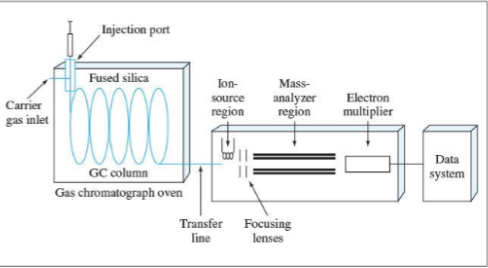
the most powerful & robust GC detector
based on measuring mass-to-charge ratio of ions generated from effluent
often combined with quadrupole mass analyzers
capability to identify analytes based on unique EI mass spectra based on unique EI mass spectra
qualitative & quantitative analyses
Total Ion Chromatogram (TIC)
sum of all ion abundances as a function of time (all ions being fragmented in instrument)
all peaks corresponding to ions in this range
click on peak = get mass spectrum (correspond to ions in smaller range)
Extracted Ion Chromatogram (EIC)
selection of specific fragments (m/z) from the TIC
“I want to see a chromatogram for these ___ lines from TIC)”
ex) have a few for ADB-BUTINACA and its internal standard, can select (examples) 181, 182, 183 => EIC show spectrum with only these three ions
Generated FROM mass spectrum to track that ion throughout the run (shows elution of something specific in MS)
SIM Chromatogram
TIC corresponding to only a few fragments monitored throughout the experiment
same as TIC but for selected peaks/few fragments
EIC chromatogram of MS from this get you back the SIM chromatogram
LOOK AT ION RATIOS
Criteria looked at for GC-MS
retention time (2%)
ions → diagnostic ions (most intense/stable ions)
molecular ion best to look for
ion ratios (± 20%)
some exceptions to rule
S/N (>3 for ID)
library searches (only in full scan)