Crime - Lecture 6
 Call Kai
 Learn
 Practice Test
 Spaced Repetition
 Match
 Flashcards
 Knowt Play
1/83

Earn XP
Description and Tags
Neuropsychological and structural neuroimaging
84 Terms
rogers et al. (2016) - core problem and primary objective
to address inconsistent grey matter volume (GMV) findings caused by heterogeneous conduct problem samples and small sample sizes by conducting the first quantitative, image-based whole-brain VBm meta-analysis comparing youths with CP to typically developing controls
rogers et al. (2016) - inclusion criteria, exclusion criteria, and final sample
included whole-brain VBM studies (2007-2015) comparing CP and TD youths (excluding ROI-only, DTI, surface-based morphometry, and duplicate datasets), yielding 13 studies with 394 CP youths (83% male) and 350 TP youths (77.7% male)
rogers et al. (2016) - meta-analytic technique and secondary analyses used
used anisotropic effect-size signed differential mapping with raw statistical parametric maps for 11 of 13 studies, alongside jackknife sensitivity analysis, a childhood-onset subgroup meta-analysis, and a meta-regressions
rogers et al. (2016) - main contrast GMV findings in youths with CP vs TD controls
bilateral GMV reductions (with no increases) in:
left amygdala (extending to anterior insula)
right insula (extending to vlPFC/OFC and STG)
left medial superior frontal gyrus (extending to right ACC)
left fusiform gyrus
rogers et al. (2016) - jackknife sensitivity analysis findings
the left amygdala GMV reduction was the most robust finding, remaining significant across all 13 leave-one-out iterations, while insular and frontal GMV reductions remained stable across 11 to 12 iterations
rogers et al. (2016) - subgroup and meta-regression effects of childhood-onset CP and CU traits
childhood-onset CP showed a left-lateralised GMV reduction in the left anterior insula and left amygdala
whereas, higher CU traits were associated with a smaller GMV reduction in the left putamen, bringing volume closer to TD controls
rogers et al. (2016) - effects of sex, age range, CD severity, ADHD, and IQ
higher male proportion and wider age ranges predicted greater left amygdala GMV reductions
higher female proportion linked to increased right inferior temporal gyrus GMV (driven by one female-only study)
higher CD severity linked to right STG reductions
ADHD comorbidity and ID had no moderating effect
rogers et al. (2016) - functional roles and clinical manifestations of amygdala and anterior insula reductions in CP/CD
amygdala (threat processing, aversive conditioning, face emotion recognition, emotion empathy) reductions align with blunted distress recognition and poor moral socialisation
anterior insula (interoception, empathic pain, risk adjustment) reductions explain impaired empathy and risk-insensitive decision-making
rogers et al. (2016) - functional roles and clinical manifestations of vlPFC/OFC, medial SFG/rostral ACC, and putamen alterations in CP/CD
vlPFC/OFC (emotion regulation, inhibition, reversal learning) deficits promote reactive aggression and impulsivity
medial SFG/rostral ACC (social cognition, Theory of Mind, affective empathy) deficits drive peer disregard
putamen (reward/reinforcement learning) differences relfect distinct reward-driven pathways in psychopathy
rogers et al. (2016) - methodological strengths and limitations
strengths:
used raw statistical maps for 85% of studies (avoiding peak-coordinate bias)
showed no publication bias
ruled out ADHD confounds
limitations
VBM cannot separate thickness, surface area, or gyrification
could not isolate adolescent-onset CP
obly 5 studies reported CU traits
cross-sectional design precludes causality
raine et al. (2011) - core problem & primary objective
core problem
males exhibit cross-culturally higher rates of crime, violence, and APD) than females, which traditional socio-cultural models fail to robustly explain
primary objective
test whether structural grey matter reductions in PFC sub-regions (specifically orbitofrontal and middle frontal grey) characterise APD, predict antisocially across sexes, and explain the gender gap in APD
raine et al. (2011) - rutter, caspi & moffitt’s (2003) three evidential criteria for causation
males and females must differ on the supposed risk factor
the risk factor must predict psychopathology within each sex
controlling for the risk factor must reduce or eliminate the observed sex difference in psychopathology
raine et al. (2011) - ppt sample design
recruited from LA temporary employment agencies (community sample with high antisocial base rates)
males: 18 DSM-IV APD, 30 healthy controls, 24 substance-dependent controls
psychiatric control subsample: matched to APD group on comorbidites (schizophrenia-spectrum, affective, anxiety, other personality disorders)
females: independent sample from the same agencies to test sex differences and cross-sex generalisability
raine et al. (2011) - diagnostic, offending, and cognitive/psychosocial measures
diagnostics: SCID-I and SCID-II
offending: self-report crime checklist (44 lifespan offences)
cognitive & psychosocial: WAIS-R (IQ), SES, and 10 demographic/family trauma variables
raine et al. (2011) - structural MRI analysis & parcellation
scanner: 1.5T scanner
parcellation: manual delineation of 5 bilateral sub-regions
superior frontal, middle frontal, inferior frontal, orbitofrontal, and rectus gyri
scaling & reliability: volumes corrected for whole-brain volume
high inter-rater reliability
raine et al. (2011) - prefrontal specificity & hemisphere laterality in APD males
grey matter reductions vs healthy controls: orbitofrontal, middle frontal, and right rectus gyrus
specificity: restricted to grey matter (no differences in prefrontal white matter or total brain volume)
superior and inferior gyro were spared
laterality: bilateral in orbitofrontal cortex, but significantly stronger in the right hemisphere for middle frontal and rectus gyri
raine et al. (2011) - cross-sex relationships supporting criterion 2
inverse correlations between frontal grey matter and antisociality generalised across both sexes
females: orbitofrontal volume correlated with crime and APD symptoms
middle frontal volume correlated with crime
males: orbitofrontal volume correlated with crime and APD
middle frontal volume correlated with crime and APD
raine et al. (2011) - explaining the gender gap via criterion 1 & 3
criterion 1 (sex dimorphism)
unselected males showed significantly lower relative orbitofrontal and middle frontal grey volumes than females
criterion 3 (statistical mediation)
controlling for orbitofrontal grey alone reduced the sex difference in ASB by 65.9%
controlling for all 3 regions reduced it by 77.3%, rendering the gender gap non-significant
raine et al. (2011) - robustness against confounds
substance & psychiatric comorbidity
APD males still showed significant orbitofrontal, middle frontal, and right rectal deficits compared to substance-dependent and matched psychiatric controls
head injury & trauma
deficits persisted after covarying for head injury and trauma response
psychological risk factors
the 3 frontal grey matrics predicted APD over and above 10 psychosocial risk factors (e.g. poverty, abuse, institutional rearing, parental criminality), raising classification accuracy from 73.9% to 100%
raine et al. (2011) - neurofunctional mechanisms & critical evaluation
mechanisms
orbitofrontal/ventral PFC (reward encoding, passive avoidance, reversal learning, empathy)
middle frontal gyrus (contingency awareness, moral decision-making, delay of gratification)
right rectal/ventromedial hyrus (inhibiting responses to unexpected stimuli, self-reflection)
strengths
strict control groups
manual ROI tracing
satisfying all 3 causal criteria
limitations
small female sample
cross-sectional design (cannot establish temporal causality)
multi-etiological complexity (social, genetic, neurochemical, and amygdala factors interact)
sobhani & bechara (2011) - core thesis
typically developing individuals refrain from corrupt and immoral acts by unconsciously binding social values with the anticipatory emotional risk of punishment
immoral, corrupt, and psychopathic behaviours stem from a failure of the somatic marker circuitry
primarily the vmPFC and amygdala
resulting in a dissociation between declarative moral knowledge and actual behaviour
sobhani & bechara (2011) - mechanism of somatic marker hypothesis framework
when pondering decisions under uncertainty, covert or overt emotional signals (‘somatic markers’) are triggered to bias choices toward advantageous outcomes and away from punitive ones
deprived from these markers, individuals rely solely on immediate rewards
sobhani & bechara (2011) - primary vs secondary inducers in somatic state activation
primary inducers are immediate, direct emotional stimuli in the environment (e.g. an immediate threat or reward) processed by the amygdala
secondary inducers are complex memories, imagined future scenarios, cognition, and moral deliberation (e.g. anticipating future societal punishment) processed by the vmPFC
sobhani & bechara (2011) - signalling routes & neurotransmitter modulation in the SMH
the body loop activates visceral/autonomic changes via the hypothalamus, brainstem, and vagus nerve, relayed back to the somatosensory cortex and insula
the ‘as-if-body’ loop is an internal shortcut simulating bodily states (via the insula and posterior cingulate) without peripheral effectors
both modulate dopamine and serotonin nuclei in the brainstem to drive reward prediction errors and behavioural adjustment
sobhani & bechara (2011) - iowa gambling task & autonomic signalling findings
healthy controls generate anticipatory skin conductance responses (SCRs) before picking risky cards (decks A & B), guiding them to safe decks (C & D) during the unconscious ‘pre-hunch’ phase
vmPFC lesion patients lack anticipatory SCRs (despite normal reactive SCRs after outcomes) and persistently choose badly
50% reach the ‘conceptual period’ and explicitly know which decks are bad yet still select them
sobhani & bechara (2011) - double dissociation between working memory and decision-making
dlPFC damage impairs working memory while leaving IGT decision-making relatively intact, whereas vmPFC damage impairs real-life and IGT decision-making even in patients who possess superior IQ and intact working memory
sobhani & bechara (2011) - moral judgment impairments in vmPFC damage (young et al., 2010)
vmPFC patients exhibit abnormally utilitarian moral judgments (e.g. willingness to push someone off a bridge to save five others) and judge attempted harms (e.g. attempted murder) as morally permissible if no actual physical harm occurred, because harmful intent fails to trigger an aversive somatic marker
sobhani & bechara (2011) - myopic loss aversion & ‘advantageous’ lack of emotion (shiv et al., 2005)
in a financial investment task, healthy controls become overly conservative after losses due to negative emotional biasing
whereas patients with focal lesions in emotion circuitry (vmPFC, amygdala, insula) lack loss-aversion signals, take optimal statistical risks, and earn significantly more money
explaining how ‘functional psychopaths’ prosper in finance, boardrooms, or politics
sobhani & bechara (2011) - primary psychopathy vs secondary/functional psychopathy & corruption
primary psychopathy involves innate neurodevelopmental amygdala dysfunction (extending to posterior vmPFC/septal areas), low trait anxiety, and overt violent/callous crime
secondary/functional psychopathy & corruption stem from environmental/reactive factors or vmPFC dysfunction, manifesting as covert manipulation, fraud, bribery, and white-collar sociopathy
in ultimatum/dictator games, primary psychopathic prisoners mirror vmPFC patients by rejecting unfair offers and making lower offers
sobhani & bechara (2011) - critical synthesis: acquired vs developmental sociopathy & diagnostic dissociation
adult-onset vmPFC lesions (‘acquired sociopathy’) rarely cause severe predatory violence because early social rules were internalised, whereas childhood-onset vmPFC lesions prevent moral socialisation and produce persistent adult antisociality
furthermore, organic somatic defects cause punishment insensitivity, whereas environmentally conditioned corruption (with intact circuitry) responds to enforced punishment contingences
explaining ‘absence of a lesion of the intellect’ alongside severe antisocial exploitation
gregory et al. (2012) - core problem & diagnostic dilemma
persistent violent offenders are clinically heterogeneous:
most show reactive aggression and emotional lability, while a minority exhibit CU traits, psychopathy, and instrumental violence
diagnostic systems like the DSM treat ASPD as a single unitary category, and past imaging studies conflated psychopathic and nom-psychopathic offenders, lowered diagnostic cutoffs, used non-blind manual tracing, or failed to control for substance use disorders (SUDs) and comorbities
gregory et al. (2012) - primary objective
to use automayed, whole-brain voxel-based morphometry to test whether structural grey matter (GM) volume differences categorically distinguish violent offenders with ASPD and pyschopathy (ASPD+P) from violent offenders with ASPD without psychopathy (ASPD-P) and healthy offenders
gregory et al. (2012) - participant sample & grouping
66 men aged 20-50 recruited from National Probation Services and community sites in London
ASPD+P: DSM-IV ASPD with PCL-R score >/= 25
ASPD-P: persistently violent offenders with DSM-IV ASPD and PCL-R score < 25
healthy non offenders: control men with no criminal convictions, ASPD, or psychopathy
gregory et al. (2012) - matching, exclusions & objective testing
exclusions: lifetime major psychotic and mood disorders (schizophrenia spectrum, bipolar, MDD), neurological illness, and head injury with loss of consciousness >/= 1 hour
matching: offender groups were matched on age, full-scale IQ, educational attainment, and lifetime SUD rates (alcohol, cannabis, cocaine)
objective testing: daily urine and saliva toxicological screening on testing days
gregory et al. (2012) - imaging & statistical analysis
high-resolution spoiled gradient-echo structural images were acquired on a 1.5T scanner
fully automated, modulated whole-brain VBM
small volume corrections were applied to a priori ROIs with age and IQ as nuisance covariates
gregory et al. (2012) - key findings: ASPD+P vs healthy nonoffenders
violent offenders with psychopathy (ASPD+P) showed marked bilateral grey matter volume reductions in discrete social brain regions
anterior rostral medial PFC extending into superior frontal gyrus
temporal poles, extending into inferior and middle temporal gyri
anterior insula, extending into primary and premotor cortices
gregory et al. (2012) - key findings: ASPD+P vs ASPD-P & ASPD-P vs nonoffenders
ASPD+P vs ASPD-P:
ASPD+P showed significantly reduced GM volume in bilateral arMPFC and bilateral temporal poles
temporal pole differences survived corrected thresholds after controlling for scanning-day positive drug screens and co-occuring personality disoders
ASPD-P vs nonoffenders:
no significant GM volume differences in whole-brain or ROI analyses
gregory et al. (2012) - amygdala & vmPFC null findings
no volumetric differences were found in the amygdala or vmPFC across ASPD+P, ASPD-P, and controls
the authors argued prior reports of atrophy were likely driven by manual tracking biases, lower PCL-R thresholds, or unexcluded comorbidities, noting that functional or microstructural connectivity deficits can still exist without macrostructural volume loss
gregory et al. (2012) - functional neuroanatomy & clinical implications of affected regions in ASPD+P
arMPFC:
self-relfection, cognitive branching, and understanding others’ intentions
disruption impairs guilt, remorse, and moral appraisal
temporal poles
social conceptual knowledge and socio-emotional framing
disruption parallels kluver-bucy syndrome and frontotemporal dementia (emotional blunting, empathy loss)
anterior insula
interoception, distress processing, and averive conditioning
disruption drives punishment insensitivity and lack of empathic resonance
gregory et al. (2012) - critical evaluation: clinical relevance, strengths & limitations
clinical relevance
psychopathy (ASPD+P) is a distinct neurodevelopmental phenotype
while ASPD-P responds to standard CBT, ASPD+P shows minimal response and requires tailored interventions
strengths
standardised european PCL-R cutoff, tight matching on age/IQ/lifetime SUDs, and automated bias-free VBM
limitations
male-only cohort, small cell size, and VBM’s inability to separate cortical thickness, surface area, or white matter microstructure
phineas gage - the accident
25 year old phineas gage was wokring with a blasting crew when he was in an accident that drove a tamping iron through his head
the rod entered through the left cheekbone, past his eye, and out the top of his head
he survived the trauma, but exhibited significant personality & behavioural changes
erratic, impulsive, aggressive, lacking guilt
the lesion was mostly indicating the vmPFC
theory of the somatic marker hypothesis

more recent evidence - vmPFC damage
tumour growing in the brain that is compressing the vmPFC

glenn & raine (2014) - more recent evidence of vmPFC damage
single case example
the lesion is show to link to behaviour
when it is there, so is the behaviour and vice versa
can now do pharmacological intervention to show this
but this was a ‘natural’ example
lesion in the area is associated with the onset of abnormal and antisocial behaviour

de brito & hodgins (2009) - antisocial personality disorder
indexes a lifelong pattern of ASB
conduct disorder and ASPD
the symptoms of ASPD include impulsivity, consistent irresponsibility, repeated criminal acts, repeated fights or assaults, recklessness, deceitfulness, and a lack of remorse
poor decision-making
excessive risk-taking
impulsivity
symptoms you often see in patients who have sustained lesions in the vmPFC
anderson et al. - acquired antisocial personality disorder/psychopathy
lesions to vmPFC lead to changes:
behaviour
affect
personality
lesions in childhood and adulthood
resemble the clinical presentation of ASPD/psychopathy
hypothesis: individuals with ASPD/psychopathy may have abnormalities within the PFC (vmPFC/OFC)

raine et al. - reduced prefrontal grey matter volume and reduced autonomic activity in ASPD - methods
clinical control group: individuals who had substance dependence
high comorbidity between ASPD and substance dependence
looked at grey and white matter
also interested in linking this to the ANS (skin conductance & HR)
PFC is also implicated in generating the somatic marker

raine et al. - reduced prefrontal grey matter volume and reduced autonomic activity in ASPD - results
in terms of grey matter:
individuals with ASPD had decreased volume of PFC compared to both other groups
no differences in white matter between the three groups
those with ASPD showed reduced HR and skin conductance compared to the other groups
ASPD group were impaired compared to the other groups
conducted all analyses controlling for other confounding variables
e.g. SES, parental divorce, abuse, family size, foster care

yang & raine (2009) - prefrontal structural and functional brain imaging findings in antisocial, violent, and psychotic individuals: meta-analysis - methods
43 studies across structural and functional
test the hypothesis of can we see abnormalities within the PFC when we compare the literature

yang & raine (2009) - prefrontal structural and functional brain imaging findings in antisocial, violent, and psychotic individuals: meta-analysis - results
subdivided the PFC into subregions
could show across those three studies that individuals with antisocial, violent behaviour, or psychopathy within the orbitofrontal cortex, specifically within the right
also in the left dlPFC (associated with executive functions, such as working memory)
also in the anterior cingulate cortex (mostly right)
show reliable abnormalities in several subregions of the PFC
limited by methods available at the time
not just PFC

aoki et al. (2013) - neural bases of ASB: a voxel-based meta-analysis - methods
voxel-based morphometry
require an image of the brain
can use software to automatically segment the brain into three tissue types (grey, white and CSF)
gives you a proxy for the measure of the size of the ventricles (filled with spinal fluid)
do not have to limit yourself to subregions of the brain
included adults as well as children
young people with CD
adults with ASPD or psychopathy

aoki et al. (2013) - neural bases of ASB: a voxel-based meta-analysis - results
among AS individuals, there was a reduction in grey matter in three regions
lentiform nucleus → part of the basal ganglia, includes subnuclei
also in left insular & left superior frontal gyrus
the AS group showed increased grey matter in several different regions
fusiform gyrus (face region)
inferior & superior parietal lobule
cingular gyrus
right postcentral gyrus
a combination of decreased and increased grey matter in AS individuals
big limitation of meta-analyses
did not look at subgroups (e.g. children, CU traits)

clark et al. (2004) - vmPFC and affective decision-making
vmPFC is essential for adequate affective decision-making
affective decision-making involves the evaluation of multiple responses associated with differing probabilities of reward and punishment, followed by the selection of the optimal response
affective decision-making under ambiguity
outcome probabilties are unknown (being punished or rewarded)
i.e. Iowa Gambling Task
affective decision-making under risk
outcome probabilities are known
i.e. Cambridge Gambling Task
bechara et al. (1994) - affective decision-making in ASPD - Iowa Gambling Task
uses four decks of cards
the individual is instructed to draw one card at a time from any of the decks
have to earn as many points as they can in the time
bad decks - if you draw a card from them, they will either lead to a gain or a high level of punishment (loss)
if you only draw from these decks, in the long run you lose $250
good decks - less of a reward, but the punishment is also much less
if you only draw from these decks, in the long run you gain $250
in healthy individuals
will start with decks A and B (bad)
quickly will realise it is beneficial to draw from decks C and D (good)

bechara et al. (1994) - affective decision-making in ASPD - Iowa Gambling Task - men with ASPD
patients with vmPFC lesions
are impaired at the task
tend to persist at drawing cards from decks A and B
can consciously state they knew it is not a good decision, but keep making it
also down in young people with CD

bechara et al. - different contributions of the human amygdala and ventromedial PFC to decision-making
regions implicated in the Iowa Gambling task
three groups: controls, amygdala lesions, vmPFC lesions
controls
initially, start drawing from decks A and B
quickly begin to draw more cards from decks C and D
somatic marker and skin conductance shown
amygdala and vmPFC lesions
persist in drawing from the bad decks of cards
both regions of the brain are important for appropriate affective decision-making in ambiguity
when the outcomes are unknown, and need to be worked out

mitchell et al. (2002) - risky decisions and response reversal: is there evidence of orbitofrontal cortex dysfunction in psychopathic individuals? - results
control group
learnt as the task progresses
sample less from the high-risk decks
psychopathy
improvement is not there
improve and then reach a plateau
still sample of the high risk
vassileva et al.
included a group with substance use disorder
associated with poor decision making and dysfunction in oribtofrontal cortex

mitchell et al. (2002) - risky decisions and response reversal: is there evidence of orbitofrontal cortex dysfunction in psychopathic individuals? - methods
administering several tasks, including the Iowa Gambling
psychopathic inmates, and control inmates
no differences in age or IQ
anderson et al. - impairment of social and moral behaviour related to early damage in the human PFC - methods
tested whether lesions sustained early in development are also associated with the clinical presentation
normal control group (no lesion), 2 subjects (male and female; sustained lesions in vmPFC before age 16 months)
both subjects made a full recovery, but had an increase in ASB ad aggression
lack of guilt/remorse
compared subjects to those who developed lesions in adulthood
iowa gambling task
anderson et al. - impairment of social and moral behaviour related to early damage in the human PFC - results
both subjects sample more from the ‘bad’ decks of cards
anticipatory SCRs
subjects have reduced SCRs compared to controls for both decks, but especially the bad decks
subjects (early onset) were more impaired than those who developed lesions in adulthood

mataro et al. (2001) - does PFC damage necessarily lead tp antisocial and aggressive behaviour?
does damage to PFC (ventromedial) lead to antisocial/aggressive behaviour
none of the symptoms include antisocial and aggressive behaviour
wife provided a good network of social support following the injury

bigler et al. (2001) - gunshot wound to mPFC
adolescent woth a long-standing and well-documented history of CD, also comorbid for ADHD
during the course of playing russian roulette sustained a self-inflicted gunshot wound to the mPFC
no personality and behavioural changes following injury
still exhibited symptoms of CD and ASB
no changes in clinical presentation

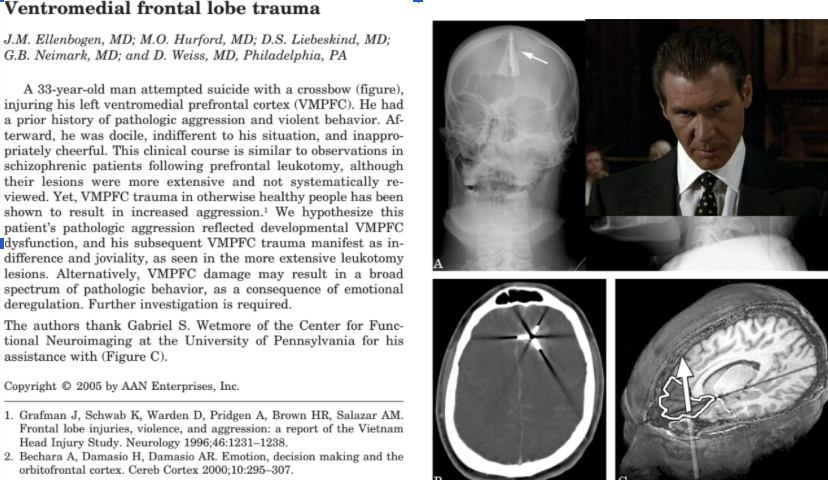
ellenbogen et al. - ventromedial frontal lobe trauma
33-year-old man attempted suicide with a crossbow
prior history of violent behaviour
afterwards was docile and inappropriately cheerful
‘cured’ him of his ASB
ventromedial frontal lobe trauma
raine et al. (2009) - sex differences in orbitofrontal grey as a partial explanation for sex differences in antisocial personality - methods
used structural MRI to understand if there is a neural basis in the sex differences of ASPD
three groups: ASPD, substance misuse, healthy control
what is the relationship between structural brain correlates (specifically PFC subdivisions)
correlations between brain matter in regions and the measure of ASB for the group (self-report and diagnostic)

raine et al. (2009) - sex differences in orbitofrontal grey as a partial explanation for sex differences in antisocial personality - results
across males and females, the lower the volume of PFC subdivisions, the greater the score on ASB
males score higher than females on ASB
males have lower volumes than females
does brain matter volume explain the sex differences in ASB; needed to show:
males and females differ on risk factors (brain volume) - is the case
the risk factor is associated with an increase in ASB in both sexes - is the case
control statistically for the sex differences, then the differences in ASB between the sexes should be diminished - is the case

blair et al. (2006); raine et al. (2010) - psychopathy: a neurodevelopmental disorder?
it has been suggested that psychopathy might be a neurodevelopmental disorder
need to study children to explore this hypothesis
results are unlikely to be confounded by prolonged substance abuse, which is an important confound in the adult studies
raine et al. (2010) - neurodevelopmental marker for limbic maldevelopment in ASPD and psychopathy - methods
control and ASPD
demographics, trauma, antisocial
cavum septum pellicudum
cave between the two ventricles in the brain
as we develop, the ‘cave’ is fully apparent
around 20 weeks of gestation, it will close
by 3-6 months postnatal, it will have fully closed
two ventricles with a thin sheet in the middle
are individuals with ASPD more likely to be characterised by neutral markers such as this

raine et al. (2010) - neurodevelopmental marker for limbic maldevelopment in ASPD and psychopathy - results
those with cavum septum pellicudum are more likely to be charged for a criminal offence
those with score higher in:
aggressive/life-course
psychopathy
ASPD
charges and convictions
gives us a window into what happened in development to link to ASB
do not know why this occurs
may be due to alcohol in pregnancy
may be due to repeated trauma/brain injury

toivonen et al. (2013) - cavum septum pellicudum and psychopathy
did not replicate raine et al. (2010)
found the prevalence of CSP to be equal in the two groups

pardini et al. - lower amygdala volume in men is associated with childhood aggression, early psychopathic traits, and future violence - methods
sample of boys recruited at age 6-7
parents and teachers were given screening questionnaires
those scoring in the top 30% on ASB measures were retained for a longitudinal study follow-up
another group scoring low on ASB was included as a control
assessments were done between aged 10 and 19, then repeated before follow-up at age 26
self-report measure of ASB in adolescence, parent and teacher measures in childhood, MRI data at age 26, criminal records
classified into three groups
control - no evidence of ASB violence
transient violence - violence spanning between 1 and 3 years
chronic violence - violence repeatedly in assessments spanning 1 to 4 years

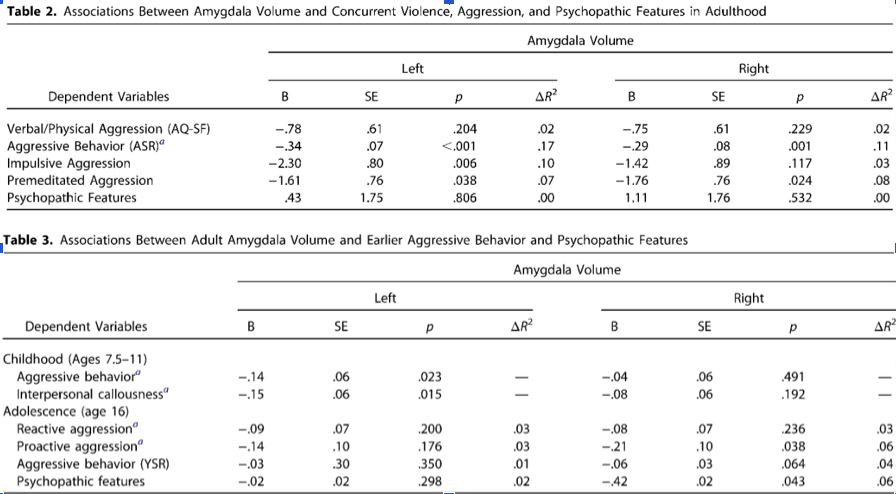
pardini et al. - lower amygdala volume in men is associated with childhood aggression, early psychopathic traits, and future violence - results table
results of MRI scan at age 26
testing the hypothesis of dysfunctional amygdala and psychopathy
top table
regression analysis looking at ASB measures and amygdala volumes (left & right)
aggressive behaviour, impulsive aggression, instrumental aggression are significantly related to the amygdala volume (negative)
lower the amygdala volume, the greater the score on these measures
bottom table
negative relationship of aggressive behaviour and interpersonal callousness with the left amygdala volume
proactive aggression, aggressive behaviour, and psychopathic features share a negative relationship with right amygdala volume
pardini et al. - lower amygdala volume in men is associated with childhood aggression, early psychopathic traits, and future violence - results graph
whether amygdala volume could predict future measures of violence and psychopathy at age 29
after the scan, ppts were classified as those who showed violence and those who did not post-scan
those showing violence showed lower amygdala volume bilaterally
the lower the volume of the amygdala, the greater the psychopathic features at age 29
limitation
focused on males

dugre & de brito (2024) - unravelling the morphological brain architecture of human aggression: a systematic review of meta-analysis of structural neuroimaging studies
found general measures of aggression are associated with reductions in the medial PFC
reactive aggression
reductions in grey matter volume, bilaterally in the temporal lobes, were associated with aggression
proactive aggression
increased volume in the caudate was associated with more proactive aggression

blair et al. (2006); moffitt et al. (2008) - children with CP+CU traits
children with conduct problems and CU traits:
early and severe conduct problems
lack empathy
novelty seeking
a possible sub typing index for DSM-V
white et al. (2013) - the relationship between large cavum septum pellucidum and ASB, CU traits and psychopathy in adolescents
large CSP was not higher among those with a more severe form of DBD
DBD youth with a large CSP did not show increased levels of aggression and PT relative to other DBD youth

blair et al. (2006); Dadds et al. (2006) - neuropsychological profile of CP+CU
neuropsychological profile of these children consistent with:
amygdala dysfunction
failure to recognise fear and sadness in faces
failure to learn in passive avoidance paradigms
ventromedial/ventrolateral PFC dysfunction
extinction paradigms
response reversal
risky decision-making (iowa gambling task)
evidence for grey matter abnormalities in CD in 2015
for reviews see Rogers & De Brito and Baker et al.
two studies → overall reduction in GMV (6%; 13%)
reduction in GMV in several cortical and subcortical brain regions
anterior and posterior insula
temproal lobes bilaterally
right ventromedial PFC incorporating orbitofrontal cortex
right dorsolateral PFC
anterior cingulate cortex
hippocampus
amygdala
striatal regions
rogers & de brito - cortical and subcortical GMV in youths with CP - meta-analytic evidence
13 VBM studies
394 youths with CP
350 TD youths
used 85% of the original data
subgroup analysis
reliability analysis
meta-regression analyses
robust evidence for decreased GMV in left amygdala and anterior insula bilaterally
reduction in the fusiform gyrus

hedging et al. (2009) - conduct disorder: sex matters
getting the phenotypes right: an essential ingredient for understanding aetiological mechanims underlying persistent violence and developing effective treatments

collishaw et al. (2004); afifi et al. (2011); berkout et al. (2011); meier et al. (2011); kerekes et al. (2014) - conduct disorder: sex matters
recent evidence suggests that the prevalence of CD in females has increased
there are pronounced sex differences in:
the development and course of the disorder
the aetiology and physiology
patterns of comorbidity, particularly for internalising disorders (e.g. PTSD, depression)
despite this body of evidence, the majority of neuroimaging studies on CD have focused on male subjects only
fairchild et al. (2013) - brain structure abnormalities in adolescent girls with CD - methods
females with CD using MRI
healthy controls with CD (aged around 17/18)
used VBM
entire grey matter across entire cortex

fairchild et al. (2013) - brain structure abnormalities in adolescent girls with CD - results
amygdala volume
main effect of diagnosis
both males and females with CD show reduced volume of the right amygdala compared to healthy controls
in the anterior insula
diagnosis by sex interaction
differing patterns between sexes
those with CD show increased volume bilaterally
opposite for females; those with CD show a reduction in volume

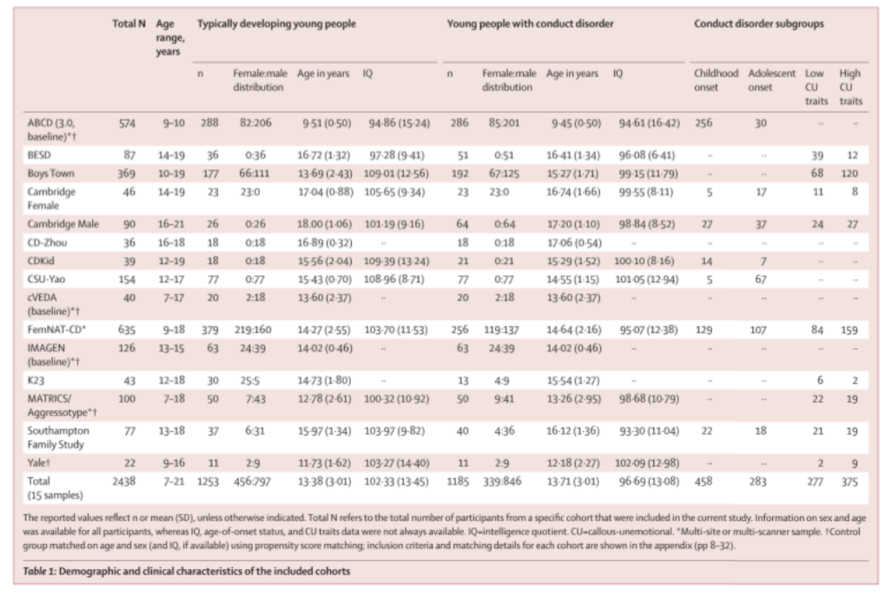
gao et al. - cortical structure and subcortical volumes in CD: a coordinated analysis of 15 international cohorts from the ENIGMA-antisocial behaviour working group - methods
15 international cohorts (n = 2438)
795 females (32.6%)
europe
usa
china
india
participants aged 7-21 years
gao et al. - cortical structure and subcortical volumes in CD: a coordinated analysis of 15 international cohorts from the ENIGMA-antisocial behaviour working group - cortical thickness results
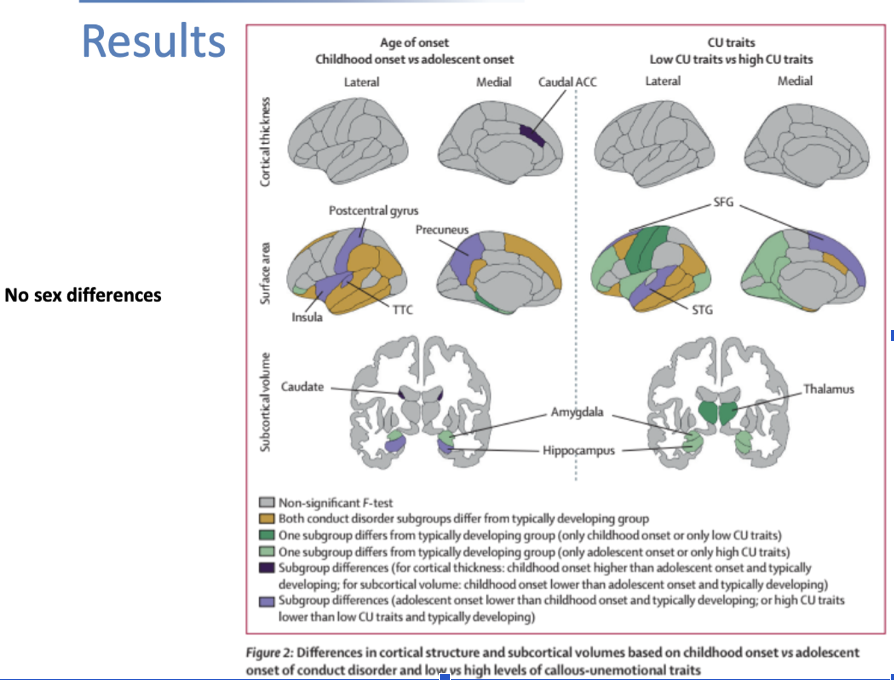
hardly any differences in cortical thickness
increase in the anterior cingulate cortex and decrease in the temporal lobe
out of the 34 regions, 26 showed a decrease in surface area in those with CD
decreased volume in:
hippocampus, amygdala, thalamus, nucleus accumbens

gao et al. - cortical structure and subcortical volumes in CD: a coordinated analysis of 15 international cohorts from the ENIGMA-antisocial behaviour working group - sex differences results
no sex differencesin those with CD
when they looked at the subgroup, there were not many differences
those with high levels of CU traits showed the greatest differences compared to the controls