Heart 2
 Call Kai
 Learn
 Practice Test
 Spaced Repetition
 Match
 Flashcards
 Knowt Play
1/27

There's no tags or description
Looks like no tags are added yet.
28 Terms
Coronary arteries
Both left and right coronary arteries arise
from base of aorta and supply arterial
blood to heart
Left coronary artery
supplies
interventricular septum, anterior
ventricular walls, left atrium, and posterior
wall of left ventricle; has two branches:
Right coronary artery
supplies right atrium
and most of right ventricle; has two
branches:
Cardiac veins
collect blood from capillary
beds
Coronary sinus
empties into right atrium;
formed by merging cardiac veins
Intercalated discs
are connecting junctions
between cardiac cells that contain desmose and gap junctions
-Allows heart to be a functional
syncytium, a single coordinated unit
Angina pectoris
Thoracic pain caused by fleeting deficiency in
blood delivery to myocardium
Myocardial infarction (heart attack)
Prolonged coronary blockage
• Areas of cell death are repaired with
noncontractile scar tissue
Cardiac muscle cells depolarization and contraction triggerd by…
electrical signals
from pacemaker cells
Autorhymicity
some cells spontaneously
depolarize and cause others to do so
Cardiac conductive cells do not…
have a stable resting
potential
Heart depolarizes and
contracts without…
nervous
system stimulation,
Systole
contraction
Diastole
relaxation
Nodes
Specialized clump of myocardial
conducting cells
Lubb/Dubb
-AV Valves close: First sound “Lubb”
-SL Valves close: second sound “Dubb/Dup
Arrhythmias
irregular heart rhythms
• Uncoordinated atrial and ventricular contractions
Fibrillation
rapid, irregular contractions
decreased time between action potentials =
heart beats faster
more time
lapse between action potential
slower
heart rate
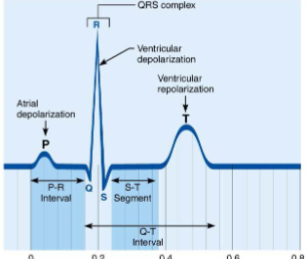
Electrocardiogram
) is a
graphic recording of electrical activity
PQRST
Tachycardia vs Bradycardia
Tachy; abnormally fast heart rate
Brachy; heart rate slower than 60 beats/min
Sinus rhythm
normal contractile pattern of the hear
Fibrillation
the heart beats in a wild, uncontrolled manner,
which prevents it from being able to pump effectively
Heart block
an interruption in the normal conduction pathway
from Atria to ventricles
Cardiac Output
Amount of blood pumped by
each ventricle in 1 minute
• It is the product of heart rate
and stroke volume
Stroke Volume
Volume of blood pumped out by
one ventricle with each beat
• Generally, correlates with the
force of ventricular contractio