Endocrine System 1
 Call Kai
 Learn
 Practice Test
 Spaced Repetition
 Match
 Flashcards
 Knowt Play
1/11

There's no tags or description
Looks like no tags are added yet.
12 Terms

Hypothalamus/Pituitary & Thyroid
What do they do? Work together to regulate certain hormones
Hypothalamus = body’s thermostat
coordinates changes in SNS & PNS
communicates with pituitary via “releasing” and ”inhibiting” hormones and neuronal input
Hormones: GHRH, TRH, CRH, GnRH, PIF, dopamine
Pituitary = controls growth and metabolism
master gland
communicates with the hypothalamus by blood and nerves
hormones: GH, ACTH, TSH, LH, FSH
Measuring hormone output determines what is wrong
* know what is wrong when labs are strange
Thyroid
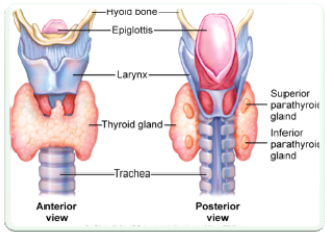
Thyroid → Located on top of the trachea
Regulates metabolism
Hormones: Thyroxine (T4), Triiodothyronine (T3),
Calcitonin
Disorders: Hypo/hyperthyroidism, Cancer
Parathyroid Glands → Located on the posterior
Surface of the thyroid
Superior/Inferior – responsible for eucalcemia

Hypothyroidism
Hypo is slow! Slows things down!
Etiology
Autoimmune Disease (Hashimoto’s Thyroiditis)
Surgical removal of the thyroid
Radiation treatment
certain medications
In autoimmune disease: body mistakes thyroid gland cells & their enzymes for invaders destroys cells, leaves no thyroid cells or enzymes to produce thyroid hormone
Causes: primary (loss of the gland itself), secondary (pituitary gland issue, if issue with TSH) or tertiary (hypothalamus issue), Goiter (not enough Iodine),
Hair loss, fatigue, sensitivity to cold, bradycardia, menstrual change, weight gain, dry skin
Diagnostic Studies
History and physical examination
Laboratory tests
• Serum TSH (Determines location of hypothyroidism – pituitary & secondary)
• Free T4 - biologically active
• Serum T3 – usually free T3 and bound T3
• Serum T4 (Total T4) - biologically active & protein bound inactive T4
• Increased Cholesterol & trig, increased CK, anemia
• TRH Stimulation test – increased TSH after TRH injection = hypothalamic dysfunction
T4 can convert to T3
Treatment
Goal: Restoration of euthyroid state as safely and rapidly as possible
Low calorie diet
Synthetic T4 (levothyroxine): levitating thyroid levels
Monitor thyroid levels

Thyroid Disorders: Thyroid Replacements: levothyroxine
Thyroid Replacements:
levothyroxine (Synthroid)
MOA
Synthetically prepared T4; T4 is converted to T3
Therapeutic Use
hypothyroidism
Adverse Drug Reactions (rare) (hyperthyroidism)
Thyrotoxicosis (toxic amt of thyroid hormones, doesnt tell u whats going on tho), hyperthyroidism
Tachycardia
Headache, Insomnia, irritability
Diarrhea
Tremors
Interventions
Monitor thyroid function (thyroid labs every 6-8 weeks)
Monitor for s/sx hyperthyroid
Client Instructions
Take in the morning on empty stomach
Must taper when discontinuing
May require lifelong therapy
Taper medication
Formulations are not interchangeable
Contraindications
Thyrotoxicosis
Recent Myocardial Infarction
Severe renal impairment
Drug Interactions
Ca supplements (reduces absorption)
Antacids (reduces absorption)
Increases anticoagulant effects of warfarin
Precautions
CV disease
Renal Impairment
Diabetes Mellitus
Older adults

Hyperthyroidism
What does it mean? Speeds things up
Thyroid is over functioning, increasing metabolic rate
Definition: sustained increase in synthesis & release of thyroid hormones (from thyroid)
Causes: Autoimmune overproduction (Graves’ Disease), exogenous iodine excess, pituitary tumor, too much Synthroid, thyroid cancer
More common in women & 20–40-year-olds
Graves' Disease
Precipitating factors
• Infection
• Stressful life events (interacting with genetic factors)
accounts for 75% of hyperthyroidism cases
Antibodies are developed to TSH receptor
• Thyrotropin receptor antibody (TRAb)
• Leads to clinical manifestations of thyrotoxicosis (may progress to Thyroid storm)
• Antibodies attached to receptors on thyroid causing an increase in T3. T4
• May progress to destruction of thyroid tissue, leading to hypothyroidism
Treatment
Reduce symptoms of hyperthyroidism (Betablockers)
Thyroidectomy (requires lifelong replacement)
Pharmacotherapy
• PTU
• Radioactive Iodine

Thyroid Disorders: Antithyroid Drugs (Thioamides): propylthiaouracil/ PTU
Antithyroid Drugs (Thioamides)
propylthiaouracil/ PTU
MOA
Limits the synthesis of thyroid hormones by blocking iodine from being integrated in tyrosine. Also inhibits peripheral conversion of T4 to T3.
Therapeutic Use
Hyperthyroidism (Grave’s Disease)
Thyrotoxic Crisis
Suppression of thyroid in prep for thyroidectomy: if thyroid is so large
*can be used alone or in combination with radiation
Adverse Drug Reactions
Hepatotoxicity
Hypothyroidism
Agranulocytosis (uncommon) (fever, sore throat but pain in throat!)
Aplastic anemia (rare)
Rash
N/V and headache
Interventions
Monitor thyroid function (thyroid labs every 6-8 weeks)
Monitor for s/sx hypothyroid
Baseline CBC then as needed (for agranulocytosis)
Client Instructions
Take every 8h (short half-life)
Report fever and sore throat (s/sx of agranulocytosis)
Monitor for rash/bone pain
Medication must be tapered
Can takes 3-12 weeks to normalize
*pt saying something not making sense “i should feel affects in a week” FALSE!
Contraindications
Hypersensitivity
Drug Interactions
Additive effect when used with antineoplastics or radiation on bone marrow suppression. : monitor for hyperthyroidism
Precautions
Immunosuppression
Bone marrow depression
Infection
Liver dysfunction: jaundice, pain, ascites (abdominal distention)
Pregnancy
Thyroid Disorders: Antithyroid Drugs (Thioamides): methiamazole/ Tapazole
Antithyroid Drugs (Thioamides):
methiamazole/ Tapazole
MOA
Limits the synthesis of thyroid hormones by blocking iodine from being integrated in tyrosine. no impact on synthesis of t4 or t3.
Therapeutic Use
Hyperthyroidism (Graves’ Disease)
Thyrotoxic Crisis Thyroid storm—as part of combination treatment.
Methimazole can be used; it is not sufficient by itself.
May be used as primary drug therapy or to control hyperthyroidism before definitive treatment with radioactive iodine or surgery.
*can be used alone or in combination with radiation
Adverse Drug Reactions
Hypothyroidism
Agranulocytosis (uncommon)
Aplastic anemia (rare)
Rash
N/V and headache
Liver injury
Interventions
Monitor thyroid function (thyroid
labs every 6-8 weeks)
Monitor for s/sx hypothyroid
Baseline CBC then as needed (for agranulocytosis)
Client Instructions
Report fever and sore throat (s/sx of agranulocytosis)!
Monitor for rash/bone pain
Medication must be tapered
Can take 3-12 weeks to normalize
Contraindications
Hypersensitivity
Drug Interactions
Additive effect when used with antineoplastics or radiation on bone marrow suppression.
May increase the effect of warfarin—monitor PT/INR
Precautions
Immunosuppression
Bone marrow depression
Infection
Liver dysfunction
Risk for fetal harm
Thyroid Disorders: Antithyroid Drugs: iodine-131
Antithyroid Drugs:
iodine-131 (Radioactive Iodine)
MOA
Over time the thyroid will take in radioactive iodine, which will eventually destroy thyroid tissue and glandular function
Therapeutic Use
Hyperthyroidism (Grave’s Disease)
Thyroid Cancer (much higher dose given for cancer)
Adverse Drug Reactions
Hypothyroidism
Bone marrow depression (rare)
Radiation sickness (rare)
Interventions
Monitor thyroid function
Monitor for s/sx hypothyroid
Baseline CBC then as needed
Monitor for radiation sickness
Client Instructions
Limit exposure to others (radiation) especially children & pregnant women
Report fever and sore throat (s/sx of agranulocytosis)
Report bloody nose:
Contraindications
Pregnancy
Breastfeeding (does enter breastmilk)
Drug Interactions
Do not give other antithyroid medications while giving, because they will reduce the uptake
Precautions
Use caution in pre-pubescent children
*body still having radiation when on this even tho only targeting in thyroid gland.

Adrenal Glands
What does it do? Stress response, blood pressure, fight-or-flight
Adrenal Glands → Located on top of the kidneys (think add to renal)
Cortex: cortisol (stress/metabolism) & Aldosterone (BP)
Medulla: Adrenaline & noradrenaline (fight-or-flight) & sex hormones
Disorders of the Adrenal Glands → causes
Primary – the gland itself (JFK)
Secondary – stimulating gland is the problem (pituitary)
Tertiary – releasing organ is the problem (hypothalamus)
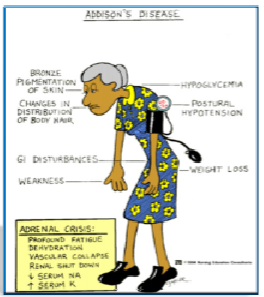
Addison’s Disease
*ADD more hormones
Disordered Adrenal Function - INSUFFICIENCY
Mental Status → mood changes, irritability
Glycemic Response → Hypo*
Hydration/Electrolytes → lose Na+ & H20, ↑K+
Low cortisol, aldosterone, sex hormones
(symptoms of hyperkalemia?) Fast & Irregular heartbeat, muscle twitching, spasms, weakness
Addison’s Disease
Clinical Manifestations → Anorexia/nausea, hyperpigmentation, GI upset
Fluid Balance → Hypotension (d/t increase capillary permeability & vascular collapse - losing Na+ & water (but retaining K+)
What happens to glucose? DECREASE
Adrenal insufficiency”= addison’s disease
LOW cortisol and LOW aldosterone
Adrenals regulate BP, Na & H20 balance, Stress, Body hair during puberty
Autoimmune (mostly) or idiopathic atrophy (Tumor or poor pituitary function)
Abruptly stopped steroids
Give steroids because the Adrenals stop producing and releasing steroids
Treatment
Increase Na+ (broth, salty foods): retain salt
Daily I&O (weight gain/loss)
Meds (corticosteroids) – DON’T ABRUPTLY STOP!
Address fluid volume deficit
Addison’s Crisis may occur (who is most at risk?)
Immediate parenteral hydrocortisone!
Profound dehydration: NS + D10 (ultimately hypotensive)
Cyanotic: Give O2
Tachycardia
Hypoglycemic/Hyperkalemia
Adrenal Disorders: Glucocorticoids: hydrocortisone (Cortef)
Glucocorticoids:
hydrocortisone (Cortef)
MOA
A synthetic preparation of Cortisol
Mimics cortisol- increases availability of glucose
Therapeutic use
acute or chronic adrenal insufficiency (Addison’s disease) without these patients will die
Adverse Drug Reactions
Adrenal insufficiency
Cushing’s syndrome (overshoot!)
(both rare if therapeutic doses)
Interventions
Monitor for weight changes
Monitor for adrenal insufficiency: not enough
Monitor for Cushing
Client Instructions
Report stress
Avoid live vaccines: steroid that dampens immune response
Monitor weight changes
Minimize carbohydrates
Contraindications
Small doses – none.
Large doses – severe infection
Live vaccines
Drug Interactions
Birth control (if large dosing)
Phenobarb (if large dosing)
Precautions
None
Adrenal Disorders: mineralocorticoids: fludrocortisone
mineralocorticoids
fludrocortisone
MOA
Mimics the action of aldosterone (ADH)
Regulates sodium potassium and water levels
Usually give with hydrocortisone
Therapeutic Use
Acute or chronic adrenocortical insufficiencies (Addison’s disease, primary
Hypoaldosteronism and congenital adrenal hyperplasia)
Adverse Drug Reactions
Few at low doses
Fluid & electrolyte imbalances
Hypo K
Heart failure
Interventions
Monitor for s/sx of ADR
Monitor for fluid/elec imbalance
Client Instructions
Report weight gain
Follow a diet high in potassium
Report weakness or heart changes: potassium
Have BP checked regularly
Take with milk
Must taper dose!
Contraindications
Hypersensitivity
Drug Interactions
Potassium depleting diuretics
Salt and foods high in sodium (increases sodium retention and potassium loss)
Precautions
Heart failure
Addison’s Disease (may have exaggerated response)
OB
Cushing’s Syndrome
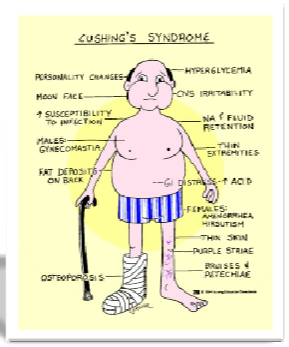
Disordered Adrenal Function - EXCESS
Mental Status → mood changes, cranky
Glycemic Response → Hyper* due to which 3 pathways?
Immune Response → Suppression - @ risk for?
Physical Hallmark → Moon face
High Cortisol
Cushing’s syndrome
Causes → tumors of adrenal gland, lung cancer, iatrogenic
Mental Status → mood changes, euphoria
Glycemic Response → Hyper* due to which 3 pathways?
Immune Response → Suppression - @ risk for?
