Ling 1 Midterm Review:
 Call Kai
 Learn
 Practice Test
 Spaced Repetition
 Match
 Flashcards
 Knowt Play
1/46

Earn XP
Description and Tags
Please help me get an A!!
47 Terms
linguistic competence
knowledge of words and grammar
linguistic performance
how we use linguistic competence in speech production/comprehension
Linguistic creativity
languages use a finite set of rules to create infinite sentences, thanks to linguistic creativity, you can understand sentences of any length, even ones you haven’t heard before.
Universal Grammar
Children have an innate ability to understand language
All human languages share deep underlying structures (eg, phonetics, morphology, syntax, lexicon, semantics, linguistic creativity)
prescriptive grammar
linguists try to “prescribe” a grammar for population (state what’s “correct” and “incorrect”)
descriptive grammar
linguists describe how a speaker actually speaks without telling them what’s right or wrong
McGurk Effect
Multisensory integration: Your brain does not process hearing and vision in separate, isolated boxes. Instead, it automatically and continuously blends sensory inputs into a single, unified perception of the world. [
Unconscious processing: The illusion happens automatically. Even if you know how the trick works and that the audio and video do not match, you cannot force your brain to stop hearing the altered sound.
What is it: a mismatch between what you hear and the mouth sounds you see causes brain to perceive a completely different sound
Wug Test
Test to show that children can apply rules of their native lang to nonsense words—highlighted that children could apply plural, past tense, & possessive forms of nouns/verbs that they’d never heard before
dialect
variety of a language whose grammar differs in systematic ways (eg; lexical, phonological, syntactic, semantic diffs)
can vary by socioeconomic class, region, gender, generation
dominant/”prestige” dialect
“Standard dialect” of a language, perpetuated by upper class, education systems, NOT more correct/better than other dialects!
[i]
feet “ee”
[ɪ] capital I
sit “ih”
[e]
late “ay”
[ɛ]
“bet” eh
[æ]
rad, cat, thank “ah”
[ʌ] (stressed positions)
“but” “uh”
[ə] (unstressed positions)
about “uh” comma
[u]
boot “oo”
[ʊ]
book, took “eugh”
[ɔ]
caught , frog “aw”
[ɑ]
as in not, “aw” (some dialects merge [ɔ] and [ɑ])
dipthongs
combination of vowel and glide ([aj] as in eye, [ɔɪ] as in soil/boy, [aw] as in house)
How are vowels categorized?
Tongue position
Front
Central
Back
Tongue height
High
Mid
Low
Tenseness
Tense
lax
Lip rounding
rounded
unrounded
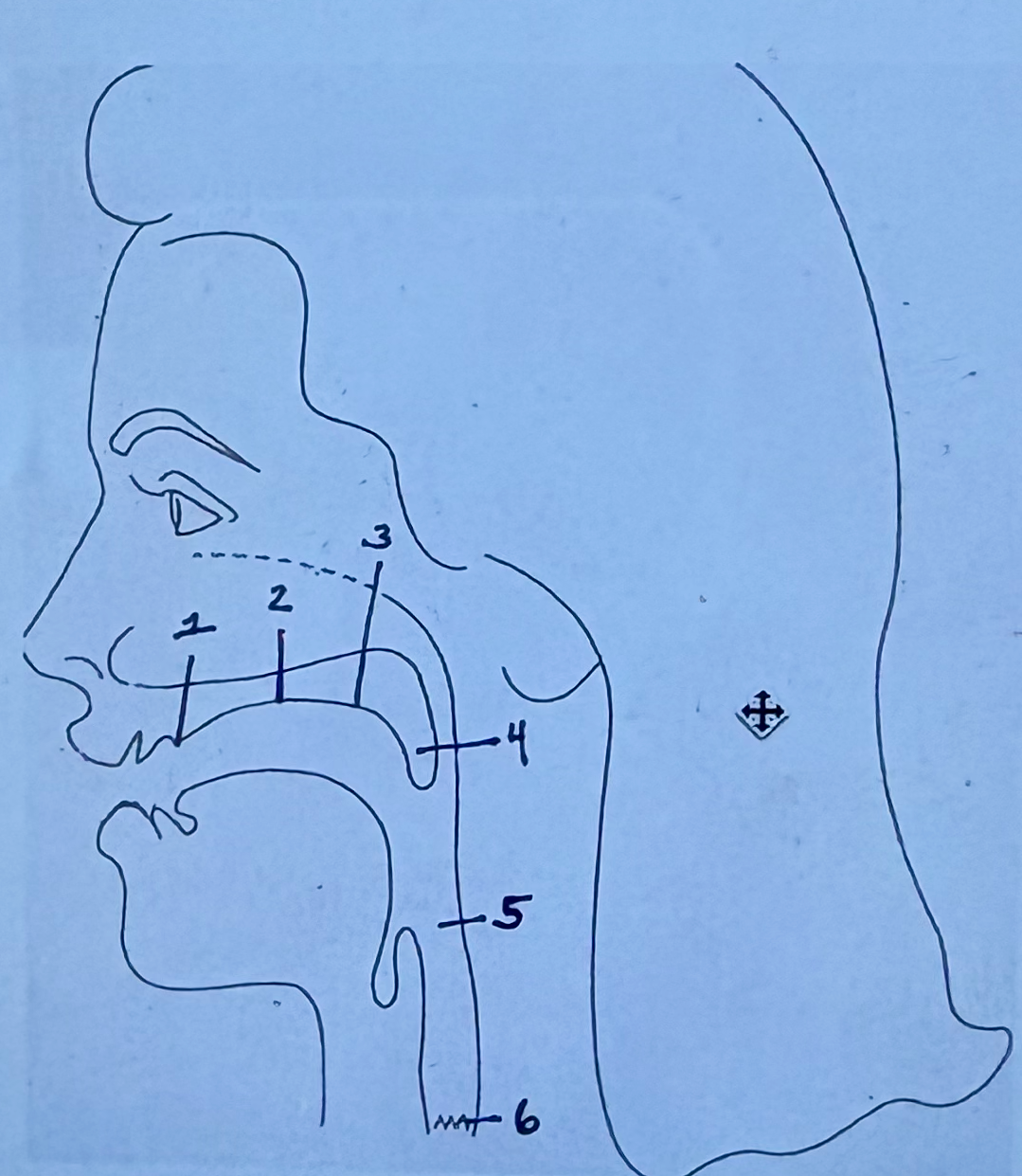
1 (name site of articulation & consonants that occur here)
alveolar ridge—site directly behind upper front teeth; site of articulation = alveolars ([t], [d], [n], [s], [z], [l], [r])

2 (name site of articulation & consonants that occur here)
hard palate—behind alveolar ridge (center of roof of mouth); site of articulation = palatals ([ʃ] “sh”, [ʒ] (as in “genre”), [tʃ] “ch”, [dʒ] (as in “judge”), [j] (as in “yes”)

3 (name site of articulation & consonants that occur here)
velum (or soft palate)—-behind hard palate; site of articulation = velars ([k], [g], [ŋ] “ng”)
5
Glottis—-site of articulation= glottal, ([ʔ] (glottal stop in uh oh) [h])
Bilabial
Site of articulation = when two lips press together ([b], [m], [p])
Labiodental
site of articulation = when upper teeth meet bottom lip ([v], [f])
interdental
site of articulation= where tongue meets front teeth ([θ] (thigh, breathe), [ð] (thy, father, breathe)
Labiovelar
site of articulation = lips and velum (bilabial & velar—- [w])
Classification of consonants: voicing
Whether a consonant is voiced (vocal folds vibrating—bc vocal folds are together & air forces thru which causes vibrations) or voiceless (open glottis, vocal folds separate and air flowing thru)
How to check if a consonant is voiceless
press fingers to adam’s apple and speak! (do small sound, don’t add vowel bc otherwise you’ll feel a vibration! eg; instead of “ba” just do “buh” or “tuh” instead of “tah”)
Manner of articulation—Stops
Stop = airflow is completely blocked
Stops can be oral (velum raised, blocks nasal cavity—when stop released, air flows out of mouth)
Or nasal (velum lowered, air flows out of nasal cavity when stop is released)
Nasal stops (all the rest of the consonants are oral!)
[m], [n], [ŋ] (ng)
Manner of articulation—aspiration
brief puff of air that escapes after stop is released before vocal cords vibrate for voicing vowels [p], [t], [k] ←only occur in word-initial position (eg, pool, tale, kale)
Manner of articulation—fricatives
Major, but NOT complete obstruction in vocal tract (not a complete stop, air can still force its way thru)
[f], [v], [θ], [ð], [s], [z], [ʃ], [ʒ] (as in genre, pleasure), [h]
Manner of articulation: Affricates
stop quickly followed by a fricative!
[tʃ] as in cheap, [dʒ] as in Judge ←notice how the symbols are a combo of a stop and a fricative!
Manner of articulation: Liquids
Minor obstruction of vocal tract with tongue, but air still passes through. Liquids can be LATERAL ([l], air passes thru sides of tongue)
or RETROFLEX ([r] tongue curves back behind alveolar ridge in retroflex position, air passes thru)
Manner of articulation: Glides
[j] (as in yes) = palatal glide, [w] = labial-velar glide
Broca’s Aphasia
Damage to frontal lobe in left hemisphere
Few words, but coherent
Semantics ok, syntax not ok, comprehension mostly ok, writing not ok
Wernicke’s Aphasia
Damage to temporal lobe in left hemisphere
Speech is fluent but incoherent (struggle with semantics, but syntax is ok)
Grammar is unaffected—but word choice/meaning is
Comprehension = impaired
Writing = not ok
fMRI Experiment, BSL vs. English
Researchers scanned brain to see ppl process English & BSL
Consistently, each group had Broca’s area (frontal) and Wernicke’s area (temporal) light up
Suggests that even tho spoken + sign language use diff modalities, both are still processed in same area of brain
Is language associated with intelligence: Specific Language Impairment (SLI)
Characterized by specific types of difficulty with language
Children may start speaking late
Still retain normal IQ and ability in other areas (eg, comprehension + hearing)
Study conducted (Rice and Oetting), took 50 five year old children w/ SLI and 58 non-SLI younger children
Both groups used sentences of comparable length, recorded spontaneous speech + plural noun endings
Typically developing children (despite young age) performed better
SLI disproves theory that high IQ=strong lang ability!
Is language associated with intelligence: Williams Syndrome
Language is intact, but low IQ
Limited spatial and motor skills
Exceptional linguistic ability—-also disproves theory that strong language ability = high IQ
Is language associated with intelligence; Linguistic Savants
Low general intelligence (IQ) but patients have complex language
(eg; Christopher can’t take care of himself, but knows multiple (20) languages)
Further proof of dissociation between general intelligence and linguistic ability!