Physiology of the Kindey
 Call Kai
 Learn
Learn Practice Test
 Spaced Repetition
 Match
Match Flashcards
 Knowt Play
1/68

There's no tags or description
Looks like no tags are added yet.
Name | Mastery | Learn | Test | Matching | Spaced | Call with Kai | Chat |
|---|
No analytics yet
Send a link to your students to track their progress
69 Terms
What is Polycystic Kindey Disease?
Group of disorders
Progressive formation of fluid filled cysts causing the loss of function in nephrons
1:2000 in NL
How much body weight, cardiac output and energy consumption does the kidney use?

What are the symptoms of kidney diseases?
Change in urination
Swelling of legs, ankels, face and hands
Fatigue and shortness of breath
Itch and cramps
Nausea and vomiting
Hypertension
What are Functions of the Kidneys?

What hormones and emzymes does the kidney produce?
Hormone: erythropoietin which controls erythrocyte production, 1,25 dihydroxy vitamine D, calcitrol, calcium and phosphate homeostasis)
Enzyme: Renin which controls Na+ and water reabsorption.
What are the three basic renal processes that lead to the formation of urine? How do they take place and how are they regulated?
Processes are: glomerular filtration, tubular reabsorption, tubular secretion
Reabsorption and secretion of the fluid takes place via diffusion and carrier mediated transport
Regulation takes place by modulation of density and activity of channels and transporters.
What are the three fates a substance can have through the urine and what does it depend on and what are examples?
Based on their ohysiological role, they can either be completely excreted into the urine, partially be absobed or completely be absorbed.
Example of total excretion: toxic subatances; partial absorption: Na+ and water and complete reabsorption is glucose.

Where does creatine belong in terms of how much is secreted?
Creatine fits none of the scenarios since it is freely filtered but not reabsorbed and only highly secreted.
What is the issue in urine of diabetes mellitus patients?
They will have glucose secreted in their urine because they conain glucose above the threshold level. Hence secretion in urine of excess glucose.
What is the fuction of the Renal corpuscle?
Filtration of blood
What does the proximal convulated tubule do?
Reabsorption of most of the filtered water, Na+, Cl- glucose, amino acid and secretion
What does the Loop of Henle do?
generation of osmotic gradient
What does the distal convulated tubule do?
Fine tuning of water reabsorption; secretion (a.o. drugs and toxins)
What does the collecting duct?
Fine tuning of water reabsorption; secretion (e.g. K+)
Overview Image of Nephron

Just know that the morphology of the convulated tubules effects the function of them
Which arteries take blood to and from the Bowman’s Capsule?
To is the Afferent arteriole
From is the Efferent arteriole
What is the filtration barrier and what are its three layers?
Its the Barrier that seperates blood in the glomerlus from Bowman’s Space.

What are blood components that can and cannot pass the barriers?
Can pass: amino acids, creatine, electrolytes, glucose, urea and water
Cant pass: erythrocytes and plasma proteins
What is needed for filtrate to pass through the ultrafiltration barrier?
driving pressure which comes from starling forces (hydrostatic forces and colloid osmotic pressure)
How do you calculate net filtration pressure and what are the components?
(Glomerular capillary hydrostatic pressure - Capsular hydrostatic pressure) - Blood colloid pressure

What is Glomerular filtration rate?
volume of fluid filterred by glomerulus → Bowmanns space per unit time (mL per minute)
determined by Starling forces and also by:
permeability of corpuscle membranes
surface area available for filtration
Definition: total volume filterred from glomerulus → capsular space (both kidney) per unit time usually expressed in mL per minute)
What is the normal GFR and plasma volume?
180 L/day or 125 ml/min
plasma volume: 3L
What can GFR indicate about kidney function?

How can GFR be determined?
To determine the value of GFR a substance is needed that: is freely fitted, not secreted, not reabsorbed and has a constant plasma concentration.
E.g. Insulin: gold standard but laborious and expensive; Creatine: no reabsorptiom very little secretom and slight overestimation of GFR.
Calculation for GFR ?

What is renal clearance and how is it calculated?

What effect does donating a kidney have on GFR and creatinine levels?
After donation creatinine levels will increase and GFR will decrease
How do afferent and efferent arteriole diameter changes affect GFR?
Afferent dilation → ↑ glomerular pressure → ↑ GFR.
Afferent constriction → ↓ pressure → ↓ GFR.
Moderate efferent constriction → ↑ pressure → ↑ GFR.
Efferent dilation → ↓ pressure → ↓ GFR.
What is the typical diameter of the affarent and effecerent arterioles?

Why does sodium balance affect extracellular fluid volume?
Sodium is the main extracellular cation. Retaining sodium generally promotes water retention and increases ECF volume; losing sodium with water reduces it.
What are the fluid compartments of cells?
Intracellular fluid is 67% - acts as a large reservoir preventing large osmotic changes in the extracellular fluid.
Extracellular Fluid is 33%
Plasma is 7%
Interstitial Fluid is 26%

Describe the exchange between ICF and ECF.
Water has free exchange via aquaporins
Electrolutes via transporters/channels
How does ECF concentration affect cell volume?
More concentrated ECF → water leaves cells → shrinkage. More dilute ECF → water enters cells → swelling
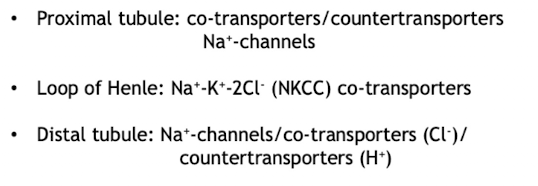
What mechanisms of Na+ reabsorption do the different components of the renal corpuscule use?
Overall driving force is Na+K+-ATPase
What effect does aldosterone have?
Increases the synthesis and incorporation of Na+K+-ATPase and the sodium channels
Overall there for the finetuning of sodium reabsorption
What is the renin-angiotensin system?
The RAAS raises blood pressure when blood volume or kidney perfusion is low:
Kidney releases renin → converts liver-produced angiotensinogen into angiotensin I.
ACE converts angiotensin I into angiotensin II.
Angiotensin II constricts blood vessels and stimulates aldosterone → kidneys retain more sodium and water → blood pressure rises
Angiotensin II also increases proximal-tubule sodium reabsorption and constricts the efferent arteriole, helping maintain glomerular pressure and GFR
What three signals stimulate renin release from juxtaglomerular cells?
↑ Renal sympathetic activity.
↓ Afferent arteriole pressure/stretch.
↓ NaCl delivery to the macula densa.
These activate RAAS to help restore blood pressure and volume.
What is the idea “water follows solutes”? And what is known about water permeability?
Reabsorption of solutes → increase intracellular osmolarity → diffusion of water (osmosis)
Water permeability of the membrane: strongly dependant on water channels via aquaporins, varies between segments of renal tubules.
How does water permeability vary along the nephron?
Proximal tubule and descending limb: high. Ascending limb: impermeable. Late distal tubule/collecting duct: ADH-dependent—more ADH → more water reabsorbed.

What does ADH do?
Allows the reabsorption of water independant to NA+ reabsorption
Increases the number of channels expressed on the membrane to increase
More channels → more water leaving the tuvular fluid → more water ruturning to the circulation → less concentrated urine.
ADH isnt the pump for water but does contributee to making the membrane more permeable.
What factors regulate the ADH secretion?
High Osmolarity ECF: meaning if the fluid is too concentrated →> we retain water
Will also make you more thirsty
Low Plasma volume: if circulating volume is too low → we conserve water
Both factors will cause ADH to increase → increased water reabsorption → H2O excretion.
What external factors can stimulate and inhibit ADH release?
Stimulation: Angiotensin II, pain, emotion, stress, pregnancy and nicotone
Inhibition: Alcohol and caffine.
How is the osmotic gradient in renal medulla?
As we go deeper in the renal medulla the concentration of the tubular fluid increases
This osmotic gradient in the medulla is the driving foce for water reabsorption in the collecting duct → it is what pulls out the water via ADH from the duct
What is needed to concentrate the urine?
Concentrated medulla
Collecting duct which allows water to leave via ADH to be reabsorbed.
What is the vasa recta?
Its a parallel set of hairpin loop capillaries in the medulla that prevent the washout of the gradient
This is done by removing reabsorbed waterr while limiting the loss of medullary solute gradient In
In the loop of henle what contributes to hyperosmotic medullary interstitial fluid?
Concentration of descending limb: high water permeability and no reabsorption of Na+ and Cl-
Concentration of ascending limb: impermeable for water and reabsorption of Na+ and Cl-
How does the loop of henle generate an osmotic gradient?
The sequence is:
The ascending limb moves salt into the interstitium without water.
Water leaves the neighbouring descending limb.
Continuous flow brings new fluid into the loop.
Repetition builds the vertical osmotic gradient.
This gradient can later draw water out of the collecting duct
What effect does urea secretion have?
Urea recycling (secretion and reabsorption) contributes to medullary osmotic gradient
How does sweating change fluid compartments?

What is the renal response to reduced plasma volume?
There will be an activation of fluid conserving responses:
reduced plasma volume → low GFR → s + high renin → aldosterone > high sodium reabsorption + high ADH therefor water reabsorption hence leading to decreased less sodium and H2O excretion

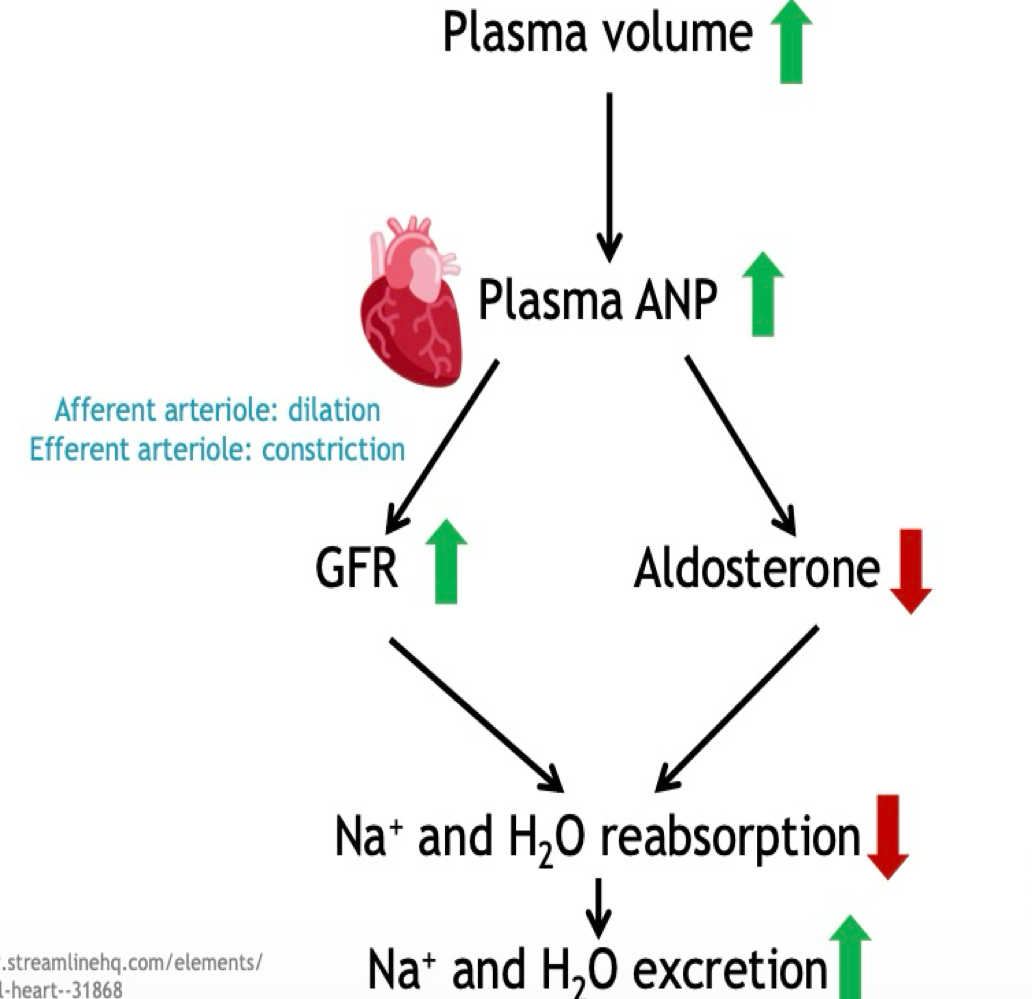
What is the response to excess volume?
Response with ANP
High plasma volume → increase in plasma ANP → High GFR and low aldosterone → sodium and water reabsorbtion is low and more sodium and water is excreted
What is the importance of Potassium Balance ?
Its important for maintaing resting membrane potential
Changes in the extracellular K+ will alter nerve and muscle (heart muscles becoming electrically active)
Hence we need careful K+ regulation
What happens to K+ in the body?
Most of the filtrated K+ is reabsorbed
Excess K+ is secreted in the cortical collecting duct via K+ channels im the luminal membranes
Increasing [K+] → stimulate the secretion of aldosterone → increased secretion if K+
What is the Micturinition Reflex and what is the mechanism explaining it?
Urination triggered by stretch receptors causing contraction of the detrusour muscle.
Bladder fills → stretch receptors detect expansion and trigger a reflex which contracts the detrusour muscle (smooth muscle of bladder).
Additionally relaxing of the bladder wall is also necessary and that is stimulated by the nervous system.
Summarise the mechanism of urine storage?
Decreased parasympathetic activity
Increased sympathetic activity
relaxiation of the detursor muscle
contraction of the internal sphincter
Activation of somatic neurons
contraction external sphincter

Summarise the mechsnism of urine release?
Increased parasympathetic activity
contraction of the detursour muscle
Decreased sympathetic activity
relaxiation of the internal sphincter
Inhibition of the somatic neurons causing relaxing of the external sphincter.
The reflex and external sphincter are influenced by…
signals from the pons and cerebrum
What are conditions related to disturbance of acid base balance?

How can we determine acidity of blood pH?

What are sources that cause us to gain H+ concentration?

What are sources that cause us to loose H+ concentration?

What are the buffer systems in the fluid compartments (intracellular and extracellular) ?
They will bind to the H+ ion and act as a buffer in your system until your body needs it and can then be released.
Intracellular: phosphate buffer system (H2PO4 → H+ + PO42-), protein buffer system and hemoglobin buffer system
Extracellular: Carbonic acid - bicarbonate system, Protein buffer system
→ they provide a temporary solution to avoid an acid-base imbalance

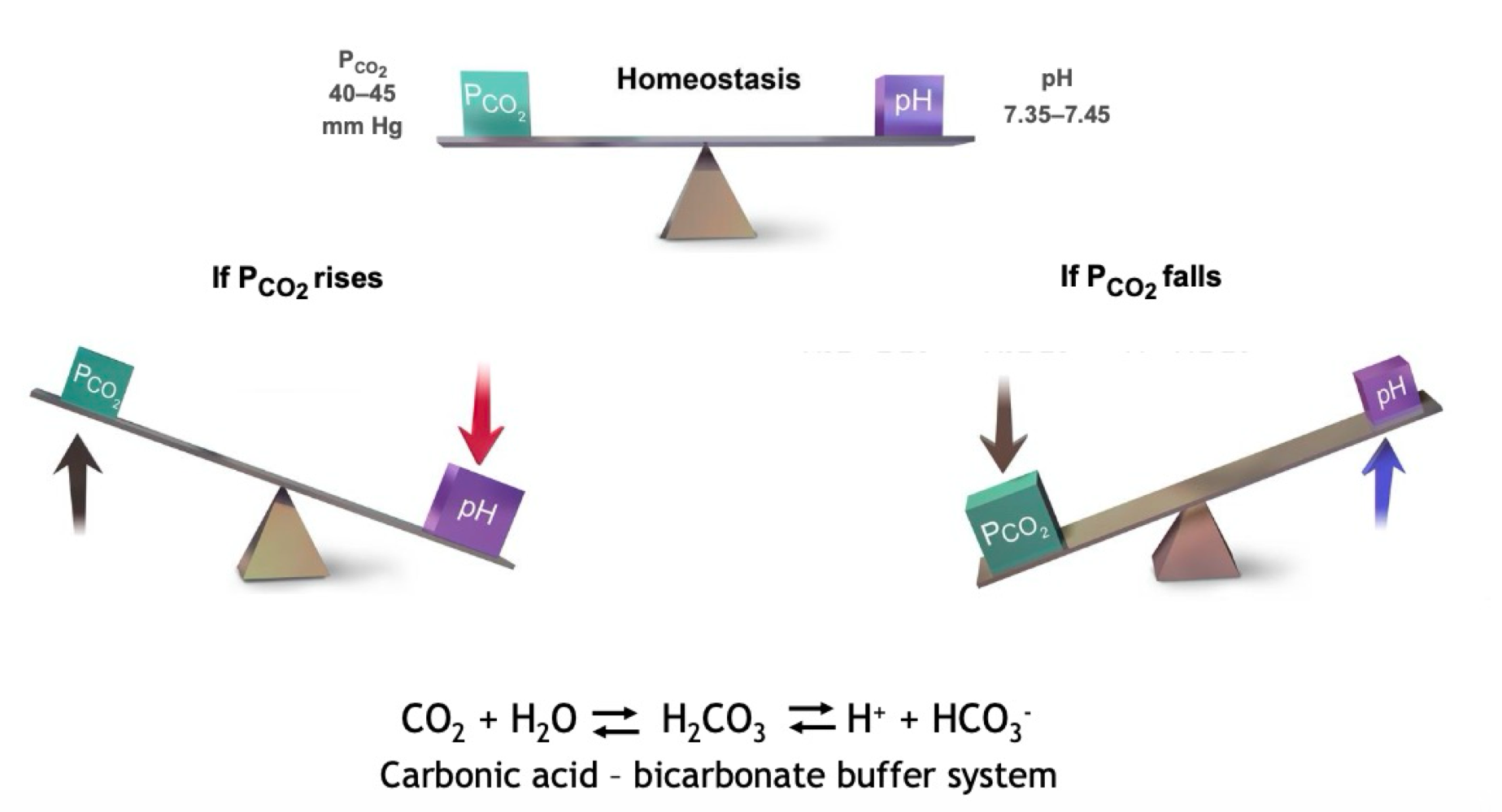
Explain the relationship between PCO2 and plasma pH?
An increase in PCO2 will cause pH to be lower a according to the carbonic acid-bicarbonate system, more H+ ions will be produced.
With the same principle PCO2 falling will cause pH to increase as bicarbonate will bind to the H+ ions causing their conversion back to CO2
→ System has a homeostasis
How do kidneys and lungs work together to regulate the acid-base balance?
The lungs regulate CO₂ through ventilation:
Increased ventilation removes more CO₂ → higher pH (less H+ concentration).
Reduced ventilation retains CO₂ → lower pH (more H+ concentration).
The kidneys:
Reabsorb filtered bicarbonate.
Excrete acid.
Generate new bicarbonate to replace bicarbonate consumed in buffering. (see image for reactions)
The lungs can respond quickly; renal adjustments develop more slowly. The lungs exhale CO₂—not free hydrogen ions directly
![<p>The lungs regulate CO₂ through ventilation:</p><ul><li><p class="my-2 [&+p]:mt-4 [&_strong:has(+br)]:inline-block [&_strong:has(+br)]:align-top">Increased ventilation removes more CO₂ → higher pH (less H+ concentration).</p></li><li><p class="my-2 [&+p]:mt-4 [&_strong:has(+br)]:inline-block [&_strong:has(+br)]:align-top">Reduced ventilation retains CO₂ → lower pH (more H+ concentration).</p></li></ul><p class="my-2 [&+p]:mt-4 [&_strong:has(+br)]:inline-block [&_strong:has(+br)]:align-top">The kidneys:</p><ul><li><p class="my-2 [&+p]:mt-4 [&_strong:has(+br)]:inline-block [&_strong:has(+br)]:align-top">Reabsorb filtered bicarbonate.</p></li><li><p class="my-2 [&+p]:mt-4 [&_strong:has(+br)]:inline-block [&_strong:has(+br)]:align-top">Excrete acid.</p></li><li><p class="my-2 [&+p]:mt-4 [&_strong:has(+br)]:inline-block [&_strong:has(+br)]:align-top">Generate new bicarbonate to replace bicarbonate consumed in buffering. (see image for reactions)</p></li></ul><p class="my-2 [&+p]:mt-4 [&_strong:has(+br)]:inline-block [&_strong:has(+br)]:align-top">The lungs can respond quickly; renal adjustments develop more slowly. The lungs exhale CO₂—not free hydrogen ions directly</p>](https://assets.knowt.com/user-attachments/9534a320-c1b3-4b35-b439-43cb71439a44.png)
How is bicarbonate reabsorbed?
The tubular cell secretes H+ into the lumen. It combines with filtered bicarbonate, ultimately forming CO₂ and water. CO₂ enters the cell, where bicarbonate is formed again and transported toward the blood.

How is new bicarbonate made from phosphate?
Here, secreted hydrogen ions bind urinary phosphate instead of filtered bicarbonate:

The hydrogen ion leaves in urine as buffered acid. The corresponding bicarbonate produced in the tubular cell enters the blood.
![<p>Here, secreted hydrogen ions bind urinary phosphate instead of filtered bicarbonate:</p><img src="https://assets.knowt.com/user-attachments/9ca86865-86e9-4b64-b504-047dfdcff8f8.png" data-width="50%" data-align="center" style="display: block; width: 50%; margin-left: auto; margin-right: auto;"><p class="my-2 [&+p]:mt-4 [&_strong:has(+br)]:inline-block [&_strong:has(+br)]:align-top">The hydrogen ion leaves in urine as buffered acid. The corresponding bicarbonate produced in the tubular cell enters the blood.</p>](https://assets.knowt.com/user-attachments/22a0e182-8570-4be1-9f81-52f5cd746947.png)
How is new bicarbonate made from ammonia?
Renal metabolism produces ammonia/ammonium along with new bicarbonate.
Ammonia can bind hydrogen ions:
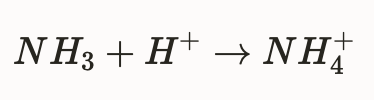
Ammonium is excreted in urine, while new bicarbonate is added to blood. This system can increase substantially during acidosis, helping the kidneys remove more acid
![<p>Renal metabolism produces ammonia/ammonium along with new bicarbonate.</p><p class="my-2 [&+p]:mt-4 [&_strong:has(+br)]:inline-block [&_strong:has(+br)]:align-top">Ammonia can bind hydrogen ions:</p><img src="https://assets.knowt.com/user-attachments/475689cd-797d-4c53-bd88-ec2000fc7e26.png" data-width="50%" data-align="center" style="display: block; width: 50%; margin-left: auto; margin-right: auto;"><p class="my-2 [&+p]:mt-4 [&_strong:has(+br)]:inline-block [&_strong:has(+br)]:align-top">Ammonium is excreted in urine, while new bicarbonate is added to blood. This system can increase substantially during acidosis, helping the kidneys remove more acid</p>](https://assets.knowt.com/user-attachments/01cc19f7-f622-4d75-aa71-b93381741fe5.png)
State the 4 acid-base disorders and their compensations?
Primary disorder | Primary change | Effect on pH | Expected compensation |
|---|---|---|---|
Metabolic acidosis | Bicarbonate decreases | Falls | Ventilation increases; CO₂ falls |
Metabolic alkalosis | Bicarbonate increases | Rises | Ventilation decreases; CO₂ rises |
Respiratory acidosis | CO₂ increases | Falls | Kidneys increase bicarbonate |
Respiratory alkalosis | CO₂ decreases | Rises | Kidneys reduce bicarbonate |