Endocrine drugs
 Call Kai
 Learn
 Practice Test
 Spaced Repetition
 Match
 Flashcards
 Knowt Play
1/169

There's no tags or description
Looks like no tags are added yet.
170 Terms
What endocrine glands do
produce hormones that control body systems
To work properly, just the right amount of hormone needs to be released when it is needed
Endocrine diseases
Caused by too much or too little of the hormone being produced compared to what the body actually needs
Endocrine drugs
Mimic the effects of natural hormones and in so doing correct or alter the physiology of the endocrine gland or system
Endocrin negative feedback loop
Endocrine gland 1 detects low level of hormones
Gland 1 send a signal to gland 2
Gland 2 produces the hormone the body needs to produce some effect
The same hormone also sends negative feedback to gland 1 to shut down further release of stimulatory hormone to gland 2
3 gland system for negative feelback loop
Gland 1 = 1 hypothalamus in the brain
Hypothalamus produces hormone 1 that stimulates gland 2
Gland 2 = pituitary gland
Pituitary gland produces hormone 2 that stimulated gland 3
Gland 3 = target gland
The target gland 3 produces the hormone the body needs (ex. Thyroid hormone, progesterone, etc.)
The target gland's hormone also helps produce the negative feedback on the hypothalamus and pituitary

Exogenous compound
originating from outside of the body
Endogenous hormone
originating from within the body
Control of endocrine hormones
If an exogenous compound such as a DRUG that is similar to the natural endogenous hormone
The exogenous drug will do the same beneficial effect as the natural endogenous hormone
The exogenous drug will also cause the same negative feedback mechanism that the endogenous natural hormone does
DRUGS HAVE TO BE USED CAREFULLY TO AVOID CAUSING HORMONE IMBALANCES
Normal function of thyroid gland
Hypothalamus releases Thyrotropin-Releasing Hormone (TRH)
TRH stimulates nearby pituitary gland
Pituitary gland is stimulated to release Thyroid-Stimulating Hormone (TSH)
Pituitary TSH stimulates the thyroid gland to produce triiodothyronine (T3) or Thyroxin (T4)
T3 and T4 are released into the body and taken up by cells in the body to increase the body's metabolic rate
T3 is the biologically active form of thyroid hormone (even though produced less than T4)
T4 is converted by enzymes in the body tissues to T3 (removing an iodine converts T4 --> T3)
T4 acts as a circulating precursor reservoir of hormone to be converted to T3 as needed
T3, T4 provides negative feedback

T3
triiodiothyronine
T4
thyroxin
What thyroid disease to cats normally get?
Hyperthyroidism (high T3, T4)
What thyroid disease to dogs normally get?
hypothyroidism (low T3, T4)
What thyroid disease to horses normally get?
hypothyroidism (not recognized much)
Primary thyroid disease
problem with the thyroid gland itself
Secondary thyroid disease
thyroid normal; problem with the pituitary gland (TSH)
Tertiary thyroid disease
thyroid, pituitary normal; problem with the hypothalamus (TRH)
Prognosis for secondary and tertiary thyroid disease
End result is the same (low or high T3/T4) but prognosis much worse for secondary and tertiary because often affects other hormones too
What is a goiter
Enlarged thyroid gland - but problem is Not with the thyroid gland itself!
Goiter
Enlarged thyroid gland - but problem is Not with the thyroid gland itself!
Cattle raised strictly on pasture without mineral supplementation - lack iodine
No iodine = no T3/T4
Treatment for goiter
give supplemental iodine (this condition is rare today)
Signs of hypothyroidism
Lethargic
Weight gain in spite of normal consumption of food
Heat-seeking behavior (dog lays on heat register on floor)
Bradycardia
Decreased growth of young animals
Alopecia, decreased hair growth, dry scaly skin
Main function of T3 and T4
Regulation of metabolic rate and cellular metabolism
Treatment for hypothyroidism
Most common is supplementation of thyroid hormone drugs
Synthetic T4 (levothyroxine)
Levothyroxine is the drug of choice for treatment and preferred over synthetic T3 (liothyronine)
Main advantages of T4 over synthetic T3 for treatment of hypothyroidism
levothyroxine T4 allows each tissue to convert T4 to T3 (active hormone) based upon its metabolic need (T3 bypasses)
CNS has a highly metabolic rate, adipose tissue has a very low rate
Levothyroxine
synthetic T4
Liothyronine
Synthetic T3
function of levothyroxine
returns T4 and T3 to normal; with T3, only T3 normalizes
More closely mimics the natural negative feedback mechanism
Has a longer half life than T3 so needs to be dosed less frequently
Brands when treating hypothyroidism
some endocrinologist recommend using a well-known brand name because they may be more reliable
Best rule: stick with one brand; don't be constantly switching rands based on whatever is cheapest
Thyrotoxicosis
Clinical signs resulting from excessive thyroid hormone
Rarely happens in vet patients (more humans)
Because dogs tolerate higher levels of T4, hypothyroidism may be diagnosed by instituting 4 week regimen of T4 to see if clinical signs improve
Outward changes in hair, skin, weight, etc. may be subtle and not conclusive even after 4 weeks; it’s better to do lab work to diagnose hypothyroidism
Euthyroidism
Normal thyroid levels
Hyperthyroidism
increased circulating T3/T4
Middle aged elderly cats; hormone secreting tumor
Clinical signs of hyperthyroidism
relate to thyrotoxicosis and increased metabolic rate for all cells in the body
Weight loss despite increased appetite
Tachycardia (exceeds 240bpm)
Heat intolerant (overheated easily)
PD, diarrhea, unkempt hair coat
Much more active, playful, aggressive
Palpable enlargement of one side of thyroid gland
4 options for treatment of hyperthyroidism
Surgical excision of thyroid tumor (thyroidectomy) - produces cure
Injection of radioactive iodine (131I) - produces cure
Inhibition of thyroid hormone production - control only, no cure
Low iodine diet - control only, no cure
Choice for treatment of hyperthyroidism is based on
Cost
Client ability/willingness to administer daily medication (for oral drugs)
Anesthetic/surgical risk (for thyroidectomy)
Drugs for hyperthyroidism
Methimazole (Felimazole, Tapazole)
Radioactive iodine (131I)
Idoine-limited diet
Methimazole (Felimazole, Tapazole)
anti-thyroid drug
Blocks thyroid tumors ability to use iodine to produce T3/T4
Inexpensive, relatively safe, tolerated by old cats, but NO CURE
Sometimes used for reduce hyperthyroidism clinical signs to make cat a better surgical candidate (reduce tachycardia) then remove tumor by thyroidectomy
May be used to establish euthyroidism in older cats to check renal function
Small % experience liver problems, bleeding (loss of clotting factors from liver disease) , leukopenia, thrombocytopenia
Methimazole can be used to establish euthyroidism in older cats to check renal function
Increase BP in hyperthyroidism = increased perfusion of kidneys
If old cat has reduced renal function, the hyperthyroidism increased perfusion may cover up renal failure - once euthyroid --> signs of renal failure appear
Administration of Radioactive iodine (131I)
One time SQ or IV
Iodine
Is natural component of T3/T4 so is taken up only by thyroid tissue that is actively secreting this hormone
High T3/T4 levels from tumor
Negative feedback on TRH and TSH production (tumor produces T3/T4 without TSH stimulation)
Normal thyroid tissue has atrophied because no TSH
Thyroid tumor concentrates radioactive iodine with a lethal dose of beta particle radiation (beta particles only penetrate 1-2 mm of tissue) - destroys just tumor
Using Radioactive iodine (131I)
131I Gamma radiation (more dangerous, penetrating) requires cat be isolated, feces and urine collected as radioactive waste - cat housed in special facility
After 3 days - 3 weeks (by state regulations) cat is released
Iodine-limited Diet
prevent formation of T3/T4 by limiting iodine needed to create the hormones
Used for: control because it does not affect the underlying tumor causing the hyperthyroidism
Diet must be strictly confined to prevent other sources of iodine's from treats, snack, other foods
Cats requiring other prescription diets may not be able to use this diet
Can't be used in multiple cat households unless affected cat fed separately and prevented from eating other cats' food
Exocrine function
digestive enzymes put into small intestine
Low T3/T4 has what effect on TRH and TSH release?
The body is going to increase TRH and TSH because the body thinks it needs more
What effect does change in TSH have on thyroid gland? How does the gland respond?
The gland is going to stimulate the thyroid to make more T3 and T4
Endocrine function
Hormones
3 pancreative hormones
Insulin, glucagon, and somatostatin
What is the only pancreatic enzyme used for therapy?
Insulin
Insulin
causes cells to actively transport glucose from blood into cells
What happens without insulin
get hyperglycemia (high blood sugar)
Effects of insulin
causes cells to actively transport glucose from blood into cells
causes the liver to store glucose as glycogen storage molecule
facilitates fat deposition in adipose tissue
Lack of insulin
diabetes mellitus characterized by hyperglycemia and glucosuria (glucose found in the urine)
Beta cells in pancreas
these cells produce insulin
Most common cause of diabetes mellitus
Destruction of beta cells which leads to a lack of insulin
Type 1 diabetes
Beta cell destruction and lack of enough insulin
Insulin dependent diabetes mellitus (IDDM)
Type 2 diabetes
Problem with the insulin receptor and beta cells are producing appropriate amounts of insulin
Non-insulin dependent diabetes mellitus (NIDDM)
NIDDM
Not enough insulin receptors on cells of target tissues
Insulin receptors are present in adequate numbers, but become non-responsive to presence of insulin
Treatment for Type 1 diabetes
Insulin must be used by injection
Does not exactly mimic the way body releases insulin
Must be coordinated with meal times and amount f food
Requires strong commitment of owners 365 days of the year
Reason insulin can’t be given by mouth
Insulin is a protein and would be natured by stomach acid and digested by intestinal enzymes --- and the molecules is too big to be absorbed
Classifications of the types of Insulin
Species from which the insulin is derived
Duration of action
What can reduce effectivenes of insulin injection
Species differences can generate antibodies against the insulin
Pork (porcine) insulin
Is antigenically similar to dog insulin - one of the insulins of choice for dogs and cats - porcine insulin zinc suspension (Vetsulin)
Recombinant human insulin
(Insulin glargine and insulin detemir) are created by combining strands of DNA together that do not occur in nature - antigenically similar enough to dogs and cats to be used in these species
Types of insulin by species
Porcine insulin zinc suspension (Vetsulin)
recommended and typically used for dogs and cats
Recombinant human insulin (Insulin glargine and insulin detemir)
Short acting insulin
regular (crystalline) insulin (only one that can be given IV)
INtermediate acting insulin
NPH(neutral protamine Hagedorn)
Porcine insulin zinc suspension (Vetsulin)
Long acting insulin
protamine zinc insulins (PZI)
Insulin glargine
Insulin determir
Duration of action for insulin classification
this hormone is combined into crystals with zinc or a fish protein called protamine
How quickly/slowly the crystal dissolves and releases insulin determines the duration of the insulin
Using insulin in canine diabetes
Initial stabilization
by starting intermediate duration recombinant human NPH insulin or porcine insulin zine suspension
If hyperglycemia is severe enough, regular (crystalline) insulin can be given by IV to bring the glucose level down until the intermediate insulins can be used
Using insulin in cat diabetes
Regular (crystalline) IV initially for stabilization
NPH doesn't last long in the cat as it does in the dog
Long acting PZI insulin used more commonly for controlling cats than intermediate insulins
Re-suspending Insulin
Most insulins are suspensions
THIS VARIES BY BRAND OF INSULIN!!!
Most say to re-suspend by rolling the bottle gently back and forth between hands - do NOT shake - will break apart insulin molecule!
Vetsulin manufacturer says its insulin "should be shaken thoroughly" to create a milky homogenous liquid - FOLLOW THE MANUFACTURER'S INSTRUCTIONS
Considerations for insulin
Most are suspensions and need to be re-suspended before use
Injection site
Syringes and bottle can be U-40 or U-100
Injection sites for Insulin
Injection SQ 3/4 to 2 inches to either side of the dorsal midline
Any location between scapula and midlumbar
Alternate subsequent injections from side to side
Syringes and Insulin bottle are listed as U-40 or U-100
Means there are 40 units or 100 units per mL of insulin
Client draws up X number of Units instead of mL
Use the U-40 bottle with the U-40 syringe to give an accurate dose
Hypoglycemic agents
Sulfonylurea compounds like glipizide
these lower the BG
Oral
How oral hypoglycemic agents work
Combine with beta cells in pancreas and stimulate release of additional insulin
Canine diabetes and hypoglycemic agents
results primarily from loss of beta cells and subsequent lack of insulin - no beta cells left to be stimulated by glipizide so not very usefuk
Feline diabetes and hypoglycemic agents
Has been tried for many years - but evidence seems to point to no medical advantage or consistent improvement in feline patients - no recommended
Use of reproductive drug in food animals and equine
Synchronize estrous cycle (NOTE: "Estrous")
Delay the onset of estrus (NOTE: "Estrus")
Terminate pregnancies
Induce ovulation (with persistent follicles)
Use of reproductive drugs in cats and dogs
to prevent pregnancy or alter the state of the uterus
Female repro endocrine drugs work by…
by blocking or enhancing the normal reproductive physiology - drugs have to be used at the appropriate phase or they will not work
the 2 general phases of Estrous
Follucular phase
Luteal phase
Common signs of Type 1 diabetes
INcreased thirst
Urinates more often
Weight loss
Doesn’t eat
Tired, lack of energy
Vomiting
Cataracts (in dogs)
what time of the day is insulin given in type 1 diabetes
typically at meal time
Follicular Phases
Controlled by ovarian follicular cells that contain the ovum (egg)
Ends near the onset of estrus (heat) with ovulation of the egg
Luteal phase
Controlled by corpus luteum (CL)
Ends with lysis of CL and return to follicular phase
Hormone production during the follicular phase
Cycle starts with neural input, presence of estrogen, or absence of progesterone
Hypothalamus releases Gonadotropin releasing hormone (GnRH)
Pituitary gland releases Follicle stimulating hormone
FSH stimulates ovarian follicles developments - oocytes (egg cells)
Follicle produces estrogen (estrus signs
Follicle produces inhibin --> creates negative feedback on pituitary to decrease FSH

Hormones during the end of the follicular phase
When follicle matures --- the hypothalamus releases GnRH in a different way than it did previously to signal pituitary FSH release
GnRH now stimulates pituitary gland to release Luteinizing hormone (LH)
LH causes the mature follicle to rupture and release the egg (oocyte)
LH transforms the follicular cells into cells of the corpus luteum(CL) --> this ends the follicular phase and starts luteal phase

What produces progesteron
the corpus leteum
What type of insulin can you give IV
ONLY SHORT ACTING REGULAR insulin
What takes control of the estrous cycle during luteal phase
the corpus luteum
Function of progesterone
To shut down the hypothalamus - pituitary - follicle system
Prepare the uterus to receive, important and support a fertilized ovum
Causes uterine lining to thicken and secrete a nutrient rich fluid
Keeps uterine smooth muscle in a quiet, non-contractile state
Hormones during the end of the luteal phase
CL is on a "timer" and degenerates after a set period of time if the egg is not fertilized and implanted in the uterus
When CL degenerates, the progesterone production stops and negative feedback is removed from hypothalamus and pituitary gland
Then the cycle starts over again with the hypothalamus releasing GnRH to stimulate the pituitary gland to again stimulate follicle formation
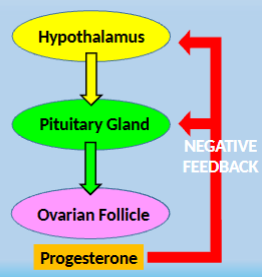
Lack of progestrone
abortion (termination of pregnancy)
Initation of parturition
At the end of pregnancy the fetus pituitary releases Adrenal corticotropic hormone (ACTH)
ACTH stimulates adrenal gland to produce cortisol
Cortisol causes uterus to begin to secrete estrogen and PGs
Prostaglandins in the uterus
lyses the CL which terminates progesterone production
Progesterone also helps to maintain the pregnancy and keep the uterine myometrium "calm"
Estrogen from the uterus effects
Makes the myometrium more “twitchy”
Causes more oxytocin receptors to appear on the myometrium
Effect of fetal pressure on cervix or stimulation of nipples
causes pituitary to release surge of oxytocin --uterine contractions - LABOR
Types of reproduction drugs
GnRH or gonadorelins
Progestins, progestogens, progestational hormones
Estrogen compounds
Prostaglandins