Macroeconomics Study Guide
 Call Kai
 Learn
 Practice Test
 Spaced Repetition
 Match
 Flashcards
 Knowt Play
1/63

There's no tags or description
Looks like no tags are added yet.
64 Terms
The following are national income account data for a hypothetical economy in billions of dollars: gross private domestic investment ($320); imports ($35); exports ($22); personal consumption expenditures ($2,460); and, government purchases ($460). What is GDP in this economy?
$3,227 billion
The total volume of business sales in our economy is several times larger than GDP because:
The GDP excludes intermediate transactions
The service a homeowner performs when she mows her yard is not included in GDP because:
This is a nonmarket transaction
Which of the following is the largest contributor to the growth of labor productivity in the United States?
Technological advance
To avoid multiple counting in national income accounts:
Only final goods and services should be counted
A nation’s real GDP will rise by increasing the following, except:
Average price level
The sale of a used automobile would not be included in GDP of the current year because it is a:
Nonproduction transaction
Which of the following is not a component of GDP in the expenditures approach?
Workers’ wages and other compensation
If the economy's real GDP doubles in 18 years, we can:
Conclude that its average annual growth rate is about 4 percent
GDP in an economy is $11,050 billion. Consumer expenditures are $7,735 billion, government purchases are $1,989 billion, and gross investment is $1,410 billion. Net exports are:
-$84 billion
Real GDP measures the
value of final goods and services produced within the borders of a country, corrected for price changes.

Refer to the data below. GDP is:
$350 billion
Efficient financial institutions foster the flow of:
Saving and investment
Economic growth is best defined as an increase in:
Either real GDP or real GDP per capita

Refer to the data below. United States exports are
$24 billion
Which of the following does not correctly characterize modern economic growth?
It has not affected the average lifespan of human beings
Empirical studies suggest that:
Technological advances account for about 40 percent of U.S. productivity growth.
Nominal GDP was $10,624 billion in year 1 and the GDP price index was 104. Nominal GDP was $11,246 in year 2 and the GDP deflator that year was 106. What was real GDP in years 1 and 2, respectively?
$10,215 billion and $10,609 billion
In which industry or sector of the economy is output least likely to be affected by the business cycle?
Agricultural commodities
Money spent on the purchase of a new house is included in the GDP as a part of:
Gross Domestic Private Investment
Net exports is a positive number when:
A nation’s exports of goods and services exceed its imports
What economic concept would be most closely associated with a situation where an aluminum plant expands its operations and uses extensive computerization in the production line to reduce per-unit costs of production?
Economies of Scale
Which of the following economic regions has experienced the least growth in real GDP per capita since 1820?
Africa
Under what circumstances do rates of economic growth understate the growth of economic well-being?
Product quality has improved
Which of the following is not included in personal consumption expenditures?
Purchases of new houses by households
The economy has an annual inflation rate of 7%. It will take approximately how many years for the price level to double?
10 years
Other things equal, which of the following would decrease the rate of economic growth, as measured by changes in real GDP?
A decrease in the larbor force participation rate
Which of the following is the most appropriate measure when comparing living standards across counties?
Real GDP per person in US dollars
With an MPS of 0.3, the MPC will be:
0.7
The multiplier can be calculated by dividing
The change in real GDP by the initial change in spending
If the MPC in an economy is 0.75 and government expenditures increase by $6 billion, then GDP will increase by:
$24 billion
The nominal rate of interest is 8.5 percent and the real rate is 5 percent. The expected rate of return on an investment is 8 percent. The firm should:
Undertake the investment because the expected rate of return of 8 percent is greater than the real rate of interest.
A decline in disposable income:
Decreases consumption by moving along a specific consumer schedule
The relationship between the real interest rate and the quantity of investment demanded is shown by the:
Investment demand curve
Assume BLS determines that a typical consumer buys 30 apples and 60 hamburgers per month. The price of an apple was $1 and the price of a hamburger was $3 in 2010. The price of an apple rose to $2 in 2011, but the price of a hamburger remained the same in 2011. What is the CPI in 2011 if the base year is 2010?
114.3
The full-time homemakers and retirees are classified in the BLS data as:
Not in the labor force
A person’s real income will increase by 2% if their nominal income:
Increases by 5% while the price index rises by 3%
If the slope of the consumption schedule is 0.8, MPC must be:
0.8
A downward shift of the consumption schedule might be caused by a(an):
Increase in real interest rate
If a lump-sum tax of $40 billion is levied at each level of income and the MPC is 0.75, then the consumption schedule will shift:
Downward by $30 billion
Capital goods, because their purchases can be postponed like ______ consumer goods, tend to contribute to ________ in investment spending.
durable; instability
"Full employment" refers to the situation when there is:
No cyclical unemployment
Which of the following could shift both consumption and saving schedules upward?
a decrease in the personal income tax
In the late 1990s the U.S. stock market boomed, causing U.S. consumption to rise. Economists refer to this outcome as the:
wealth effect
Which of the following would shift the investment demand curve to the left?
Rising maintenance costs of investment goods AND increasing business taxes
If consumers expect prices to rise and shortages to occur in the future, then it will shift:
the consumption schedule upward and the saving schedule downward.
At the point where the consumption schedule intersects the 45-degree line:
the APC is 1.00.
If the Consumer Price Index was 110 in one year and 118 in the next year, then the rate of inflation is approximately:
7.3 percent
The GDP gap measures the difference:
Between actual GDP and potential GDP
The MPC can be defined as the fraction of a:
change in income that is spent
The investment demand slopes downward and to the right because lower real interest rates:
Enable more investment projects to be undertaken profitably.
Assuming the total population is 100 million, the labor force is 80 million, and 72 million workers are employed, the unemployment rate is:
10 percent
A recession is a decline in:
Real GDP that lasts six months or longer
If the negative GDP gap were equal to 6% of the potential GDP, Okun's law suggests that the actual unemployment rate would exceed the natural rate of unemployment by:
3%
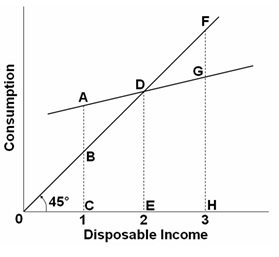
Refer to the consumption schedule below. At income level 3, the amount of saving is:
positive
When we draw an investment demand curve we hold constant all of the following except:
the interest rate
When oil and energy prices rise, the economy tends to experience:
Cost-push inflation
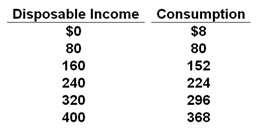
The following table shows disposable income (DI) and consumption (C) levels for a private, closed economy. All figures are in billions of dollars. If plotted on a graph, the slope of the saving schedule would be:
0.1
A trough in the business cycle occurs when:
Employment and output reach their lowest levels
A headline states: "Real GDP falls again as the economy slumps." This condition is most likely to produce what type of unemployment?
Cyclical
In calculating the unemployment rate, "discouraged" workers who are not actively seeking employment are:
Excluded from the labor force
A worker who loses a job at a call center because business firms switch the call center to another country is an example of:
Structural unemployment
In contrast to investment, consumption is:
Relatively stable
If Carol's disposable income increases from $1,000 to $1,600 and her level of saving increases from minus $100 to a plus $100, her marginal propensity to:
Consume is two-thirds