English language and linguistics (terminology)
 Call Kai
 Learn
Learn Practice Test
 Spaced Repetition
 Match
Match Flashcards
 Knowt Play
1/19

Earn XP
Description and Tags
English Language and Linguistics (5 ETCS) at Turku university
Name | Mastery | Learn | Test | Matching | Spaced | Call with Kai | Chat |
|---|
No analytics yet
Send a link to your students to track their progress
20 Terms
Medium
physical form of a message (e.g. written and spoken)
Channel
phsycial means by message is transmitted (e.g. radio, phone, printed book, computer screen, …)
Phoneme
The smallest unit of sound in a language that can distinguish meaning. These differ from language to language.
(e.g., swapping /p/ for /b/ turns pat into bat)
Allophone
A variant pronounciation (for example, that changes in context)
e.g. the voiceless plosive /t/ and the aspirated form /θ/
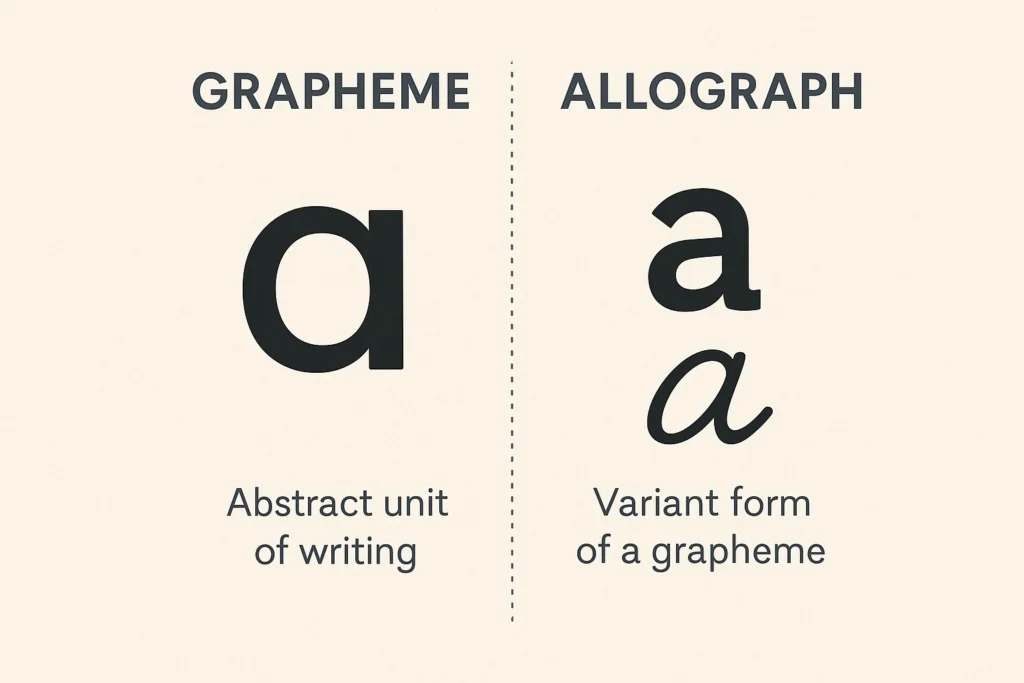
Grapheme
A grapheme is a letter, or group of letters, that acts as the smallest unit in a written language. It’s a symbole to used to represent a phoneme.

Allograph
a variant of a grapheme (like the style, cursive, capital,…)
alphabet
Each symbol generally represents a single consonant or vowel sound (e.g., English, Greek, Cyrillic). Mixing these small sounds together creates words
syllabary
Each symbol represents a complete sound unit (syllable) like "ka", "mi", or "no" (e.g., Japanese Hiragana/Katakana or Cherokee).

logographic
a script where each written character or symbol represents a complete word or a meaningful unit of language (morpheme) rather than a specific speech sound

phonographic
a type of writing where symbols or characters represent the sounds of a spoken language rather than units of meaning
Alphabets: Symbols represent individual consonants and vowels (e.g., the Latin alphabet, used for English, French, and Spanish).
Syllabaries: Each symbol stands for an entire syllable (e.g., Japanese Kana).
pictogram
resembles what it means (looks like an apple if it means apple)
ideogram
picture for an abstract idea or concept

logogram
represents a word or morpheme in a language
orthography
the standardized system of conventions used to write a language

elicitation
Drawing conclusion based on informants’ intuition
phonetics
A science that studies the characteristics of human sound-making (especially those used in speech)
phonology
A branch of linguistics which studies the sound systems of languages
generative phonology
Emphasis on the phonological features or components of sounds
Phonotactics
the specific rules of a language that decide which sound combinations are allowed and where they can go in a word