Chapter 1: Framing Religious Education: Worldviews
0.0(0)
Studied by 2 people Call Kai
 Learn
Learn Practice Test
 Spaced Repetition
 Match
Match Flashcards
 Knowt Play
Card Sorting
1/12

Earn XP
Description and Tags
13 Terms
1
New cards
Worldview
How one perceives and interprets the world and life experiences.
2
New cards
Beliefs
Ideas and convictions that people hold to be true.
3
New cards
Spiritual
Indicates a sense of relatedness to something bigger than the self.
4
New cards
Sacred texts
Texts which religious traditions consider to be foundational or central to the practice of their beliefs.

5
New cards
Rituals
Traditions, habits and actions that are repeated in a family, community or society.
6
New cards
Faith
The unquestioning belief in something that does not need to be proved.
7
New cards
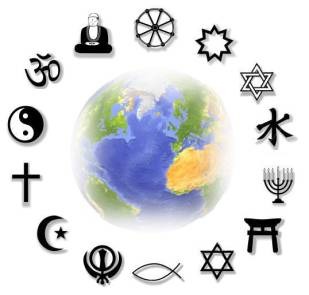
Major world religions
Refers to Hinduism, Judaism, Buddhism, Christianity and Islam.
8
New cards
Monotheism
The belief in one God.
9
New cards
Polytheism
The belief in many gods.
10
New cards
Secularism
The belief that religion should have no direct influence on society or public life.
11
New cards
Humanism
The belief that human existence is the only source of knowledge and moral code to live by.
12
New cards
Atheism
The denial of the existence of God.
13
New cards
Agnosticism
The belief that humans cannot know whether God exists or not.