Econ unit 1 - 5
 Call Kai
 Learn
Learn Practice Test
 Spaced Repetition
 Match
Match Flashcards
 Knowt Play
1/59

There's no tags or description
Looks like no tags are added yet.
Name | Mastery | Learn | Test | Matching | Spaced | Call with Kai | Chat |
|---|
No analytics yet
Send a link to your students to track their progress
60 Terms
What is Economics
A social science that studies how people make decisions in the face of scaricty
Scarcity
Universal phenomenon that arises because resources are finite
Micro vs Macro
Micro - A single area of the economy (individual units)
Macro - Economy as a whole (aggregate)
Positive statement
Fact based and can be confirmed or refuted by evidence
Normative statement
Describes how the world should be
Where is agreement among economists most likely to occur?
More agreement with positive micro statements and less with normative macro statements

Total economic surplus
Difference between total benefits and total costs
Cost benefit principle
People are inherently rational and a rational decision maker should undertake an action only if the marginal benefit is better than the marginal cost.
Example of Cost Benefit Princple

Marginal benefit
The amount of benefit you get per additional unit
Marginal cost
The cost required per additional unit
incentive principle
People partake in more of an action when the marginal benefit increases and less when the marginal cost increases
Factors of production
Inputs in the production process, broadly categorized as land, labor, and capital
Households and firms
Households - The decision making entities that seeks to gain benefits from consuming
Firms - The primary producers of goods and services
Represented by the Preliminary Circular flow diagram

Burden of production
Producing one good means producing less of another
Three economic questions
What to produce [product decision]
How to produce it? [resource use decision]
For whom to produce it? [distributional decision]
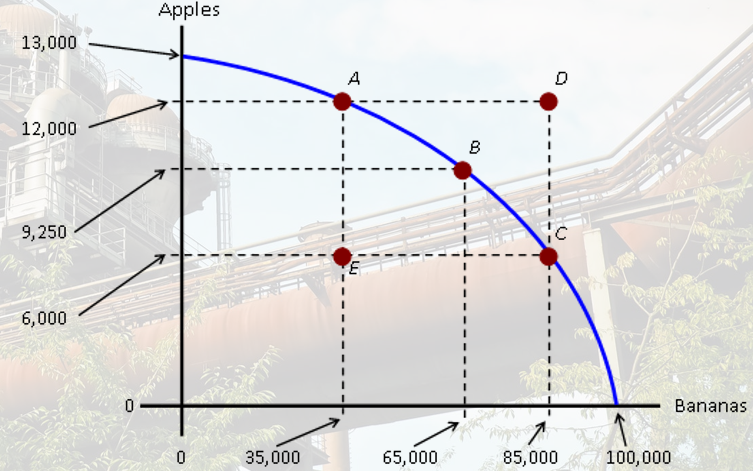
PPF
A curve summarizing the limits of production that a society faces. Combinations of goods that can be produced are represented through A, B, C, and E with D being unattainable and E being Inefficient.
Specialization
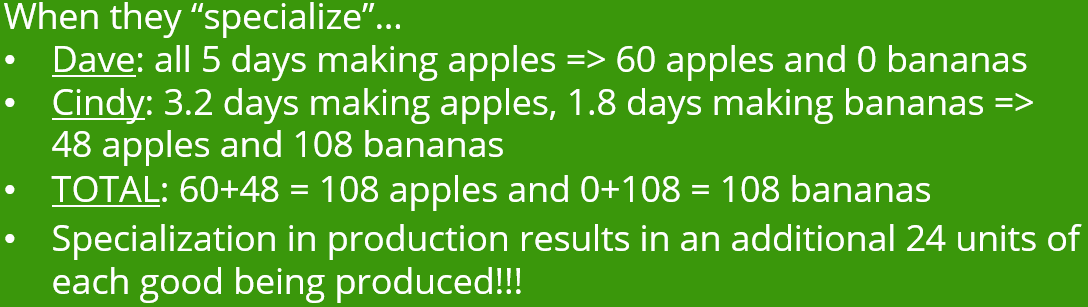
Specialization in production allows a society (and a company) to produce greater amounts of output than they otherwise could. Often is accompanied with trade, which is better off with specialization.
Absolute advantage
One person can produce more of the same good compared to another person/firm in the same time.
Opportunity cost
The value of the next alternative that must be forgone to undertake the activity.

Comparative advantage
One person has a lower opportunity cost in production than another
Voluntary trade
A universal “win - win” as one party wouldn’t trade if they were being shafted
Law of comparative advantage
When increasing the production of a good, a society should do so by using the productive resource with the lowest opportunity cost
Economic System
The rules and methods put in place by a society to determine what goods are produced. All economic systems include Households, Firms, Markets, and the Government.
Produced asset
Things that aid in production that are man made like machines, factories, or transport.
Capitalism
An economic system in which the means of production are privately owned for a profit. Evolved from Feudalism.
Socialism
An economic system in which the means of production are owned by the government
Feudalism
Economic system where land ownership is restricted to an aristocratic nobility.
Property rights
Right to control - the right to decide how to use your property
Right to transfer - the right to obtain or relinquish ownership of property from one person to another
Right to restitution - the right to be compensated when he damages your property
Consumer Sovereignty
The freedom to purchase or not purchase a good/service at a price in a free market
Proletariat
Working class
Communism
Economic system where means of production is owned by all people in society
Types of economic incentives
Material Rewards (monetary or increases in consumption)
Moral suasion (because it’s the right thing to do)
coercion (use of force or intimidation)
Mixed economy
Not every government has a perfect capitalistic or communistic system, the applications are always mixed
Structural measures
Attempts by economists to gauge differences in economic institutions, rules, or structures of different systems
incentive principle
We are more likely to do something if its benefit rises, and less likely if its cost rises
Three functions of Money
Medium of Exchange
Store of Value
Unit of Measure
Basic Circular Flow Diagram

Law of Demand
All other factors fixed, a greater quantity of a good will be demanded at lower prices (demand curves are downward sloping).
Law of supply
All other factors fixed, a greater quantity of a good will be supplied at higher prices (supply curves are upward sloping).
Buyer’s Reservation Price
Maximum amount a buyer is willing to give up to buy an item
Seller’s Reservation Price
Minimum amount a seller is willing to accept in order to part with an item
Rules of Equilibrium
Equilibrium is a state that no buyer or seller can alter to increase their own benefit. There’s always market pressure for prices to reach equilibrium (stable and self enforcing). Any price where there is excess supply/demand is not stable.
Determinants of Demand
Decrease in the price of a Complement Good (dip for chips)
Increase in the price of a substitute good
Increase in income (for normal good)
Decrease in income (for inferior goods)
Increased preference by consumers (new study ect)
Increase in market size
Expectation of higher future prices
Determinants of Supply
Decrease in cost of production
Improvement in technology
Favorable conditions of uncertain events (good weather for farming business)
Increase in Market size
expectation of lower prices (if house markets thought the prices would go down, they’d unload all their supply asap)
Supply vs Quantity supplied
The price of a good it’s self can never be the change in supply, as an increase in “own price” is just the price going up along the curve.
What happens when demand changes
Demand increases - Increase in price and quantity
Demand decreases - decrease in price and quantity
What happens when Supply changes
Supply increases - Decrease in price and increase in quantity
Supply decreases - Increase in price and decrease in quantity
Who wrote I, Pencil
Lenard Read
Negative Sum environment
A situation in which the sum of gains and losses results in negative values (doesn’t mean one side doesn’t profit)
Zero sum environment
A situation in which the sum of gains and losses results in a value of zero
Positive sum environment
A situation in which the sum of gains and losses over all people is positive in value (doesn’t guarantee a win win outcome)
Win-Win outcome
An outcome for which all people are better off than they would have been if the outcome was not realized (everyone wins) Only possible in a positive sum environment.
Win-Lose outcome
An outcome for which some are better off and some are worse off (Some win some lose)
Consumer and producer surplus
The surplus amount a consumer or producer makes or saves compared to the reservation price
Social surplus
The sum of gains over every person in society
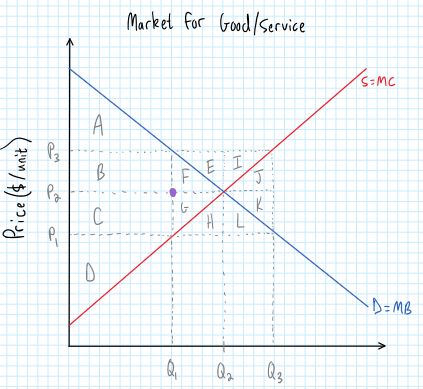
Deadweight loss
The difference between the maximum possible level of total social surplus and the realized level of total social surplus. If a trade is efficient then DWL is zero.
Inefficiency from trade
Can be from both too little or too much trade, which causes inefficiency
How is consumer surplus represented visually?
Anything above the price level that’s under the demand curve is consumer surplus (areas A and B)

How is producer surplus represented visually?
Anything below the price level that’s over the supply curve is producer surplus (areas C and D)