24: High Cognitive Functions & Memory Systems I & II
 Call Kai
 Learn
 Practice Test
 Spaced Repetition
 Match
 Flashcards
 Knowt Play
1/82

There's no tags or description
Looks like no tags are added yet.
83 Terms
Memory definition, relation to language?
rtention of learned information; memory and learning are non-dissociable processes
3 main types of memory
working memory, declarative memory, non-declarative memory
what is working memory?
temporary information storage, limited in capacity. Information ‘held in mind’ necessary for the task performed at the moment
what is non-declarative memory?
(Fear memory or Procedural memory, e.g. riding a bicycle), Non-conscious recollection. Hard to form (requires training)-unlike to be forgotten
what is declarative memory?
(facts and events) Generally accessible for conscious recollection. Easy to form-easy to forget
how are different types of information processed for learning & memory?
different types of information are processed and stored by different circuits/systems. No single brain structure or mechanism accounts for all learning/memory. Moreover, how information of a particular type is stored may change over time
2 divisions of long-term memory, what are they?
explicit memory: conscious recollection → declarative memory
implicit memory: unconscious recollection
parts of the brain responsible for explicit/declarative memory
prefrontal cortex, diencephalon, hippocampus
3 aspects of implicit memory, which are invovled in classical conditioning?
procedural memory (skills & habits)
skeletal musculature (cc)
emotional response (cc)
part of brain responsible for precedural memory?
basal ganglia
part of brain responsible for skeletal musculature?
cerebellum
part of brain responsible for emotional response?
amygdala
what is retrograde amnesia
memory loss for events before the trauma (forget information that was already stored)
what is anterograde amnesia
inability to form new memories. Inability to learn new information
what kind of memories do retrograde and anterograde amnesia generally affect?
declarative, not procedural
working memory is also known as? how long it lasts?
short-term memory, less than 1 minute
working memories are ___ in capacity and require ___
limited; rehearsal
key brain regions for working memory
prefrontal cortex, parietal lobe
evidence of prefrontal cortex involvement in working memory?
delay-response task in experimental animals: Animals trained associate food reward, coming soon after coming after a visual, some Prefrontal neurons respond when the animal first sees the food wells, some Prefrontal neurons cell respond during the delay period, when there is no visual stimulus
Patients with lesions in the Prefrontal cortex have great difficulty performing working memory tests
Implicit or non-declarative memories (non-conscious) includes what, is result of?
the tasks we learn, as well as the reflexes and emotional associations we have formed, operate without conscious recollection. It results from direct experience
procedural memory involves learning ____ in reaction to ___
memory for skills, habits, and behaviors that involve learning a motor response (procedure) in reaction to a sensory input.
The formation of procedural memories occurs through what two categories of learning?
non-associative learning and associative learning
what is non-associative learning? types?
Non-associative learning describes a change in behavioral response that occurs over time in response to a single type of stimulus
two types: habituation and sensitization
what is habituation?
learning to ignore a stimulus that lacks meaning; requires repeated exposure to the stimulus
(e.g. habituation to background ‘noise’ in a room).
what is sensitization?
form of learning that intensifies your response to all stimuli, even ones that previously evoked little or no reaction. Dependent on the presence of a strong sensory stimulus that causes sensitization (e.g. being scared by a noise when walking in the dark)
what is associative learning? examples of kinds?
behavior is altered by the formation of associations between events. association learned is between a behavior (that may have been initiated accidentally) and the resulting consequence via reinforcement and repetition. Examples: classical conditioning and instrumental conditioning.
what is classical conditioning? US, CS?
discovered and characterized in dogs by physiologist Ivan Pavlov. Involves associating a stimulus that evokes a measurable response with a second stimulus that normally does not evoke this response.
The first stimulus that normally evokes the response, is called the unconditional stimulus (US) because no training (conditioning) is required to produce the response.
The second type of stimulus, the one that normally does not evoke this same response, is called the conditional stimulus (CS) because this one requires training (conditioning) before it will yield this response
whatis instrumental/operant conditioning
an individual learns to associate a behavior (motor act) with the result of the behavior (consequence), typically a reward such as food or some other positive reinforcement
AR (accidental response) → R (reinforcement) → DR (deliberate response)
what are reinforcers and punishments, with respect to operant/instrumental conditioning?
reinforcers: events that increase the probability that the response will occur again
punishments: events that decrease the probability that the response will occur again
part of brain primarily involved in procedural memory and habit learning?
caudate-putamen, collectively known as striatum
the striatum is key for ___ learning and ____ memories involved in _____
motor learning; procedural; forming habits
what did rodent studies show about striatum importance in procedural memories?
association between goal (presence of food reward) and presence of light → formed habit rather than spatial navigation; it followed light rather than going off memory in maze
experimental striatum lesions affected performance of this task, but amygdala and hippocampus lesions didn’t affect
therefore showing striatum important in forming habits/procedural memories
degeneration in Huntington’s patients, symptoms?
degeneration of Striatal neurons; difficulty learning tasks in which motor responses are associated with a stimulus
degeneration in Parkinson’s patients, symptoms?
degeneration of projection from substantia nigra to striatum; also present difficulty with habit-learning but perform normally as declarative memory questionnaires
what does implicit memory priming in neocortex refer to?
implicit → non-declarative/non-conscious memories, specifically emotional response & fear response
part of brain responsible for fear, aggression, other emotional responses
amygdala
what is Kluver-Bucy Syndrome?
lesion of removal of amygdala had a dramatic effect on animals’ aggressive behavior and responses to fearful situation → abnormalities from these lesions = Kluver-Bucy syndrome
3 most important groups of nuclei in human amygdalas?
baso-lateral amygdala (basal & lateral nuclei)
central amygdala
cortical amygdala

label baso-lateral, central, cortical amygdala
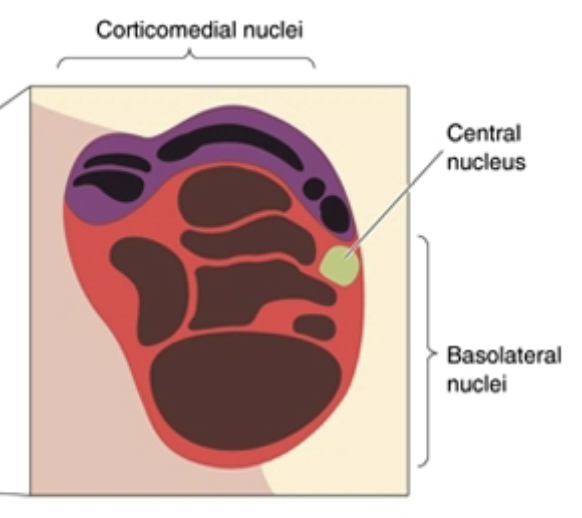
Projection neurons of the basolateral group are____?
excitatory
Projection neurons in the central nucleus tend to be ____?
inhibitory
what are the major output pathways on the central nucleus of the amygdala?
stria terminalis
ventral amygdalofugal pathway
the stria terminalis projects from the central nucleus of the amygdala to where? what it’s responsible for?
to hypothalamus
regulation of sustained stress responses, anxiety, and neuroendocrine systems via HPA axis
long-lasting anxiety and anticipation of potential threats
the ventral amygdalofugal pathway projects from the amygdala to where? what it’s responsible for?
projects to brainstem, hypothalamus, thalamus, and cerebral cortex
rapid activation of physical fight-or-flight responses, immediate physical response to fearful situations, and conscious processing
inputs and outputs of lateral amygdala (LA)?
receives projections from all sensory streams (inputs ‘collected’ here)
sends excitatory projections to the central amygdala (CE)
also strongly connected to basal amygdala (B) which sends projections to cortical and subcortical structures (ie, ventral striatum)
inputs and outputs of central amygdala?
receives projections from basal and lateral amygdala
sends output to hypothalamus (ANS control) and brainstem (neuromodulatory systems)
most important structures involved in different memory systems
hippocampus, amygdala, caudate/other parts of basal ganglia
memory that hippocampus is involved in? major output path?
Involved in Declarative memory. Also participates in emotional memory as it connects with the Amygdala
Fornix – major output path
memory that amygdala is involved in? major output path?
involved in Emotional and Fear memory
Stria Terminalis – Output from amygdala to hypothalamus
memory that caudate and other parts of basal ganglia are involved in?
Procedural memory, habits, skills
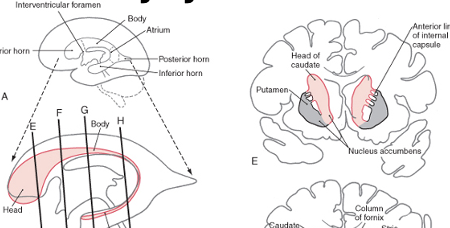
the red is…?
caudate
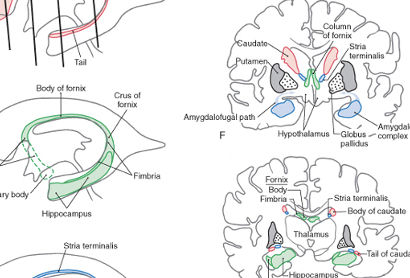
the green is…?
hippocampus
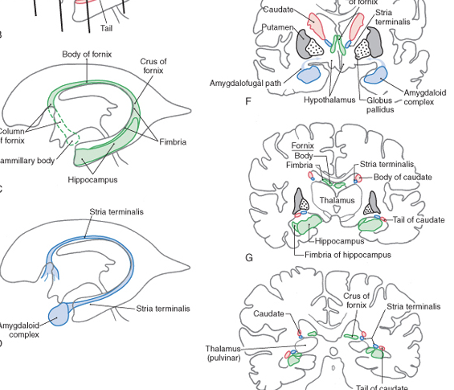
the blue is…?
amygdala
types of declarative memory - what they are, vs. procedural memory?
declarative = explicit. includes semantic (ie, knowing what guitar is) and episodic (ie, remembering buying your first guitar)
procedural = implicit (ie, remembering how to play a guitar)
Declarative memory: memory of _____. Generally accessible for _____
how difficult to form and forget?
facts and events; conscious recollection
easy to form, easy to forget
what is a memory trace?
Where is the representation of a memory (the memory of an object, event, experience) in the brain?
Where is declarative memory formed and stored?
Involvement of the Hippocampus and associated cortices in the medial Temporal lobe, and other cortical areas,
what does the case of Henry Molaison tell us?
location of explicit memory trace:
heuffered from intractable epilepsy from the age of 10 and they surgically removed parts of his temporal lobe bilaterally - he could not form new memories (anterograde amnesia)
shows us the role of hippocampal formation in memory
hippocampal formation is made up of?
Hippocampus + Perirhinal cortex + Parahippocampal cortices +Entorhinal cortex all together
Functions of Hippocampus and Hippocampal formation in memory:
1) Binding sensory information for the purpose of memory consolidation
2) Supports spatial memory of location of objects, and spatial navigation
3) Storage of memories for ‘some length of time’ (how long? Is controversial)

label hippocampus, perirhinal cortex, parahippocampal cortex
what did Henry Moraison’s brain surgery remove?
Part of the Amygdala
Hippocampus except for 2 cm at caudal end
Parahippocampal gyrus (entorhinal, perirhinal, and parahippocampal cortices)
what was the result of Henry Moraison’s brain surgery? what kind of memory was gone vs. remained intact?
Anterograde amnesia - lost capacity to acquire new memory
hippocampus involved in acquisition of new memories or short-term storage
Procedural memory intact - long term memories were intact, indicating different systems for short-term and long-term storage, also preserved procedural motor learning
what is the general structure of the hippocampus?
Consists of two thin sheets of allocortex folded onto each other: Dentate gyrus, and the Ammon’s horn (Cornu Ammonis in Latin, CA). CA have four subdivisions: CA3 to CA1
what is the trisynaptic circuit?
in the hippocampus

inputs from associative areas of cortex (already processed info) projects where before going to HC?
entorhinal cortex & parahippocampal region
2 main divisions of entorhinal cortex
LEC - lateral entorhinal
MEC - medial entorhinal
LEC processes inputs from?
Perirhinal cortex
MEC processes inputs from?
Postrhinal cortex (or Parahippocampal cortex)
the postrhinal cortex (POR) is connected to areas important for? __ stream?
spatial cognition, navigation, object location-context, ‘where stream’
the perirhinal cortex (PER) is connected to areas important for? ____ stream?
object recognition; ventral stream AKA ‘what stream’
the hippocampus receives _____ sensory inputs. image of connections with entorhinal and HC?
highly processed

what are place cells of the hippocampus?
cells that show very specific response to the LOCATION of the subject in space, AKA a cell responds to a specific PLACE
what is a place field?
The space location that activates firing of a particular place cell
The MEC receives information from the _____ stream and contains what kinds of cells?
”where stream’ or dorsal stream
grid cells and head direction cells
what are grid cells, where?
in MEC
exhibit multiple ‘place fields’ arranged in grid-like hexagon pattern, activated by movement in specific directions, will be preferentially activated when a subject moves in a particular direction
due to its many complex inputs, the hippocampus generates ___________
cognitive maps
what do HC cognitive maps allow an individual to do?
acquire, code, store and recall information about the relative locations and attributes of phenomena (experiences) in their spatial environment
standard model of memory consolidation
After memory acquisition and synaptic consolidation, systems consolidation occurs in which engrams are moved gradually over time into distributed areas of the neocortex
Engrams are permanently stored in a variety of neocortical areas (‘engrams’ = concept memory traces)

multiple trace model of memory consolidation
Engrams involve neocortex, but even old memories also involve the hippocampus
what is the role of sleep in memory consolidation?
Firing sequences observed during wake while the animals learn to navigate on a particular trajectory, are ‘replayed’ during non-REM sleep
Sleep helps to convert recently acquired memories (short-term) into long-term memories. During consolidation, the recently acquired memories transfer to the cortex (Prefrontal cortex primarily) for long-term storage
what other structures are involved in declarative memory?
diencephalon - dorsomedial nucleus and anterior nuclei of thalamus and mammillary bodies of the hypothalamus
what is Korsakoff’s syndrome? results from?
Often results from chronic alcoholism. Produces damage to the Dorsomedial nucleus and the Mammillary bodies
Severe memory impairment, apathy, confusion. Produces anterograde and retrograde amnesia