Rock Cycle: Fossils, Gneiss & Basalt
 Call Kai
 Learn
 Practice Test
 Spaced Repetition
 Match
 Flashcards
 Knowt Play
1/45

There's no tags or description
Looks like no tags are added yet.
46 Terms
compaction
A step in lithification; pressure due to the settling of other materials forcing sediment closer together

cementation
a step in lithification; as heat and pressure increase the sediments can change chemically, this allows sediments to be "locked" or "glued" together into a solid rock

mineral
naturally occurring substance, with definite chemical composition and a crystalline structure

erosion
the transport of fragments of rock by water, wind, ice, or gravity

lava
molten rock that has erupted onto Earth's surface

magma
molten rock below Earth's surface

rock cycle
a continuous series of processes through which rock is transformed from one type to another.

slate
A type of Metamorphic rock that was once shale rock formed by heat and pressure.

shale
A sedimentary rock formed by the deposition of successive layers of clay.

coal
Interesting rock composed of the remains of plants that lived in tropical swamps millions of years ago. Can be lower quality (sedimentary) or be acted upon by heat and pressure (metamorphic).

igneous rock
rock that forms as molten rock cools

metamorphic rock
rock that forms as heat and pressure cause changes to an existing rock

sedimentary rock
This rock type forms as loose materials called sediments become cemented together. Usually, these rocks have layers.

uplift
Rocks that have been buried are exposed at Earth's surface because forces inside the Earth pushing them to the surface.
sediments
little pieces of weathered rock, plant remains, and animal remains

heat and pressure
These two forces work together to transform rocks deep inside Earth's crust.

weathering
This is the breaking down of rocks. It can be caused by wind, rain, ice, or gravity.

wind
This causes the most erosion in dry areas that get little rainfall.

cooling
This is the process that forms igneous rock.

gneiss
This is a coarse-grained, foliated metamorphic rock. It usually contains the minrals feldspar, quartz, and mica.

granite
This is a very hard, crystalline, intrusive igneous rock. It is made mostly of quartz, mica, and feldspar. It is often used in counter tops and building materials.

basalt
This is a dark, porous, volcanic rock. Most of the ocean floor is made of this rock.

sandstone
This is a sedimentary rock consisting of sand grains cemented together, typically red, yellow, tan, or brown in color.

limestone
This is a sedimentary rock, composed mainly of seashells and calcium carbonate. It is used to make cement.

marble
This is a hard metamorphic rock formed from limestone, typically white in color. It is used in sculpture and architecture.

intrusive igneous rock
This igneous rock formed underground as magma cools slowly. Because it cools slowly, the crystals inside the rock grow very large.

extrusive igneous rock
This igneous rock forms as erupted lava cools quickly on Earth's surface. Because it cools so quickly, these rocks have very, very tiny crystals.
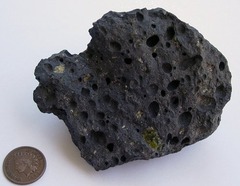
fossils
This is the remains or impression of an ancient organism. These are only found in sedimentary rock (not igneous or metamorphic).

strata
Most sedimentary rocks form in layers known as ________.

quartz
found in most rocks, this is the most common mineral in Earth's crust. It forms as lava or magma cools.

texture
how a rock looks and feels; determined by grain size, rate of cooling and composition

coarse grain
slower rate of cooling causes this; Larger crystalline grains

fine grain
faster rate of cooling causes this; smaller crystalline grains

porphyry
mixture of fine and coarse grain

glassy
crystal unable to form; Rapid rate of cooling prevents crystals from forming
pumice
a type of igneous rock in which bubbles formed inside the rock due to a extremely rapid rate of cooling which traps gases inside

clastic sedimentary rock
a classification of sedimentary rock; most common; formed from deposits of loose material

chemical sedimentary rock
A classification of sedimentary rock; formed when water evaporates leaving minerals behind

organic sedimentary rock
a classification of sedimentary rock; formed from the remains of once living things

deposition
occurs when sediments settle on the ground or a body of water
lithification
process which turns sediment into sedimentary rock; compaction and cementation

contact metamorphism
when hot magma moves into a chunk of rock, heats it up, and hardens again; results in large scale mineral changes with little deformation

regional metamorphism
when a whole region (area) of rock are put under extreme pressure and heat

foliated
a classification of a metamorphic rock that has visible layers or bands

nonfoliated
a classification of a metamorphic rock that does not have visible layers or bands

obsidian
dark, glasslike volcanic rock formed by the rapid solidification of lava without crystallization