Visual Imagery
 Call Kai
 Learn
 Practice Test
 Spaced Repetition
 Match
 Flashcards
 Knowt Play
1/26

There's no tags or description
Looks like no tags are added yet.
27 Terms
Anderson and Bower (1973)
Single representation system in which we store both verbal and visual information as propositions
Propositions are abstract, language-like in form
Imagery is epiphenomenal
The images you generate are secondary; a byproduct of underlying processes; plays no causal role
analog code
code that resembles the physical object; visual-spatial representation
Preserves the spatial properties of what is represented

symbolic code
code that is descriptive; propositional representation
Stores information as abstract, language-like statements

mental rotation studies
the ability to mentally rotate an object and distinguish it
It takes a longer amount of time to rotate an object more
Shepard and Metzler (1974)
participants would see two objects and have to judge if they were the same or different
If mental object rotation works the same time as physical object rotation, objects with higher degrees of rotation should take longer to identify

image scanning
people shift their attention or transform a visual mental image across an imagined object or map, taking time proportional to the physical distance being covered
Kosslyn et al. (1978)

Kosslyn et al. (1978)
Memorized the map
Asked to mentally ‘travel” from one landmark to another
Response when “arrived”
found that mentally travelling longer distances took a longer amount of time
image scaling studies
Ability to see finer details depending on distance (depth of perception)
Kosslyn (1978)
Think of a rabbit next to an elephant: can’t recall as many details of the rabbit because the elephant is bigger/closer
fewer details
Think of a rabbit next to a fly: can “see” more details on the rabbit because it’s bigger/closer
Able to notice fur texture, eye features, etc. when close up
more details

Le Bihan et al. (1993)
Used fMRI to examine brain activity in the primary visual cortex (occipital lobe)
Examined for presented vs. imagined stimuli

Kreimnn et al. (2000)
Single-cell recordings
Electrodes implanted in epileptic patients
Single-cell responses to presented stimuli
Same cells’ responses to imaginations

Luzatti (1978)
Damage to right parietal lobe
Neglect left half of visual world
Also neglect left half of images
Ganis et al. (2004)
Comprehensive fMRI study
Activity in front, middle, vs rear of brain
Activity for perception vs imagery
Kosslyn et al. (1999)
Transcranial magnetic stimulation (TMS)
Decreases brain functioning in a particular area of the brain for a short time
If behavior is disrupted, the deactivated part of the brain is causing that behavior
TMS to visual area of brain during perception and imagery task
Response time slower for both
Brain activity in the visual area of the brain plays a causal role for both perception and imagery
Dissociations between imagery and perception
R.M.
Damage to occipital lobe and parietal lobes
Could draw accurate pictures pf objects in front of him
Could not draw accurate pictures of objects from memory (using imagery)
C.K.
Inability to name pictures of objects, even his own drawings, in front of him
Could draw objects in great detail from memory (using imagery)
Conclusion: not perfect overlap
Perception involves sensory input and knowledge
Bottom-up and top-down processing
Perception requires lower and higher visual centers
Imagery involves knowledge, no sensory input
Just top-down processing
Just higher visual centers
concreteness effect

Memory for pictures:
Shepard (1967): 612 pictures and tested
Standing (1973): 10k pictures over 5 days
Remembered over 6000 pictures
Picture superiority effec
remembering something better in picture form than in word form
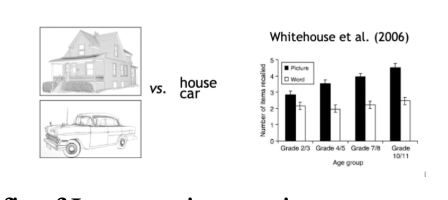
benefit of imagery instructions (Bower and Winzenz (1970))

bizarre imagery effect
remembering something better if it’s a bizarre situation
McDaniel et al. (2000)
Ex: the woman spilled MILK on the TABLE→imagery better
Ex: The woman licked MILK off of the TABLE→bizarre better
apllications of imagery
Imagery with a substitution
Name learning
foreign word learning
name learning
Think of a vivid word that sounds like the name
Link word with the person's appearance
foreign word learning
Think of a vivid word that sounds similar
Link the word with its meaning through imagery

Method of Loci
Eogknew
Walking through something in your mind you’re familiar with
Pegword Mnemonic
associate information with a well-known rhyming scheme
The most common form allows you to learn information in groups of 10

why do loci/pegword methods work?
Distinctiveness
Organization