VSEPR Theory and Molecular Geometry
 Call Kai
 Learn
 Practice Test
 Spaced Repetition
 Match
 Flashcards
 Knowt Play
1/21

Earn XP
Description and Tags
A set of vocabulary flashcards covering the core principles of VSEPR theory, electron geometries, molecular geometries, bond angles, and Lewis structure guidelines.
22 Terms
Valence Shell Electron Pair Repulsion (VSEPR) Theory
A model stating that groups of electrons around a central atom repel each other and orient themselves in a way that allows them to get as far apart as possible.
Electron Group
A lone pair of electrons or a bond (single, double, or triple) around a central atom, where each double bond or triple bond counts as only one group.
Linear Electron Geometry
The fundamental electron group arrangement for an atom with 2 electron groups, characterized by a bond angle of 180∘.

Trigonal Planar Electron Geometry
The fundamental electron group arrangement for an atom with 3 electron groups, characterized by bond angles of 120∘.

Tetrahedral Electron Geometry
The fundamental electron group arrangement for an atom with 4 electron groups, characterized by bond angles of 109.5∘.

Trigonal Bipyramidal Electron Geometry
The fundamental electron group arrangement for an atom with 5 electron groups, characterized by bond angles of 90∘ and 120∘.

Octahedral Electron Geometry
The fundamental electron group arrangement for an atom with 6 electron groups, characterized by bond angles of 90∘.

Molecular Geometry
The three-dimensional geometry of a molecule named on the basis of the positions of the bonded atoms only, treating lone pairs as non-visible.
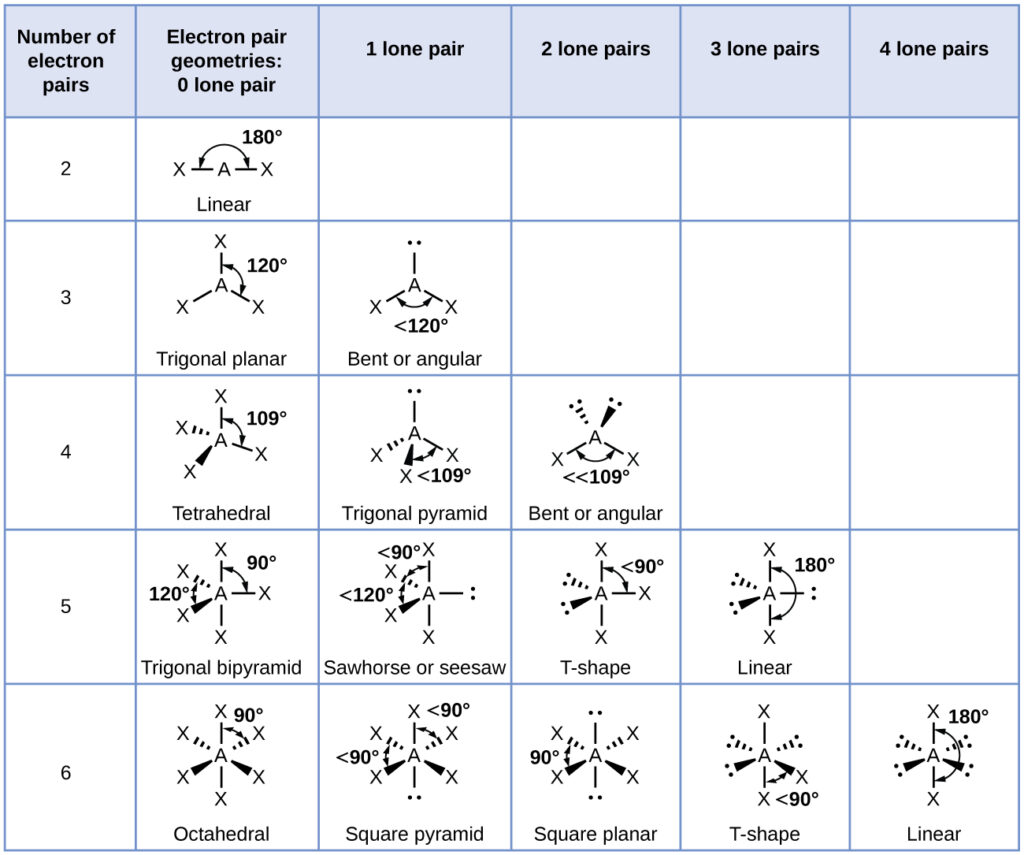
Bent Molecular Geometry (3 electron groups)
The molecular geometry of a molecule with 3 electron groups and 1 nonbonding lone pair, where the bond angle is slightly compressed to a little less than 120∘ (∼120∘).

Trigonal Pyramidal Molecular Geometry
The molecular geometry resulting from 4 electron groups with 1 nonbonding lone pair, having bond angles of approximately 109.5∘ (∼109.5∘).
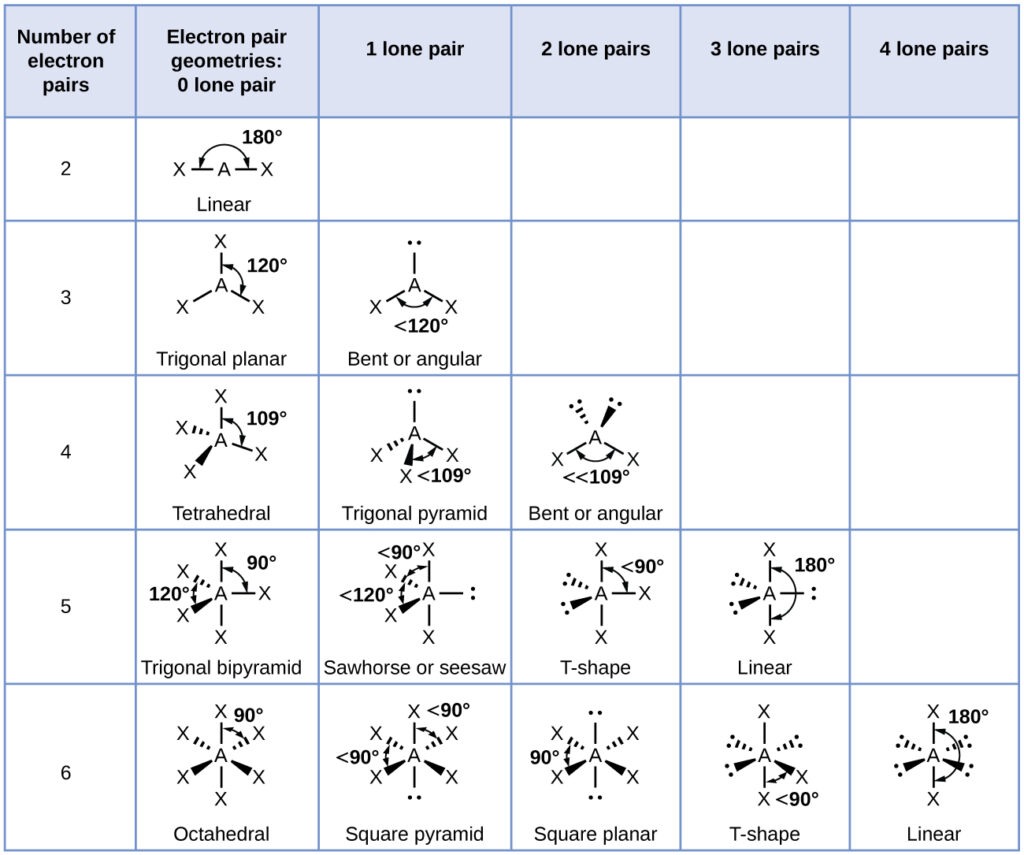
Bent Molecular Geometry (4 electron groups)
The molecular geometry resulting from 4 electron groups with 2 nonbonding lone pairs, having bond angles of approximately 109.5∘ (∼109.5∘).

Seesaw Molecular Geometry
The molecular geometry resulting from 5 electron groups with 1 nonbonding lone pair (such as in SF4), with bond angles of approximately 90∘ and 120∘ (∼90∘,∼120∘).

T-shaped Molecular Geometry
The molecular geometry resulting from 5 electron groups with 2 nonbonding lone pairs occupying equatorial positions, characterized by bond angles of approximately 90∘ (∼90∘).

Linear Molecular Geometry (5 electron groups)
The molecular geometry resulting from 5 electron groups with 3 nonbonding lone pairs occupying equatorial positions, characterized by a bond angle of 180∘.

Square Pyramidal Molecular Geometry
The molecular geometry resulting from 6 electron groups with 1 nonbonding lone pair, characterized by bond angles of approximately 90∘ (∼90∘).

Square Planar Molecular Geometry
The molecular geometry resulting from 6 electron groups with 2 nonbonding lone pairs, characterized by bond angles of 90∘.
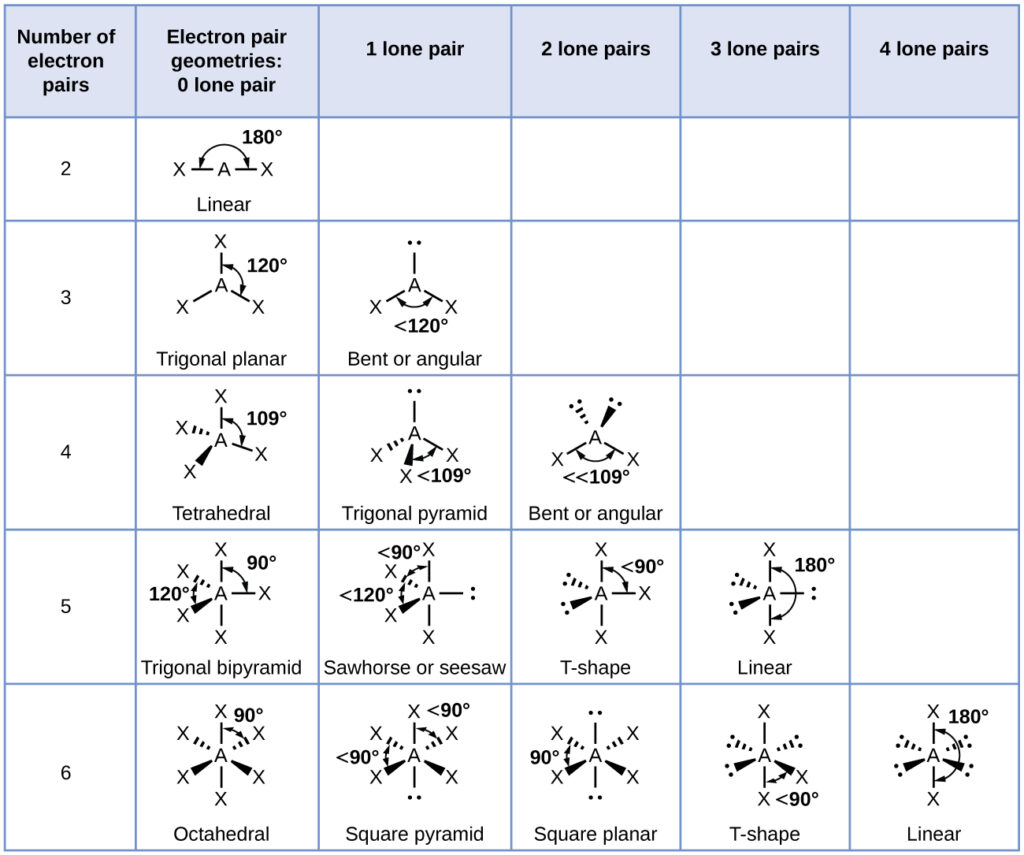
Equatorial Positions
The positions in a trigonal bipyramidal geometry that provide more space, where lone pairs preferentially reside to minimize electron repulsion.

Lone Pair Repulsion Principle
The principle that nonbonding lone pairs of electrons are more repulsive than bonded pairs, causing adjacent bond angles to be slightly compressed.
Resonance in VSEPR Prediction
The rule that when a molecule has multiple resonance structures (such as SO2), drawing any single correctly drawn Lewis structure will give the same resulting geometry.
Oxoacid Bonding Rule
The structural guideline for oxoacids (such as HNO3 or H3PO4) stating that each hydrogen atom is attached to an oxygen atom, and that oxygen atom is attached to the central atom.
Central Atom Selection Guideline
The Lewis structure rule stating that the central atom is usually listed first in the formula and is typically the less electronegative atom.
Octet Completion via Multiple Bonds
The step in drawing a Lewis structure where outer-atom electron pairs are used to form double or triple bonds if the central atom lacks an octet after initial electron distribution.