biochem terms exam 1
 Call Kai
 Learn
Learn Practice Test
 Spaced Repetition
 Match
Match Flashcards
 Knowt Play
1/236

There's no tags or description
Looks like no tags are added yet.
Name | Mastery | Learn | Test | Matching | Spaced | Call with Kai | Chat |
|---|
No analytics yet
Send a link to your students to track their progress
237 Terms
dipole
relationship between positive and negative charge

hydrogen bond donor
hydrogen bond attached to electronegative atom (O or N)
hydrogen bond acceptor
electronegative atoms with available lone pairs
C-H methyl group is NOT polar enough to be a donor
hydrogen bonds
individually weak, but many is stronger
pay attention to type of hydrogen bond
nonpolar groups exposed to water
water surrounding becomes more ordered —> less entropy (less randomness)

nonpolar groups buried together
releases ordered water —> increased entropy (more randomness)

entropy
“randomness” or “disorder”
high entropy —> more randomness
low entropy —> less randomness/more ordered
hydrophobic effect in protein core
Ala, Val, Leu, Ile, Phe
stereoisomers
bonds NEED to be broken to be stereoisomers
if you can rotate a bond so both molecules look the same —> NOT stereoisomers
enantiomers
type of stereoisomers
mirror images

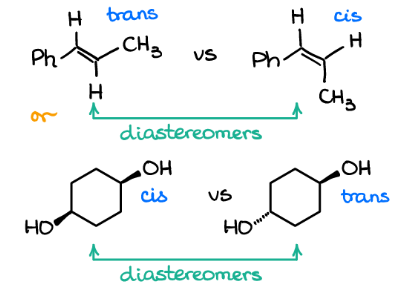
diastereomers
type of stereoisomer
NOT mirror images
cis —> trans
trans —> cis
R —> S
S —> R

geometric isomers
type of stereoisomer
cis —> trans
trans —> cis
closed system
ONLY energy exchange w the surroundings
open system
exchanges energy AND matter w the surroundings
organisms are open systems
homotropic allosteric modulator of hemoglobin
oxygen
heterotropic allosteric modulator of hemoglobin
proteins
CO2
BPG
BPG
increases oxygen delivery to tissues at high altitudes
stabilizes T state by binding in the central cavity
enabling more effective release of oxygen in tissues
How does CO2 stabilize the T state of Hb?
by binding / reacting w its N-terminal amino group
enzymes
catalysts that speed up a rxn
helps reach equilibrium faster
most are proteins
how fast does cyclophilin speed up a rxn?
10^5
how fast does carbonic anhydrase speed up a rxn?
10^7
how fast does triose phosphate isomerase speed up a rxn?
10^9
how fast does carboxypeptidase A speed up a rxn?
10^11
how fast does phosphoglucomutase speed up a rxn?
10^12
how fast does Syccinyl-CoA transferase speed up a rxn?
10^13
how fast does urease speed up a rxn?
10^14
how fast does orotidine monophosphate decarboxylase speed up a rxn?
10^17
catalytic perfection
when enzyme works at maximum efficiency
every encounter w enzyme and substrate leads to a rxn
catalytic efficiency
Kcat / Km
shows how well an enzyme converts a substrate into a product
high Kcat and low Km —> most efficient

specificity constant
Kcat / Km
turnover number
Kcat
Michaelis Constant
Km
when Vo = ½ Vmax
Maximum Velocity
Vmax
max speed or rate at which an enzyme can catalyze a rxn when fully saturated w substrate

Initial Velocity
Vo
Vo = (Vmax • S) / (Km + S)
is the rxn faster or slower w high activation E
slower
is rxn faster or slower w low activation E
faster
does adding an enzyme increase or decrease activation E
decrease
kinetics
rxn rate
enzymes affect kinetic E
thermodynamics
reaction —> product
point of equilibrium
NOT affected by enzymes
entropy equation
ΔS = S final - S initial
enthalpy
H
number and kinds of bonds
free energy equation
ΔG = ΔH - TΔS
temp on Kelvin (degrees celsius + 273)
ΔH < 0
releases heat (exothermic)
breaks bonds
ΔH > 0
absorbs heat (endothermic)
creates bonds
ΔS > 0
more randomness (increase entropy)
ΔS < 0
less randomness (decrease entropy)
more order
ΔG < 0
happens spontaneously (exergonic)
ΔG > 0
NOT spontaneous (endergonic)
equilibrium equation
Keq = product / reactant

Standard Gibbs Free Energy
ΔG°
when temp is 298K, solutes at 1M, and pressure is 1atm
Standard Gibb’s Free Energy Equation
ΔG° = -RT ln Keq
Free Energy Change of Standard Energy
ΔG = ΔG° + RT ln (products / reactants)
what orientation is hydrogen bonding strongest in?
straight line

electrostatic force equation
F = (k Q1 Q2) / εr²
F —> electrostatic force
Q1 and Q2 —> magnitude of charge
r —> distance between Q1 and Q2
ε —> constant
k —> Coulomb’s constant (1/4𝜋ε₀)

Coulomb’s Constant
k = 1 / 4𝜋ε₀
ε of vacuum
1
ε of air
1.00059
ε of water
80
Amphipathic
polar charged + nonpolar regions
nonpolar groups are hydro_____
phobic
polar groups are hydro_____
philic
when water reacts w nonpolar molecules, what happens to entropy?
it is decreased
hydrophobic effect
amphipathic molecules (polar + nonpolar)
nonpolar clusters together in center
Van Der Waals
partial positive reacts w partial negative (attracts)
osmotic pressure equation
Π = iMRT
i = Van Hoff factor (# of particles a solution splits into)
M = molarity (mols / L)
R = gas constant (0.08206)
T = temp in K
osmolarity equation
osmolarity = iM = (Π / RT)
Kw of water at 25C
1.0 × 10^-14
Kw equation
Kw = [H+] [OH-]
H+ when pH = 7
1 × 10⁻⁷
pH when [H+] = 1.0 × 10^-7
7
pH ion product equation
pH = -log[H+]
pH relationship
logarithmic
log 10 = 1
log 100 =2
log 1000 =3
acid dissociation constant
Ka
Ka = [(H+)(A-)] / [HA]
![<p>Ka</p><p>Ka = [(H+)(A-)] / [HA]</p>](https://assets.knowt.com/user-attachments/14427823-8bea-4ce8-a6a0-2756e7f755c1.heic)
is larger Ka stronger or weaker acid?
stronger (K > 1)
is low pKa stronger or weaker acid?
weaker (<7)
is lower Ka stronger or weaker acid?
weaker (K < 1)
is larger pKa stronger or weaker acid?
stronger (>7)
Henderson Hasselbach equation
pH = pKa + log (A- / HA)
Glycine
Gly
Alanine
Ala
Proline
Pro
Valine
Val
Leucine
Leu
Isoleucine
Ile
Methionine
Met
Phenylalanine
Phe
Tyrosine
Tyr
Tryptophan
Trp
Serine
Ser
Threonine
Thr
Cysteine
Cys
Asparagine
Asn
Glutamine
Gln
Lysine
Lys
Histidine
His
Arginine
Arg
Asparatate
Asp
Glutamate
Glu
Glycine
G
Alanine
A