CSULB: Management 300 Exam 3 Kenji Klein
 Call Kai
 Learn
 Practice Test
 Spaced Repetition
 Match
 Flashcards
 Knowt Play
1/89

There's no tags or description
Looks like no tags are added yet.
Name | Mastery | Learn | Test | Matching | Spaced | Call with Kai | Chat |
|---|
No analytics yet
Send a link to your students to track their progress
90 Terms
Management
Management is the process of planning, organizing, leading, and controlling (POLC) resources to achieve organizational goals efficiently and effectively.
POLC Framework
Planning, Organizing, Leading, Controlling
Planning
Setting objectives and deciding in advance the appropriate actions to achieve them.
Organizing
Arranging resources and tasks to implement plans.
Leading
Motivating, directing, and otherwise influencing people to work hard to achieve the organization's goals.
Controlling
Monitoring and evaluating the progress toward goal attainment and making corrections when needed.
Efficiency
Doing things right—minimizing resource use. Using resources well: time, money, effort.
Effectiveness
achieving the intended goal—like satisfied customers.
Management Skills
Technical, Human/Interpersonal, Conceptual
Technical Skills
Expertise in a specific task.
Human/Interpersonal Skills
Ability to work with others.
Conceptual Skills
Ability to think analytically and solve complex problems.
Types of Managers
Functional, General, Top, Middle
Functional Manager
Responsible for one area (e.g., finance, marketing).
General Manager
Responsible for multiple departments.
Top Manager
Makes strategic decisions (CEO, President).
Middle Manager
Translates strategy into action (Director, Regional Manager).
Important
feel pressing and require immediate attention (emails, calls, complaints)
Urgent
Requires immediate attention.
Urgent + Important
Crisis, deadlines, problems
Urgent + Not Important
Interruptions, calls, emails
Not Urgent + Important
Long-term planning, strategy, skill development
Not Urgent + Not Important
Time wasters, social media, busy work with no value
Nature of Boss-Subordinate Relationship
It's a mutual dependence between two fallible human beings.
Checklist for Managing Your Boss
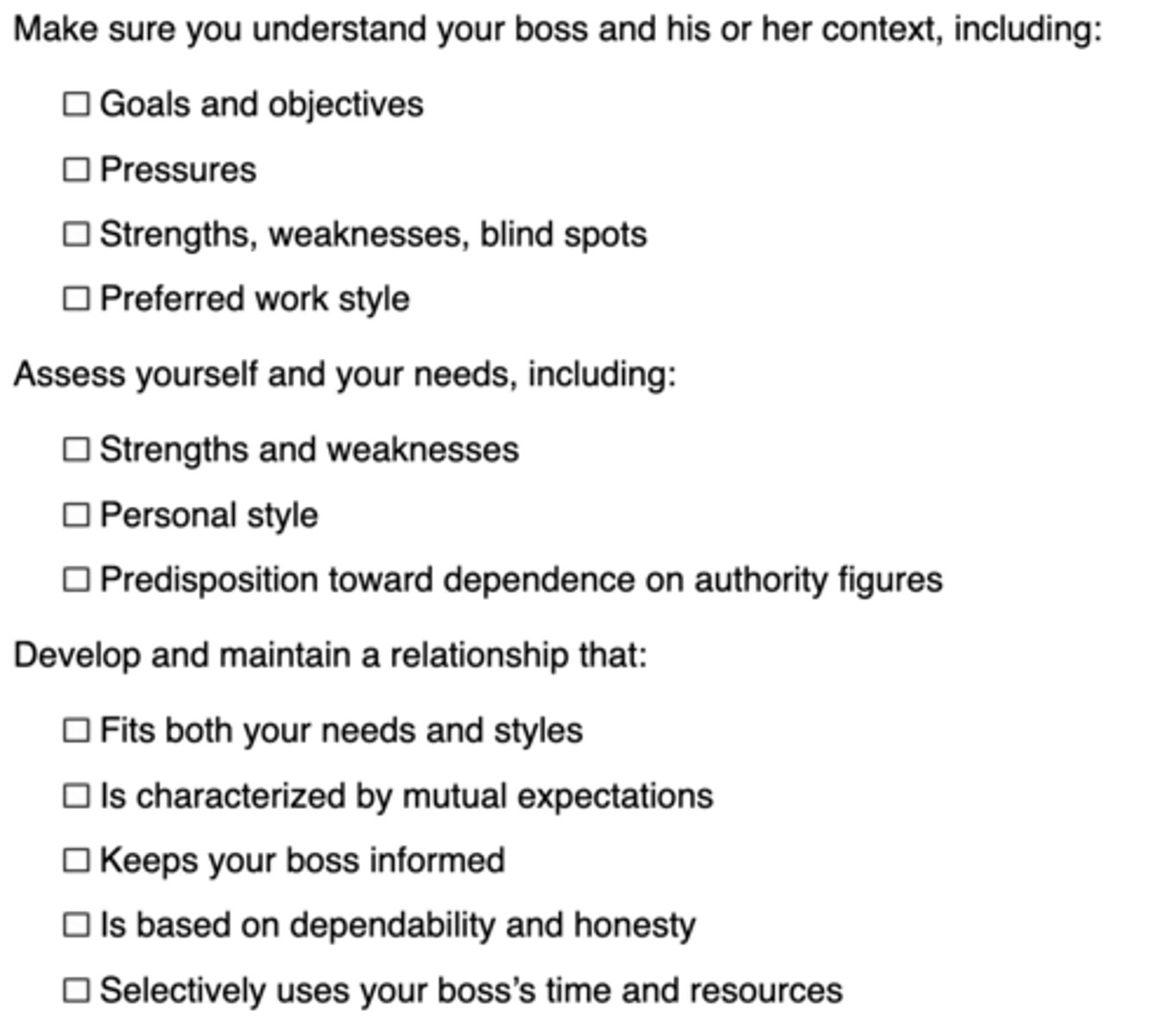
Make sure you undertsand your boss and his or her context, including
Goals and objectives, Pressures, Strengths-Weakness and blind spots, Preferred work style
Assess yourself and your needs, including
Strength and weaknesses, Personal style, Predisposition toward dependence on authority figures
Develop and maintain a relationship that
Fits both your needs and styles, Is characterized by mutual expectations, Keeps your boss informed, Is based on dependability and honesty, Selectively uses your boss's time and resources
Mutual Dependence
means that two people (in this case, a manager and their boss) rely on each other to succeed. Neither person can fully accomplish their goals without the help, cooperation, and support of the other.
Work Style Compatibility
refers to how well your way of working aligns with your boss's preferred way of processing information, making decisions, and interacting. According to Gabarro & Kotter in Managing Your Boss, understanding and adapting to your boss's work style is essential for a productive relationship.
Mutual Expectations
Don't assume you know what your boss expects—ask and clarify. Some bosses want detailed outlines before action; others prefer quick verbal check-ins. Communicate your own expectations, too. For example, if you need regular feedback or clear deadlines, bring that up early. Negotiate where needed: If your expectations don't align, work to find an agreement that works for both sides.
Goals
Desired outcomes.
Plans
Blueprints for reaching goals.
Types of Planning
Strategic & Operational
Strategic Plans
Long-term and broad.
Operational Plans
Short-term and specific.
Organizational Planning Process
1.Develop the plan, 2.Translate the plan, 3.Plan operations, 4.Execute the plan, 5.Monitor and learn.
Benefits of planning
Provides direction, reduces uncertainty, sets standards.
Limitations of planning
Can reduce flexibility, hinder creativity, create false sense of certainty.
Contingency Planning
Prepares for unexpected events.
Scenario Planning
Envisions future scenarios and plans for each.
Crisis Prevention
Reduce risk.
Crisis Preparation
Develop response strategies.
Effective Goal Criteria
Effective goals --> Are specific and measurable, Have a defined time period, Cover key result areas, are challenging but realistic, are linked to rewards
S.M.A.R.T
Specific, Measurable, Attainable, Relevant, Time-bound.
Stretch Goals
Ambitious goals that challenge and inspire but may not be immediately attainable.
Competitive Advantage
What sets the organization apart in providing value to customers.
Core Competence
Unique ability that gives the company a competitive edge.
Levels of Strategy
Corporate, Business and Functional Levels
Corporate-Level
Overall organizational direction.
Business-Level
Competitive positioning within a market.
Functional-Level
Specific functions like marketing, operations.
SWOT Analysis
Strengths, Weaknesses, Opportunities, Threats.
Strategic Business Unit (SBU)
Independent unit within an organization with its own strategy.
Diversification
Related & Unrelated
Related
Expanding into similar markets/products.
Unrelated
Expanding into completely different industries.
Vertical Integration
Acquiring suppliers (backward) or distributors (forward).
Porter's Five Forces + Complements
1.Threat of new entrants, 2.Bargaining power of suppliers, 3.Bargaining power of buyers, 4.Threat of substitute products, 5.Rivalry among competitors, 6.Complements
Threat of new entrants
The risk that new competitors will enter the market.
Bargaining power of suppliers
The ability of suppliers to drive up the prices of inputs.
Bargaining power of buyers
The ability of customers to influence pricing and terms.
Threat of substitute products
The risk that customers switch to different products that fulfill the same need.
Rivalry among competitors
The intensity of competition among existing firms.
Complements
Companies that sell products or services that enhance the value of your product.
Generic Strategies
Differentiation & Cost Leadership
Differentiation Strategy
Competing by offering unique and valuable products or services that customers perceive as better or different from the competition. Unique value.
Cost Leadership Strategy
Competing by becoming the lowest-cost producer in the industry, allowing the company to offer lower prices or enjoy higher profit margins. Lowest cost.
Organizational Structure
The formal system that defines how tasks are divided, grouped, and coordinated in an organization. It's how work gets done and how people and departments are connected.
Organization Chart
A visual representation of an organization's structure. Shows hierarchy, reporting relationships, lines of authority, and departmental groupings.
Specialization
The degree to which tasks are broken into separate jobs. Pros- Efficiency and expertise. Cons - Boredom, lack of flexibility.
Chain of Command
The unbroken line of authority from the top to the bottom of the organization. Defines who reports to whom.
Unity of Command
Each employee should report to only one manager. Prevents confusion and conflict in decision-making.
Authority
Legitimate right to make decisions and direct others.
Power
The ability to influence others (can be formal or informal).
Delegation
The process by which a manager assigns tasks and authority to subordinates. Effective delegation includes responsibility, authority, and accountability.
Reporting Relationship
Defines who is responsible for supervising whom. Important for clarity and control.
Vertical Linkages
Relationships up and down the chain of command. Used for control, decision-making, and communication.
Horizontal Linkages
Coordination across departments or functions. Important for integration and innovation.
Line
Directly involved in core business operations (e.g., sales, production).
Staff
Support roles (e.g., HR, legal, IT).
Tall Structure
Many levels of hierarchy → more control, but slower decision-making.
Flat Structure
Few levels → more autonomy and faster communication.
Centralization
Decisions made at the top. Use when consistency, control, or efficiency is key.
Decentralization
Decisions made at lower levels. Use when flexibility, speed, and responsiveness are needed.
Functional Structure
Groups people by functions (e.g., marketing, finance, operations). Pros- Efficiency, specialization. Cons- Poor cross-department coordination.
Divisional Structure
Groups people by product, geography, or customer type. Pros - Focus on specific markets/products. Cons - Duplication of resources.
Matrix Structure
Combines functional and divisional structures. Employees report to two bosses: one functional and one project/product. Pros- Better coordination across projects. Cons- Confusion/conflict from dual reporting.
Task Force
A temporary, cross-functional team created to solve a specific problem or complete a project. Encourages innovation and speed.
Service Technology
Processes with intangible output and high customer contact. Describes the nature of work in service organizations- High customer contact, Labor-intensive, Harder to standardize, Structure needs to be flexible and decentralized.