8- ALCOHOLS & ALKYL HALIDES
 Call Kai
 Learn
Learn Practice Test
 Spaced Repetition
 Match
Match Flashcards
 Knowt Play
1/56

Earn XP
Description and Tags
Proverbs 16:3
Name | Mastery | Learn | Test | Matching | Spaced | Call with Kai | Chat |
|---|
No analytics yet
Send a link to your students to track their progress
57 Terms
b. Electron-poor alpha-carbon = welcomes nucleophiles

Property of alcohols and alkyl halides:
a. Electron-rich alpha-carbon = welcomes electrophiles
b. Electron-poor alpha-carbon = welcomes nucleophiles
c. Electron-rich alpha-carbon = welcomes nucleophiles
d. Electron-poor alpha-carbon = welcomes electrophiles
c. The oxygen is singly-bonded and open for further oxidation
Property of alcohols that makes them open for further oxidation
a. The oxygen is doubly-bonded and electron-rich
b. The oxygen is triply-bonded and reactive
c. The oxygen is singly-bonded and open for further oxidation
d. The oxygen is singly-bonded and resistant to oxidation
Nucleophilic substitution
Elimination (dehydration, dehyrohalogenation)
Standard reactions common to both alcohols and alkyl halides
a. Nucleophilic substitution and Oxidation
b. Nucleophilic substitution and Elimination
c. Oxidation only
d. Nucleophilic substitution, Elimination, and Oxidation
d. Oxidation
Standard reaction exclusive to alcohols among the standard reactions listed, not shared with alkyl halides
a. Nucleophilic Substitution
b. Elimination
c. Reduction
d. Oxidation
1) Nucleophilic substitutions
2) Elimination
3) Oxidation (for alcohols)
Standard Reactions in alcohol & alkyl halides [3]
d. SOCl₂ (Thionyl chloride)

[Nucleophilic Substitution]
Reagent used to convert R-OH → R-Cl
a. PBr₃
b. NaOH
c. AlCl₃
d. SOCl₂
a. PBr₃ (Phosphorus tribromide)
[Nucleophilic Substitution]
Reagent used to convert R-OH → R-Br
a. PBr₃
b. NaOH
c. AlCl₃
d. SOCl₂
c. NaOH
[Nucleophilic Substitution]
Reagent used to convert R-X → R-OH
a. SOCl₂
b. PBr₃
c. NaOH
d. AlCl₃
c. Synthesis of ether
Application of alcohols & alkyl halides’ nucleophilic substitution in organic synthesis
a. Synthesis of ketones
b. Synthesis of esters
c. Synthesis of ether
d. Synthesis of aldehydes
b. Alkoxide

Intermediate formed when R-OH + Base during the synthesis of ether
a. Alkyl halide
b. Alkoxide
c. Carbocation
d. Acylium ion
d. Ether
Final product formed when an alkoxide + alkyl halide (RX)
a. Alcohol
b. Ketone
c. Ester
d. Ether
d. Williamson Synthesis
Name of the specific reaction used in the creation of ether from alcohol via Nucleophilic Substitution
a. Friedel-Crafts Alkylation
d. Markovnikov Synthesis
c. Baeyer's Synthesis
d. Williamson Synthesis
c. Ether from alcohol
Williamson Synthesis is defined as the creator of ________
a. Alcohol from alkyl halide
b. Ketone from alcohol
c. Ether from alcohol
d. Ester from alcohol
d. R-OH + Base → Alkoxide + RX → Ether
Correct sequence of steps in Williamson Synthesis of ether
a. R-OH → Alkoxide + RX → Ether
b. R-OH → RX → Alkoxide → Ether
c. R-X + R-OH → Base → Ether
d. R-OH + Base → Alkoxide →+ RX → Ether
c. Dehydration
Type of Elimination reaction of alcohols using a dehydrating agent (H₂SO₄) producing an alkene and H₂O
a. Dehydrohalogenation
b. Dehalogenation
c. Dehydration
d. Dehydrogenation
a. H₂SO₄
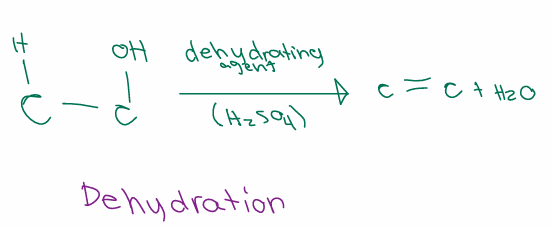
Reagent used as dehydrating agent in the Elimination (Dehydration) of alcohols
a. H₂SO₄
b. NaOH
c. PBr₃
d. KOH
d. Alkene + H₂O
[Elimination - Dehydration]
Products formed when an:
Alcohol + dehydrating agent (H2SO4) → _________
a. Alkane + H₂O
b. Alkyl halide + H₂O
c. Alkene + HX
d. Alkene + H₂O
c. Dehydrohalogenation
[Type of Elimination]
Alkyl halides + KOH (ethanol) → Alkene and HX
a. Dehydration
b. Dehydrogenation
c. Dehydrohalogenation
d. Dehalogenation
a. KOH (ethanol)

Reagent used in the Dehydrohalogenation of alkyl halides
a. KOH (ethanol)
b. NaOH
c. PBr₃
d. H₂SO₄
d. Alkene + HX
[Elimination - Dehydrohalogenation]
Products formed when:
Alkyl halide (RX) + KOH (ethanol) → _________
a. Alkene + H₂O
b. Alkane + HX
c. Alcohol + HX
d. Alkene + HX
c. H and OH (hydrogen and hydroxyl)
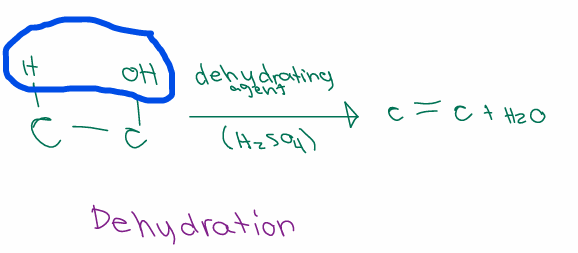
Atoms eliminated from an alcohol during Dehydration
a. H and X (hydrogen and halogen)
b. O and H (oxygen and hydrogen)
c. H and OH (hydrogen and hydroxyl)
d. C and H (carbon and hydrogen)
d. H and X (Hydrogen and Halogen)
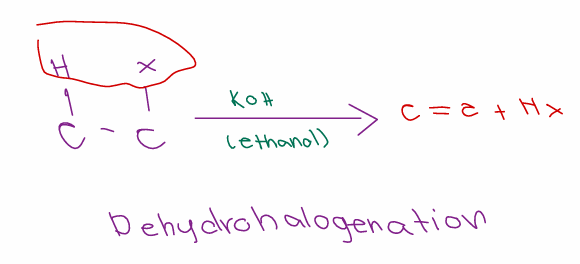
Atoms eliminated from an alkyl halide during Dehydrohalogenation
a. H and OH
b. C and X
c. O and H
d. H and X
c. Alkene
Common product formed in both Dehydration and Dehydrohalogenation during Elimination reaction
a. Alcohol
b. Alkane
c. Alkene
d. Alkyl halide
c. Alcohols
Redox reactions in terms of oxidation are applicable to which functional group
a. Alkyl halides
b. Alkenes
c. Alcohols
d. Alkynes
c. Aldehyde
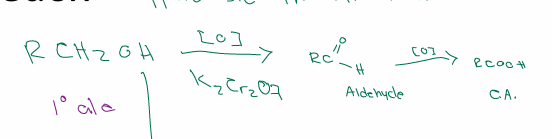
Product formed when:
Primary alcohol (1° alc) + K₂Cr₂O₇ (Potassium dichromate) → _______
a. Ketone
b. Carboxylic acid
c. Aldehyde
d. Ester
d. Carboxylic acid
Product formed when a primary alcohol (1° alc) undergoes further oxidation (second [O]) using K₂Cr₂O₇ (Potassium dichromate) beyond the aldehyde stage
a. Ketone
b. Ester
c. Alcohol
d. Carboxylic acid
d. K₂Cr₂O₇ (Potassium dichromate)
Reagent used as strong oxidizing agent in the oxidation of primary alcohols
a. PCC pyridinium chlorochromate
b. Periodinane
c. KOH (ethanol)
d. K₂Cr₂O₇ (Potassium dichromate)
PCC (pyridinium chlorochromate)
Periodinane

Weak oxidizing agents used in the oxidation of primary alcohols → aldehydes only
a. K₂Cr₂O₇ and KMnO₄
b. NaOH and H₂SO₄
c. PCC and Periodinane
d. SOCl₂ and PBr₃
d. Aldehyde only
Product formed when a primary alcohol is oxidized using PCC (pyridinium chlorochromate)
a. Carboxylic acid
b. Ketone
c. Ester
d. Aldehyde only
b. Pyridinium chlorochromate
Full name of PCC used as a weak oxidizing agent in the oxidation of primary alcohols
a. Potassium chlorochromate
b. Pyridinium chlorochromate
c. Phosphorus chlorochromate
d. Periodic chlorochromate
c. Periodinane
Second weak oxidizing agent alongside PCC that produces up to aldehydes only from primary alcohols
a. K₂Cr₂O₇
b. KMnO₄
c. Periodinane
d. H₂SO₄
d. Ketone
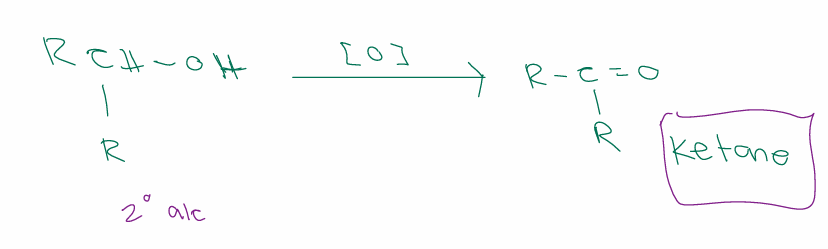
Product formed when a secondary alcohol (2° alc) undergoes oxidation
a. Carboxylic acid
b. Aldehyde
c. Ester
d. Ketone
c. No reaction
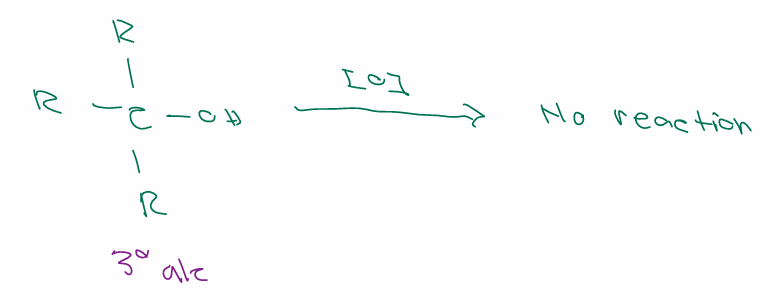
Result when a tertiary alcohol (3° alc) undergoes oxidation
a. Ketone
b. Carboxylic acid
c. No reaction
d. Aldehyde
d. Primary alcohol → Aldehyde → Carboxylic acid
Correct sequence of oxidation products of a primary alcohol using strong oxidizing agent K₂Cr₂O₇
a. Primary alcohol → Ketone → Carboxylic acid
b. Primary alcohol → Aldehyde → Ketone
c. Primary alcohol → Carboxylic acid → Aldehyde
d. Primary alcohol → Aldehyde → Carboxylic acid
d. Tertiary alcohol (3°)
Among 1°, 2°, and 3° alcohols, the one that does not undergo oxidation is
a. Primary alcohol (1°)
b. Both primary and secondary
c. Secondary alcohol (2°)
d. Tertiary alcohol (3°)
a. Monohydric
Methanol
a. Monohydric
b. Polyhydric
a. Monohydric
Ethanol
a. Monohydric
b. Polyhydric
a. Monohydric
Isopropyl alcohol
a. Monohydric
b. Polyhydric
a. Monohydric
Octanol
a. Monohydric
b. Polyhydric
a. Monohydric
Alcohol Volatile Oils
a. Monohydric
b. Polyhydric
b. Polyhydric (diol)
Ethylene glycol
a. Monohydric
b. Polyhydric
b. Polyhydric (triol)
Glycerol
a. Monohydric
b. Polyhydric
b. Polyhydric
Monosaccharides
a. Monohydric
b. Polyhydric
b. Polyhydric
Sugar Alcohols
a. Monohydric
b. Polyhydric
c. Methanol
Monohydric alcohol known as toxin in adulterated alcohols
a. Ethanol
b. Isopropyl alcohol
c. Methanol
d. Octanol
b. Ethanol
Monohydric alcohol that is the essence of liquor and wine
a. Methanol
b. Ethanol
c. Isopropyl alcohol
d. Octanol
b. Ethanol
Monohydric alcohol that is one of the two classic rubbing alcohols
a. Methanol
b. Ethanol
c. Glycerol
d. Octanol
d. Isopropyl alcohol
Monohydric alcohol known as one of the two classic rubbing alcohols, paired with ethanol
a. Methanol
b. Octanol
c. Glycerol
d. Isopropyl alcohol
c. Octanol
Monohydric alcohol used for partition coefficient analysis
a. Ethanol
b. Methanol
c. Octanol
d. Isopropyl alcohol
b. Menthol and geraniol
Examples of alcohol volatile oils
a. Eugenol and thymol
b. Menthol and geraniol
c. Vanillin and salicin
d. Cinnamaldehyde and arbutin
c. Polyhydric
Classification of alcohols that contain more than one hydroxyl group
a. Monohydric
b. Dihydric
c. Polyhydric
d. Trihydric
a. Ethylene glycol
Polyhydric alcohol known as antifreeze and a known poison
a. Ethylene glycol
b. Sorbitol
c. Mannitol
d. Glycerol
c. Glycerol
Polyhydric alcohol known as humectant and laxative
a. Ethylene glycol
b. Mannitol
c. Glycerol
d. Sorbitol
c. Glycerol
Polyhydric alcohol known as backbone of triglycerides and many phospholipids
a. Ethylene glycol
b. Mannitol
c. Glycerol
d. Sorbitol
d. Monosaccharides
Polyhydric alcohols defined as polyhydroxy aldehydes or ketones
a. Sugar alcohols
b. Glycerol
c. Ethylene glycol
d. Monosaccharides
c. Sugar alcohols
Polyhydric alcohols defined as reduced monosaccharides
a. Monosaccharides
b. Glycerol
c. Sugar alcohols
d. Ethylene glycol
a. Mannitol and sorbitol
Examples of sugar alcohols that are reduced monosaccharides
a. Mannitol and sorbitol
b. Glucose and fructose
c. Glycerol and ethylene glycol
d. Menthol and geraniol