Speech Sound Disorders
 Call Kai
 Learn
 Practice Test
 Spaced Repetition
 Match
 Flashcards
 Knowt Play
1/97

There's no tags or description
Looks like no tags are added yet.
98 Terms
Structural deficits
Sensory impairments
Neurological impairments - result in a motor speech disorder
Organic SSDs have known causes, such as…
Cleft lip/palate, dental malocclusions
List 2 examples of a structural deficit
hearing loss
List an example of a sensory impairment
Dysarthria, apraxia of speech
List 2 examples of neurological impairments
cleft lip or cleft palate
Birth abnormalities of the mouth and/or lip.
Genetic - run in families
Environmental - Teratogens that affect fetal development (drugs, substance abuse, environmental pollutants, maternal infections and diseases)
Cleft lip/palate etiology includes…
Week 5-6
During pregnancy, three prominences appear that will become the face, once fused together.
week 7
Stage of pregnancy when the Lip and gum ridge should close
Week 10-12
By what time should the hard palate, soft palate, and uvula close during pregnancy?
False: early
True or false: clefts occur late in pregnancy, as the lip and mouth do not fuse together as they should.
Cleft palate
Expose the nasal cavity to the oral cavity, either partially or completely.
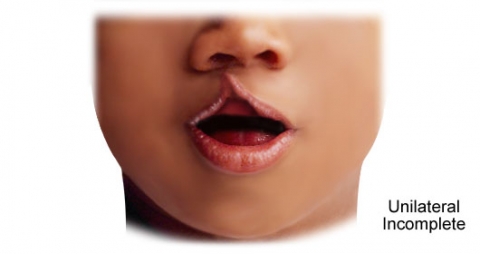
Unilateral incomplete
Identify the cleft lip
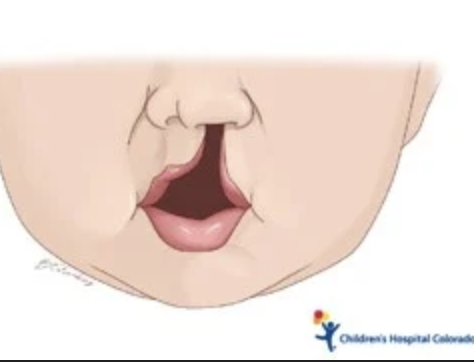
Unilateral complete
Identify the cleft lip
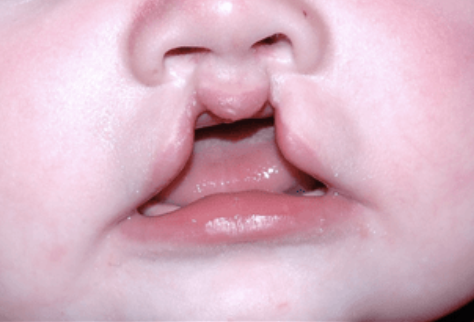
Bilateral incomplete
Identify the cleft lip
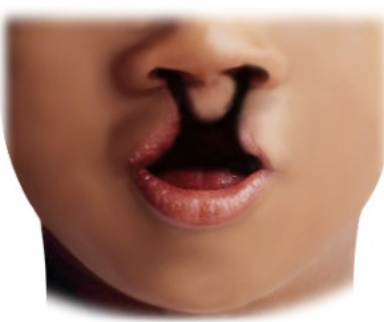
Bilateral complete
Identify the cleft lip
under the skin
submucosal meaning
6-18 months
Cleft palate repairs are usually done between __________
Psychosocial problems
Feeding difficulties
Dental problems
Ear infections and hearing loss
Speech and language disorders
Problems associated with cleft lip and palate
It is difficult to produce high pressure consonants (stops, fricatives, affricates)
How is articulation affected by a cleft lip or palate
glottal stops and pharyngeal fricatives
For people with a cleft lip or palate they usually substitute high pressure consonants with ___________and ________
Underbite
Overbite
Openbite
Examples of dental malocclusions
Dysarthria
A type of motor speech disorder where there are weak muscles in mouth, face, respiratory system
Apraxia
NO muscle weakness or paralysis, difficulty planning and coordinating movements for speech
Childhood Apraxia of Speech
What does CAS stand for - type of motor speech disorder
Case History Interview/Questionnaire
Oral Mechanism Screening
Hearing Screening
Language Evaluation
Speech Assessment
Assessment of Speech Sound Disorders is comprehensive and may include:
phonemes
Speech sounds in a language are called__________which affect meaning in language
symbols, letters
Phonemes are represented with _______ and are different than ________.
slash marks
When sounds or strings of sounds are written, they are placed between ________
brackets
When speech is transcribed, it is written between ________.
Allophone
Variations of phonemes that do not affect meaning (within a given language), such as in English /l/ in “lamp” vs /l/ in “told” or /p/ in “pin” vs /p/ in “spin”
“b” sound
“d” sound
“th” sound
“r” sound
“ew” sound
/b/ = ______ /d/ = ______/θ/ = ______ /ɹ/ = _______ /u/ = ______
through
Identify the following word based on its phonemes: /θɹu/
The International Phonetic Alphabet (IPA)
Uses symbols to represent all of the sounds in all of the world’s languages
44, 26
Standard American English uses about ______ phonemes (but has ____ letters)
Letters
______ are written representations of sounds.
False
True or false: phonemes always correspond to letters.
Place of production
Manner of production
Voicing
Consonants are described by three parameters
vowels
Open vocal tract (a, e, I, o, u) —> lips, tongue to teeth don’t touch
consonants
Some level of restriction to the vocal tract (“th” “p” “b”)
place
_____ refers to where the sound is produced
Bilabial
Labiodental
Interdental (aka linguadental)
Alveolar
Palatal
Velar
Glottal
List the different places where sound is produced
Bilabial
_______ sounds are produced with both lips
/p/, /b/, /m/
What three sounds are bilabial?
Labiodental
sounds produced with the upper teeth and lower lip.
/f/ and /v/
List examples of labiodental sounds
Interdental aka linguadental
Sounds produced with the tongue between the teeth
/ð/ voiced “th” and /θ/ voiceless “th”
List examples of interdental sounds
Alveolar
Sounds produced with tongue-tip elevation at the alveolar ridge
/t/
/d/
/s/
/z/
/n/
/L/
Examples of alveolar sounds
palatal
Sounds produced in the region of the hard palate
/ʃ/ = sh like in “fish”
/ʒ/ = zh like “measure”
/tʃ/ = ch like “chew”
/dʒ/ = j like “edge”
/j/ = y like “yellow”
/ɹ/ = r like “red”
Examples of palatal sounds
Velar
Sounds produced in the velum or soft palate
/k/
/g/ = go
/ŋ/ = like in “ring” “king”
Examples of velar sounds
Glottal
Sounds produced at the level of the glottis
/h/ = hop
/ʔ/ = “uh-oh”
Examples of glottal sounds
manner
______ refers to how the sound is produced
Stop
Fricative
Affricate
Nasal
Liquid
Glide
List the different manners for speech
stops
Produced with complete obstruction of the vocal tract
/p/
/b/
/t/
/d/
/k/
/g/
List examples of stops
fricatives
Produced with some constriction of the vocal tract
/f/
/v/
/ð/
/θ/
/s/
/z/
/ʃ/
/ʒ/
/h/
List examples of fricatives
Affricates
A stop and a fricative
/tʃ/ = ch “church” or “cherry”
/dʒ/ = “judge” “fudge”
Examples of affricates
Nasals
Produced with the velopharyngeal port open (i.e. velum down)
/m/
/n/
/ŋ/
Example of nasal sounds
liquids
Produced with a somewhat open vocal tract
/l/ and /ɹ/
Examples of liquids
glides
Produced with a gliding movement of the tongue from a more closed to a more open position
/w/
/j/ —> like y in “yellow”
Examples of glides
voicing
Whether or not the vocal folds vibrate
Voiceless
_____ sounds are produced without vocal fold vibration
/p/
/t/
/k/
/ʔ/
/f/
/θ/
/s/
/ʃ/
/h/
/tʃ/
Examples of voiceless sounds
/b/
/d/
/g/
/v/
/ð/
/z/
/ʒ/
/dʒ/
/m/
/n/
/ŋ/
/L/
/ɹ/
/w/
/i/
Examples of voiced sounds
Tongue height - high, mid, low
Tongue advancement - front, central, back
Roundness - rounded, neutral, unrounded
Tension
Vowels are described by four features
/i/
/I/
/u/
/ʊ/
Vowels with high tongue height
/e/
/ɛ/
/ɝ/
/ɚ/
/ə/
Vowels with mid tongue height
/æ/
/ʌ/
/ɔ/
Vowels with low tongue height
Front vowels
Produced with the tongue in the front of the mouth
Central vowels
Produced with the tongue in the central part of the mouth
Back vowels
Produced with the tongue in the back of the mouth
tense, lax
Vowels are classified as being _____ or _____
tense vowels
Vowels produced with greater muscle activity, longer in duration, and occur in stressed syllables
Lax vowels
Vowels produced without muscular tension, are shorter in duration, and occur in unstressed syllables.
Speech sound disorder
An impairment of an individual’s sound system that affects speech sound production
be significant
differ from age-based expectations
differ from culturally based expectation
The problem in speech sound production must…
articulation, phonological impairments
Functional disorders include…
Structural deficits
Sensory impairments
Neurological impairments
Organic disorders include…
Articulation impairment
Involves problems making sounds aka “phonetic impairment”
phonological impairment
Involves patterns of sound errors aka “phonemic impairment”
Distortions
Substitutions
Omissions
examples of articulation impairments
Unstressed syllable deletion
Final consonant deletion
Consonant harmony
Reduplication
Fronting
Cluster reduction
Stopping
Examples of phonological impairments
Unstressed syllable deletion
When the unstressed syllable in a word is omitted
Final consonant deletion
When the final consonant of a word is omitted
Consonant harmony
One consonant in a word takes on features of another consonant
reduplication
When the first syllable in a word is repeated
Fronting
When back sounds are replaced with front sounds
cluster reduction
When two or more consonants that occur together are reduced to a single consonant
stopping
When fricatives and affricates are replaced with stops